
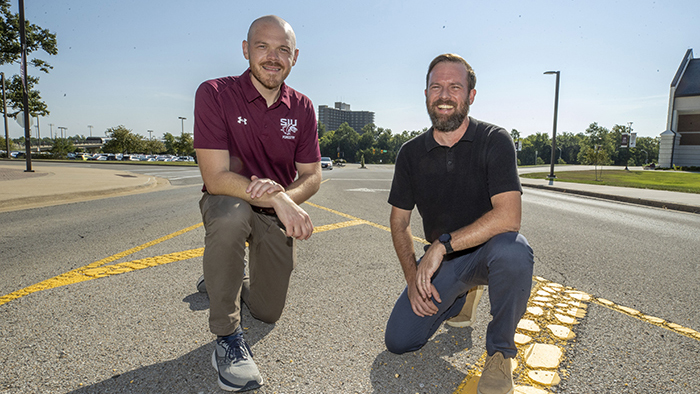
Brent Pease (left), associate professor of forestry and director of the newly established Roadside Ecology Center, and Ryan Campbell (right), director of the Center for Archaeological Investigations, are co-leading a landmark $45 million partnership with the Illinois Department of Transportation (IDOT) to conduct environmental and cultural pre-construction surveys across Southern Illinois. (Photo by Russell Bailey)
September 02, 2026
SIU secures $45 million partnership with IDOT to conduct preconstruction surveys
CARBONDALE, Ill. — Southern Illinois University Carbondale and the Illinois Department of Transportation (IDOT) are partnering on two multi-year, multi-million-dollar intergovernmental agreements worth $45 million to carry out survey work at preconstruction sites, including roadways and bridges, throughout the region.
The agreements include a $40 million pact for SIU to establish a Roadside Ecology Center aimed at mitigating and minimizing the impact of transportation projects on wildlife and ecosystems, marking the university’s largest partnering research agreement ever, and $5 million to the university’s Center for Archaeological Investigations (CAI) to conduct cultural resource surveys aimed at identifying archaeological sites that could be impact by proposed IDOT projects. The partnership began July 1, with the state’s 2027 fiscal year; the work will include several counties south of Interstate 64.
Before any construction starts, IDOT is responsible for complying with numerous state and federal regulations related to wetlands, threatened and endangered species, regulated substances and archaeology and historic sites. Part of that compliance includes extensive pre-construction surveys to identify if protected resources exist within a transportation project corridor. The activities will help ensure cultural and environmental resources are identified, recorded and considered early in the planning process, according to the agency.
Costas Tsatsoulis, SIU’s vice chancellor for research and dean of the graduate school, said the agreements highlight the university as a critical research and operational partner, gaining recognition regionally and beyond.
“The largest research partnership in history between an Illinois state agency and SIU Carbondale signals nationally that SIU is a university with the expertise and capacity to lead complex, large-scale research projects that have a significant public impact,” he said. “By entrusting SIU with this critical work, IDOT is recognizing our university as the region’s leading research partner in ecology and archaeology.”
Roadside Ecology Center
Brent Pease, an associate professor in the forestry program, will lead the new Roadside Ecology Center. He said the center’s surveys will focus on identifying threatened or endangered mammals, birds, amphibians, fish, insects and plants before construction begins. This includes the timber rattlesnake, ornate box turtle, northern long-eared bat, short-eared owl, and buffalo clover.
“The Illinois Department of Transportation is taking a university-led approach to conducting these ecology surveys and SIU is being entrusted with the lower portion of the state,” said Pease whose research interests are focused on ecology and wildlife conservation. “SIU has the expertise to lead cutting-edge research on road ecology, not only protecting the ecosystems that are vital to Southern Illinois but developing best practices that can be used across the world.”
IDOT officials stated the importance of having SIU researchers at preconstruction sites to gather data about wildlife and share their findings.
“Securing this 10-year contract with SIU Carbondale provides the Illinois Department of Transportation with talented university specialists in Southern Illinois,” said Lora Rensing, IDOT’s chief engineer and director of Highways Project Implementation. “These individuals will evaluate how highway development affects the environment in Central and Southern Illinois, which is a critical step in fulfilling IDOT’s mission to be good stewards of our environment.”
Currently, Pease is in the process of staffing the center before any surveys can take place. He plans to hire 16 full-time employees, with several of those openings filled by doctoral-level researchers as well as graduate students.
Archaeological investigations
Meanwhile, the CAI has been conducting archaeological research since 1978 and has received substantial funding in the past for similar projects from numerous agencies. The work with IDOT continues the university’s long history of archaeological research that began during the late 19th century.
Ryan Campbell, CAI director, shared how IDOT will use the information collected by his staff and students at the preconstruction sites.
“Our team will be tasked with conducting initial archaeological surveys to identify and document archaeological resources within proposed transportation project areas,” Campbell said. “For each site identified, we will provide IDOT with recommendations to help determine whether no further work is needed, or whether additional archaeological investigation, avoidance, or further consultation should take place.”
The IDOT-related work will include field work, laboratory analysis and report writing, and students will help with the process all along the way, Campbell said. Students will begin to understand where the information they collect goes and how it is interpreted.
The work not only helps IDOT but also protects archaeological resources for everyone, Campbell said.
“Working with IDOT on these projects will give SIU the opportunity to play a meaningful role in preserving archaeological sites that are important to the region and, more broadly, people everywhere” “after all, these sites are part of our collective past. Preserving them will allow us to learn more from the lives of the people who came before us.”
Supporting the R1 designation
The partnership between SIU and IDOT supports the university’s Research 1 designation by the Carnegie Classification of Institutions for Higher Education. Tsatsoulis added the agreements will help maintain the designation as well as attract high-level research students and provide state-of-the-art resources.
“These landmark agreements enhance research equipment and facilities, and strengthen research expenditures, doctoral training, and scholarly productivity, which will maintain and improve SIU’s standing among the nation’s R1 universities,” Tsatsoulis said. “In addition, this long-term funding provides important sustained financial support and promised research stability for our future faculty, postdoctoral researchers and graduate students in ecology and archaeology.”