
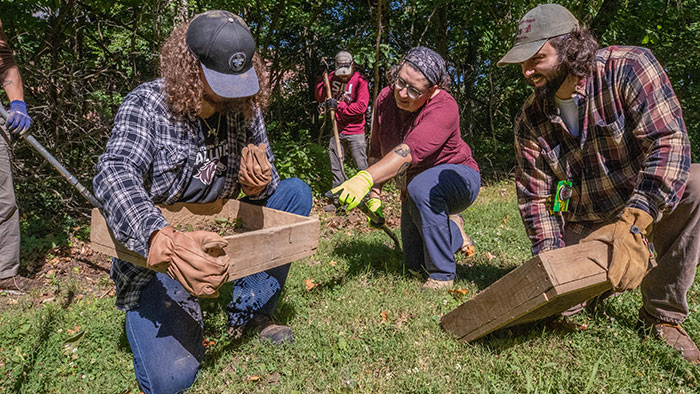
Ayla Amadio, a principal researcher and field director with SIU Carbondale’s Center for Archaeological Investigations, examines contents of a shovel test as they screen soil. This is a portion of the work CAI staff and students will perform during archaeological surveys assisting the Illinois Department of Transportation. (Photo by Russell Bailey)
July 07, 2026
SIU’s Center for Archaeological Investigations assisting IDOT with cultural resource surveys
CARBONDALE, Ill. — Southern Illinois University Carbondale’s Center for Archaeological Investigations has entered into a 10-year intergovernmental agreement with the Illinois Department of Transportation to assist with initial archaeological survey work for possible road and bridge projects in the region. The pact provides for up to $5 million over the life of the agreement, or approximately $500,000 per year.
The center will perform archaeological surveys in counties in the region, while the university’s natural resources staff will perform natural resource surveys and provide ecological assessments and environmental documentation.
Ryan Campbell, CAI director, said the intergovernmental agreement over 10 years with IDOT provides additional experiential learning and research opportunities for SIU students and faculty in a variety of archaeology-related fields. The one-year agreement is renewed annually. Campbell anticipates the work, which will likely include all counties south of Interstate 64, will start with the state’s 2027 fiscal year which began July 1.
The project “will allow us to expand into a direction that I think is very natural for us,” he said. “It allows us to partner with another state agency in a way I believe is a real benefit to both parties. IDOT has a real need to do this kind of work throughout the state. Because we have such a long history in Southern Illinois, and because we hold records and a lot of knowledge about this end of the state, it’s a natural fit for us to be doing that work for them. I’m excited to be able to help them with that component.”
The center has been conducting archaeological research since 1978 and has received substantial funding in the past for similar projects from numerous agencies. The work continues the university’s long history of archaeological research that began during the late 19th century.
Costas Tsatsoulis, SIU’s vice chancellor for research and graduate school dean, said the agreement supports and enhances SIU’s status Carnegie Classification of Institutions for Higher Education Research 1.
“This IDOT $5 million intergovernmental agreement is further proof of the quality of the archaeological work that has been ongoing in CAI for nearly 50 years. Southern Illinois University Carbondale and CAI have been nationally known for their impactful work in archaeological surveys and cultural reviews.”
Providing assessments and reports
Before any construction starts, IDOT is responsible for complying with numerous state and federal regulations related to wetlands, threatened and endangered species, regulated substances and archaeology and historic sites. Part of that compliance includes extensive pre-construction surveys to identify if protected resources exist within a transportation project corridor. The activities will help ensure cultural and environmental resources are identified, recorded and considered early in the planning process, according to the agency.
“Our team will be tasked with conducting initial archaeological surveys to identify and document archaeological resources within proposed transportation project areas,” Campbell said. “For each site identified, we will provide IDOT with recommendations to help determine whether no further work is needed, or whether additional archaeological investigation, avoidance, or further consultation should take place.”
Primary archaeological resource
This pre-construction survey work is the most common use of archaeological investigation in the United States, Campbell said. While there are purely academic research projects, 90-95% of the archaeological work and the discovery of archaeological sites begins as cultural resource management work like CAI will do with IDOT, Campbell said.
“There are probably tens of thousands of sites every year recorded across the United States this way,” he said. “It’s a massive amount of data that is brought in through these kinds of projects and it really broadens our understanding of what was going on in the past.”
Campbell is a first-generation college graduate. He initially believed academic archaeology was the only available career path — because that was his introduction to archaeology. What he likes about CAI is that the researchers and staff come from a variety of backgrounds, including the private sector, and introduce students to myriad other career paths.
“We’re giving them opportunities to work on these projects at a variety of different levels and get trained in the methods that are being used by agencies and private firms doing this kind of work today,” he said.
The IDOT-related work will include field work, laboratory analysis and report writing, and students will help with the process all along the way, Campbell said. Students will begin to understand where the information they collect goes and how it is interpreted.
The work not only helps IDOT but also protects archaeological resources for everyone, Campbell said.
“Working with IDOT on these projects will give SIU the opportunity to play a meaningful role in preserving archaeological sites that are important to the region and, more broadly, people everywhere” “after all, these sites are part of our collective past. Preserving them will allow us to learn more from the lives of the people who came before us.”