
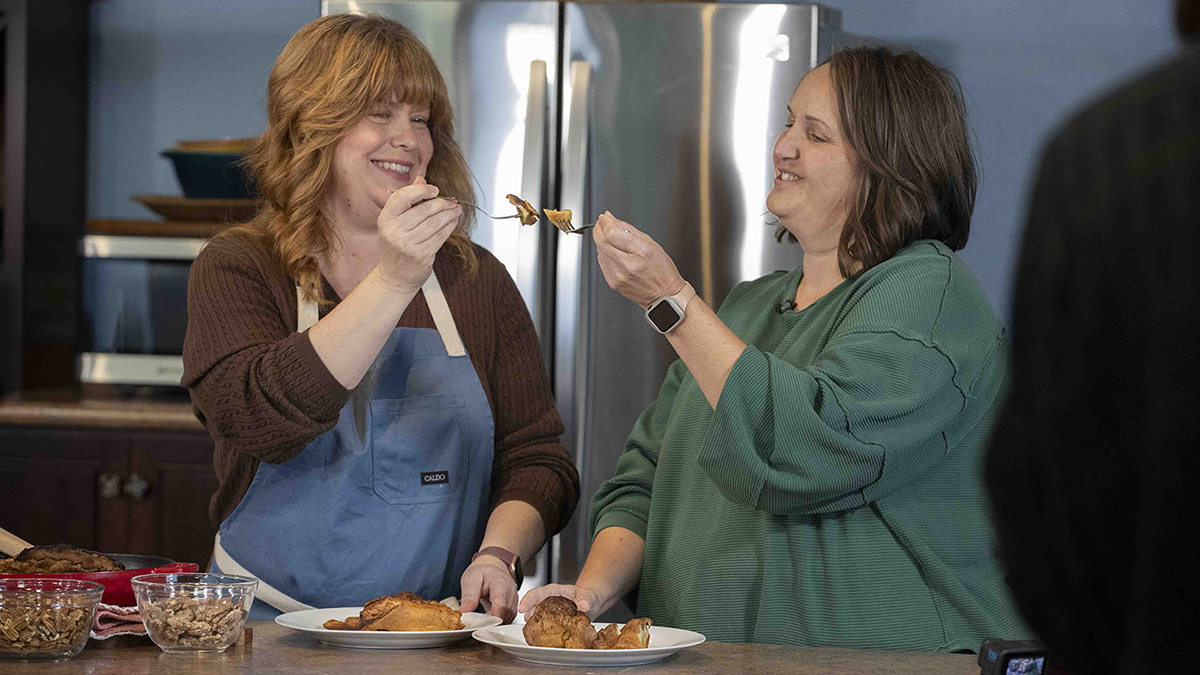
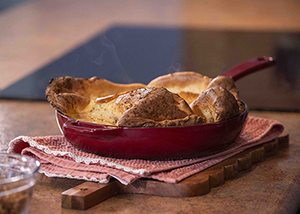
SIU Carbondale hospitality, tourism, and event management faculty Niki Davis, left, and Stephanie Rhodes, (top photo) recently launched “Our Local Table.” The 30-minute program on WSIU-TV features stories, recipes and food grown in Southern Illinois. They return to the kitchen to make dishes (bottom photo) including a Dutch Baby, based on German pancake recipes and popular in the U.S. (Photos by Russell Bailey)
November 23, 2026
‘Our Local Table’ dishes up Southern Illinois culinary and agriculture heritage on WSIU-TV
CARBONDALE, Ill. — Food binds our memories to where we grew up. It warms us with the love of home, brings us together and moves us through the senses. The meal is a gathering where we enjoy good company, share stories, and toast to good health.
“Our Local Table,” which launched on WSIU-TV earlier this fall, delivers great food and stories of regional culinary and agricultural heritage through local farmers, growers and makers of Southern Illinois. Niki Davis, professor of practice, and Stephanie Rhodes, assistant instructor in Southern Illinois University Carbondale’s hospitality, tourism, and event management program, cohost the show. Davis also serves as executive producer.
“Stephanie and I have known each other for over 25 years, and we’ve always been working in agriculture, culinary, and heritage tourism. All of that has culminated into the TV show — to showcase our local food culture and our farmers, growers and makers,” Davis said.
From podcast to PBS
They partner on a podcast, The Recipe Box Podcast - Rooted in Foods, which includes stories behind the many ways recipes are made, as well as food history, migration patterns and food evolution. “It’s all about how different families make the same recipe differently and the arguments we sometimes get into over that,” Davis said.
According to Rhodes, banana pudding is the dish that launched the podcast. “My world was shook by very different ways of making banana pudding that I was not okay with. A friend said, ‘I bet you and Niki could do a podcast about that.’ So we did.”
As storytellers, moving to WSIU-TV offers even more culinary stories to tell about how food is rich in history, movement and evolution. “It was just a natural transition into ‘What if we could do this in the TV space?’” Rhodes said.
A nice blend of ingredients
Each episode of the show moves in two halves — the first half in the field or small business; the second half in the kitchen. Davis and Rhodes are two halves of the program’s whole, coming from different but overlapping backgrounds. Davis, who grew up in the hospitality and tourism industries, is at home in the kitchen and brings much of the culinary heritage. Rhodes, meanwhile, who grew up on a farm in the region and has over 25 years in agriculture communications and tourism, is right at home working alongside the farmers and growers.
The show explores the history and science of growing, cooking, and experiencing food in an understandable way for audiences.
“We’re teachers, and all that comes back when working on the TV show,” Davis said.
Collaborative partnerships essential
The show is built around collaborative partnerships with a shared mission to support and promote local and regional farmers, growers, and small businesses. One partnership is with Barbara Bush and Kite Hill Vineyards, located south of Carbondale, where the show is recorded. “The kitchen is perfect — it’s also set up to be a kind of studio,” Rhodes said.
 “From the wine perspective, for example, the climate and the terroir — our land and soil here in Southern Illinois — plays a significant role in the qualities and varieties we produce, from the wines to the peaches and the apples and more. That is my jam,” Rhodes said.
Local and regional farmers and makers have been great partners and contributors. “We are looking at the smaller businesses that don’t have the outlet or the airtime that might need a little bit more help getting the word out,” Davis said.
For example, Glaciers End in Marion, Illinois, was the perfect partner for the first episode. “We needed to work with someone that’s like, ‘We’ll be along for the ride. We don’t really know how this ends, but we trust you,’” Rhodes said.
The farm keeps working while they are filming — as a farm has to when conditions are right and plants are ripe for picking — and Rhodes and the production crew blend in with the day’s work. “At Pink Tiger Farm in Goreville, it was really important with that window of time that they had with good weather to pick these certain hot peppers,” Rhodes said. “I grew up on a farm, and so I know it’s a big deal to give us part of their time and their space while their busy working.”
“Storytelling is what the program is about. It’s not scripted, but it’s well studied,” Davis said. “We want to make sure that whoever we’re with on the show feels comfortable with what we’re doing.”
Once word spread about the show, excitement spread among local and regional farmers, growers, makers, and viewers, so Davis and Rhodes have been able to branch out quickly and grow the show, which is already greenlighted for a second season.
“Once the first episode aired, it didn’t take long for the word to get back to us about how happy people are to see it, saying ‘It’s about time.’” Davis said.
The Neighborhood Co-op Grocery is proud to support “projects like these that highlight local foods, farmers and producers, which is essential to our mission here,” said Emily Yates, Neighborhood Co-op brand manager.
SIU student involvement
The program’s branding and marketing is created by the Saluki AdLab, a full-service team of SIU students within the College of Arts and Media. WSIU, which operates five PBS stations across Illinois, provides production support for the show, which is also done by SIU students. “Programs like Our Local Table demonstrate the value of WSIU’s partnership with SIU, bringing together education, creativity, and community engagement,” said Larry Hunter, WSIU Broadcasting Service executive director. “Having students involved in the filming and production gives them valuable, hands-on experience working alongside professionals, developing skills, and building confidence in the television industry to prepare the next generation of broadcasters and storytellers.”
Davis said she and Rhodes see students “having some real ‘aha’ learning moments while shooting the episodes. The teacher side of us loves that.”
Check your local WSIU-TV listings at WSIU PBS Television Schedule and follow Our Local Table at Our Local Table Facebook Page for upcoming and past episodes. Episodes are also found on WSIU-TV’s YouTube channel and on PBS Passport.