
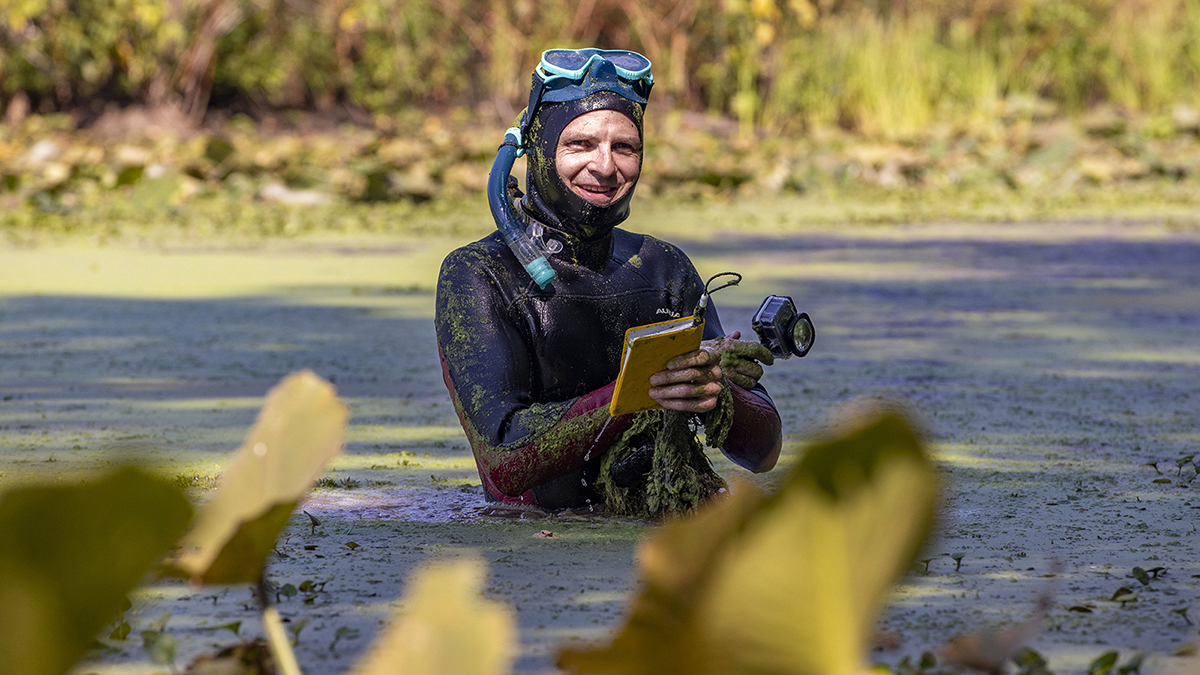
Koaw Zaczek, a graduate student in SIU’s zoology program, documented the spawning season of the bantam sunfish, a threatened species in Illinois. Zaczek spent hours swimming in a swamp infested with venomous snakes to conduct his research on the elusive fish. (Photo by Russell Bailey)
November 19, 2026
SIU researcher swims in snake-infested swamp for threatened bantam sunfish
CARBONDALE, Ill. — There are not many people who would willingly swim solo in a swamp infested with venomous snakes, especially in a rural area located miles away from a hospital with a life-saving antidote. If that’s not enough to be scared off — the threat of heat stroke from the murky 90-degree water, bites from lurking leeches, and the possibility of getting stuck in a sinkhole — just might do it.
For Koaw Zaczek, it’s a risk he’s willing to take to protect the bantam sunfish, a threatened species in Illinois and cousin to the well-known bluegill. The Southern Illinois University Carbondale graduate student braved the dangers to document in detail the spawning rituals of the elusive fish in its natural habitat, something never done before.
Editor’s note
Two VO/SOT scripts and accompanying interview and b-roll footage are available for use and can be downloaded here. If you need additional assistance, please contact Brooke Keltner at brooke.schlyerkeltner@siu.edu.
“I can pride myself on the fact, out of every biologist that I’ve talked to, no one wants to swim in these swamp waters,” Zaczek said. “It’s not just the snakes — it’s the mosquitos, deer flies, ticks and alligator fleas that leave a stingy bite. I’m not quivering in my boots. I respect nature and knew these were challenges that I had to overcome to collect the data.”
Filling in the gaps
Zaczek conducted his research in a swamp along “Snake Road,” a regionally-famous road known for shutting down twice a year for the migration of timber rattlesnakes, water moccasins and copperheads. In the fall, the snakes slither from the wetlands and cross the road to rest in the bluffs during the cold-weather seasons. Then, in late spring, the snakes become active in the warmer months and leave the bluffs, crossing the road for the wetlands.
What is a bantam sunfish? And how did Zaczek know to search for them in that specific location? Imagine a smaller, more muscular bluegill, one that prospers in water with such a low level of dissolved oxygen that it’s uninhabitable by most other fish — that’s a bantam sunfish. So, it’s a species that thrives in swamp water. That narrows it down a bit, but the decision really boiled down to filling in the research gaps left behind by Brooks Burr, a SIU professor emeritus who came to the university in the late 1970s, and James Wetzel, a former SIU student who also studied the fish.
“There’s hardly any scientific literature on the bantam sunfish, but what is out there is from Dr. Brooks Burr. He provided a quality framework for the ecology of the species,” said Zaczek, who’s from Evergreen, Colorado, and pursuing his doctoral degree in zoology. “While Dr. Wetzel’s research focused on Winter’s Pond and bringing the bantam back to a lab to mate, but he noted the fish was observed in this swamp. So, I wanted to come back and do my research in their natural habitat.”
No one has ever thoroughly documented their spawning rituals in the wild, Zaczek said. Until now…
Wading swamp waters
Zaczek’s research started in early April so he could survey the swamp and observe the fish’s behavior before spawning season. He suspected the fish would nest and mate in areas with hard clay holding plant roots, but only found a few males attracted to those microhabitats.
“When I was snorkeling, I noticed that the females began aggregating around one or two males that were at the base of fallen logs, which makes for a good hiding spot,” he said. “One of the biggest males I found decided to make his nest in a small nook in the tree, almost like a cave. It was easy for him — all he had to do was clear away a bit of algae.”
Once Zaczek figured out the males and females were communally gravitating toward logs that had fallen into the water, he set up waterproof cameras and filmed the fish for hours at a time on a daily basis. The experiment took place through the end of June, which he predicted to be the end of the bantam’s mating season. Underwater, the cameras captured males and females carrying out a 30-minute mating ritual that’s almost like a dance, during which the female drops her eggs and the male fertilizes them.
The footage reaffirmed some attributes already known about male sunfish like taking on the responsibility to build the nests, attracting females for mating and guarding the eggs. On the flip side, the footage also challenged some documented behaviors about the species.
“The literature before suggested that females are a bit bigger in size,” Zaczek said. “From what I observed, bigger males usually attract smaller females.”
While sifting through some of the recordings, Zaczek also discovered some lesser-known details about the bantam. The males leave the nested eggs sooner than other sunfish and that female bantams will eat another female’s eggs before depositing her own eggs – or intraspecific competition – a type of cannibalism by females that has hardly been seen in this group of fishes.
“The first theory is that the eggs are free food for the female fish,” he said. “The second theory is that it’s a strategy to increase the chances of her own genetic code to be passed on. The males would typically let the females eat a few of the eggs before intervening.”
Zaczek’s cameras picked up acoustics that he believes could be a male bantam mating call — and that’s an area for possible future study.
Protecting the bantam
The snakes, muck and insects are for a greater cause – to protect the threatened bantam sunfish, which has suffered a loss of habitat in Illinois from agriculture and urbanization, Zaczek said. Overall, the state has lost 90% of its wetlands, according to the Illinois Department of Natural Resources (IDNR). The agency explains these habitats are beneficial for numerous reasons:
- Store greenhouse gas emissions and prevent them from entering the atmosphere.
- Provide food and habitat for fish and other aquatic species, animals, amphibians, reptiles, and insects.
- Act as flood damage protection by providing temporary storage of water during higher rainfall events.
Zaczek hopes the information will be helpful to wildlife management like the IDNR to protect or restore their habitats, so the species’ populations can grow.
“Southern Illinois has nearly had a complete loss of wetlands, so there are very few populations of bantam remaining,” he said. “This species isn’t going to survive unless they can spawn successfully, so this will be great information for anyone trying to maintain or restore a wetland.”
(Editor’s note: Koaw Zaczek is pronounced Co-uh Zay-check )