
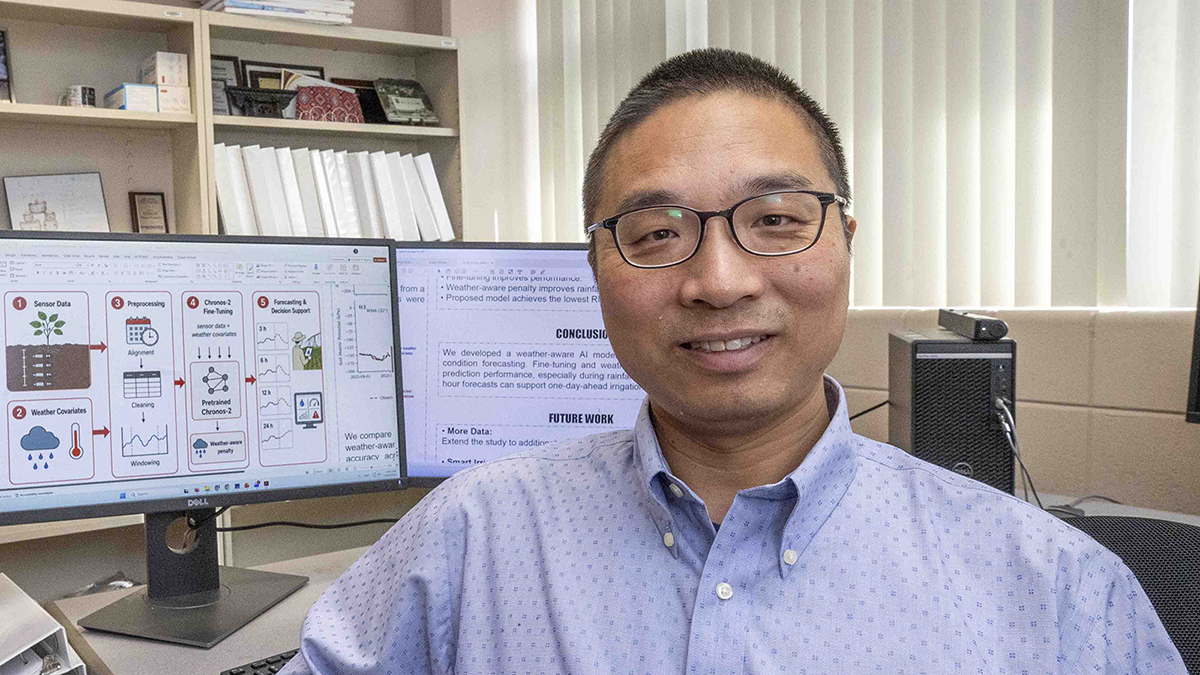
Southern Illinois University Carbondale is partnering with the University of Missouri (Mizzou) on a $300,000 grant from the USDA National Institute of Food and Agriculture to research drought stress on soybeans. Chao Lu, the professor leading the research for SIU, is investigating AI-based models for analyzing drone images and recognizing soybean wilting stress. (Photo by Russell Bailey).
November 02, 2026
SIU and Mizzou collaborate on $300k project to monitor soybean drought stress with drones, AI
CARBONDALE, Ill. — Illinois is the number one producer of soybeans in the United States, but farmers across the state face a big issue when it comes to maintaining their crops — drought. Periods with little to no rain can hamper growth or, worse yet, kill the plant.
Researchers at Southern Illinois University Carbondale are partnering with the University of Missouri (Mizzou) on a $300,000 grant from the USDA National Institute of Food and Agriculture. Together, the universities are exploring how artificial intelligence (AI) and drone-based imaging technologies can help monitor drought stress in soybean crops. The collaboration uses a multidisciplinary approach with expertise in AI, engineering and agriculture for a common goal — supporting farmers.
“Our long-term goal is to make AI-based agricultural technologies more accessible and practical for farmers,” said Chao Lu, the professor leading the research for SIU. “Managing water resources is an important part of soybean production.”
Drying up profits
Across Illinois, 43,000 soybean farmers rely on making a profit from their crops to feed and support their families, according to the Illinois Soybean Association. The impact is much larger when considering soybean farmers throughout the Midwest, who also depend on a successful harvest as part of their income. However, drought can lead to water stress, causing the plant to show visible signs of damage such as leaf wilting, discoloration or changes in leaf shape. Plant loss affects yield and the farmer’s profit.
Typically, farmers identify signs of water stress by physically seeing changes in plants while spending time in their fields. Often, with hundreds or thousands of acres to maintain, this approach can be time consuming, and farmers can discover damaged plants when they’re past the point of saving.
“While direct field observation provides valuable information, it can be difficult to apply consistently across large areas,” said Lu, a professor of electrical, computer and biomedical engineering. “The condition of soybean plants may also vary within the same field, making regular monitoring more challenging.”
A new approach
Now, researchers are investigating whether drone imaging and AI analysis can complement traditional field observations. SIU researchers use drone-based imagery of soybean fields to collect crop information. And they are developing AI models to assess different levels of soybean wilting stress.
But it’s easier said than done. There are many challenges when it comes to creating reliable AI models, especially when agricultural conditions are less predictable than a laboratory.
“Soybean fields can vary considerably in soil conditions, weather, lighting, and plant growth,” Lu said. “Even within the same field, plants may experience different conditions, which can affect their appearance and growth patterns. These variations create challenges for AI-based analysis.”
Another challenge includes collecting high-quality data as AI model development depends on reliable information for training and evaluation. Collecting agricultural data often requires considerable fieldwork, and preparing reference data can involve substantial time and effort from agricultural experts, Lu said.
Educational and outreach opportunities
Currently, two SIU graduate students are hoping to overcome some of those technology challenges by contributing to AI model development and agriculture data analysis. Lu believes this academic experience is two-fold. One, the students can apply their knowledge of computing to real-word agriculture problems, and two, they’re able to take an interdisciplinary approach, especially collaborating with Mizzou researchers who are providing expertise on the practical challenges of soybean farming.
“Engineering and agricultural research often approach problems from different perspectives,” Lu said. “By working with agricultural researchers, engineering students can gain a better understanding of the challenges faced in agricultural environments and how technical approaches may contribute to possible solutions.”
The grant also supports Lu and his graduate students attending outreach events to share their research and introduce AI technologies to the public, including agricultural communities.
Continuous improvement
Going forward, there’s still much work to be done by SIU and Mizzou together as the grant continues through June 30, 2027. The universities plan to continue developing and evaluating AI models under a broader range of agricultural conditions..
“One important direction is to examine how the models perform when field conditions differ from those represented in the existing research data,” Lu said. “This will help us better understand their strengths and limitations and identify areas where further improvements may be needed.”
The team’s also interested in exploring how information form drone imagery, soil measurements and weather data can complement one another as well as ways to make these tools affordable for the masses if the technology can be developed.