
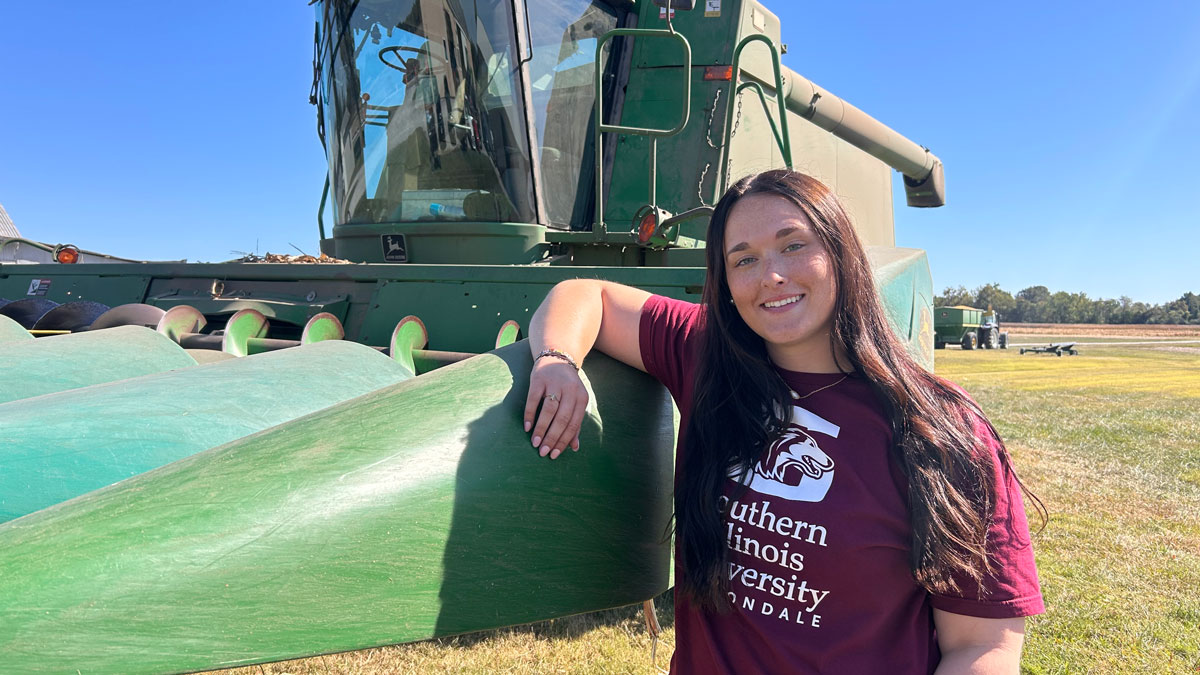
SIU’s Hannah Humphreys, who is pursuing a degree in agriculture education, is a student worker at the Agronomy Center. This fall, she went from learning to mow grass to harvesting crops in a combine. The sophomore believes learning new skills will benefit her future students after she graduates and leads her own classroom. (Photo by Brooke Keltner).
October 26, 2026
From lawnmower to combine: SIU students learn to harvest crops
CARBONDALE, Ill. — Like farmers across the state, Southern Illinois University Carbondale is in the midst of harvesting its fall crops, including soybeans and corn. The annual ritual is not only necessary to maintain the farmland but is also helping teach generations of college students valuable lessons for their future careers.
One of those students is Hannah Humphreys, a sophomore in agricultural education. She works at SIU’s Agronomy Center, home to about 70 acres of small and large research plots. She applied to work at the center as a way to gain hands-on experience for when she leads her own classroom.
“It’s really cool to see some of my course work come to life,” said Humphreys, who’s also pursuing a minor in horticulture and endorsement in elementary education. “You can sit in the classroom and hear about this stuff all day, but when you come out here you get to see it being applied.”
From lawnmower to combine
Since starting the job in May, Humphreys went from never riding a lawnmower, to mowing large swaths of grass around the center to now operating a combine – a piece of equipment that’s weighed by the tons and so large it requires a ladder for the driver to enter its cabin.
“At first I was pretty intimidated because I get nervous just driving in traffic,” said Humphreys of West Frankfort, Illinois. “Driving something this big isn’t so bad once you get the hang of it and know what you’re looking out for.”
The skills needed to operate the combine go beyond simply driving the machinery but also include mastering how to set up the combine for different crops. Humphreys must properly select the front attachment needed for the combine, which varies depending on the crop being harvested. She must also determine the attachment’s height and the correct speed for the machine, so it does not get jammed. In harvesting corn, Humphreys carefully aligned the noses of the combine attachment between the corn stalk rows before slowly making her way down the rows.
“The rollers pull the stalks in and the gathering chains bring the ears up,” Humphreys said, in explaining how the machine works. “Then the separator gets the kernels off the cob by rubbing the kernels off the cob. The kernels go into a grain tank behind the driver’s cabin and the combine shoots everything unused as “trash” out the back.
As the combine rolls down the rows, it kicks up dust and plant debris swirls in the air like a mini tornado. On the inside of the cabin, the machine roars and the seats shake. Humphreys only takes her eyes away from the windshield to look at a screen that displays real-time harvest data. That includes a map of the plots harvested, the plots that still need to be finished, the number of bushels harvested, along with the weight of the harvest and moisture levels.
Mistakes are learning opportunities
Chris Vick, director of University Farms, said student workers at the Agronomy Center learn more than just about harvesting crops. Those lessons include basic agronomy – or the science and technology of crop production and soil management – farming, planting and harvesting, and research, which is a main learning pillar.
“We help the researchers with their projects in whatever capacity they need us to, whether that’s planting seeds, applying different types of pesticides at varying levels, or taking soil or water quality samples,” Vick said. “One researcher out here is comparing different types of cover crops, so we will plant that for them when we finish harvesting. Many students who work here go on to work in labs or become professors.”
The Agronomy Center is just one facet of University Farms, which has more than 600 acres of crop research and production, 120 acres of hay production, about 300 acres of pasture for animal centers and 1,000 acres of forest and watershed areas. Overall, dozens of student workers contribute to feeding and grooming livestock, cleaning out stalls, fixing equipment and other agriculture-related responsibilities.
“We really rely on our student workers, and we couldn’t do it without them,” said Vick, who started as a student worker at University Farms himself in 1995 and worked his way up to his current position.
Over the years, he’s met students too afraid to drive a combine – which he only encourages if the student feels comfortable – and has witnessed small crashes, bumps and scratches. For him, the best part of the job is seeing students learn from their mistakes and make progress just like the strides that Humphreys has made.
“The most rewarding part is the memories with the students and seeing them go on to work in the agriculture industry, or become professors, or even teachers,” Vick said, referring to Humphreys. “She’s going to be an agricultural teacher which influences a lot of kids for many years.”
Inspiring the next generation
Humphreys experienced that influence firsthand from her own high school ag teacher, West Frankfort’s Josh Billingsley, who also led the school’s FFA.
“He very much encouraged me to try all ag-related things to see what area I would be interested in,” Humphreys said. “That’s why I chose to become an agricultural educator, so I can have that impact on my own students.”
As a highly active member of her high school’s FFA club, she attended many agriculture-related events hosted by SIU. When it came time to start applying for college two years ago, Humphreys’ followed her heart and became a Saluki.
“I was on campus a lot and became familiar with all the opportunities that SIU offers, so it definitely made the choice easy when deciding,” she said. “I’m also really close with my family and still live at home. I get to go home to my family every night and that’s pretty cool. Not a lot of college students get to do that.”
After graduating from SIU, Humphreys’ goal is to stay close to her family in Southern Illinois and become a local agricultural teacher. If all goes to plan, she may have a full circle moment one day, bringing her own ag students to events on the campus of her alma mater.