
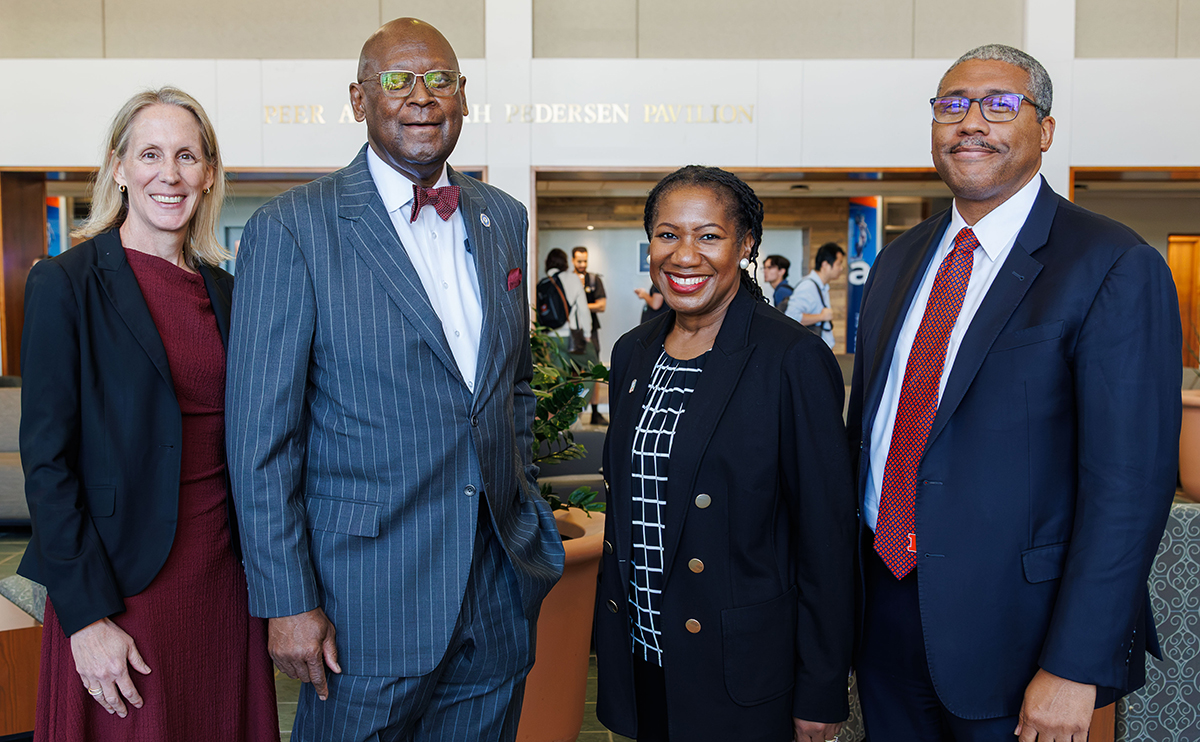
SIU Simmons Law School Dean Hannah Brenner Johnson, left, with (from left) Illinois Supreme Court Chief Justice P. Scott Neville, Jr., Cassandra Hill, dean, Northern Illinois University College of Law and Jamelle Sharpe, dean, University of Illinois College of Law. (Photo by University of Illinois College of Law)
October 14, 2026
SIU Simmons Law School, Illinois Supreme Court partner in creating Housing Justice Clinic
CARBONDALE, Ill. — A new collaboration between Southern Illinois University Simmons Law School and the Illinois Supreme Court will expand access to legal representation for people facing housing-related issues while giving law students valuable hands-on experience.
Through the recently approved Housing Justice Clinic initiative, students will learn to handle cases involving matters such as evictions and foreclosures. Under the supervision of licensed attorneys, they will provide critical legal services to low-income residents in Southern Illinois who might otherwise be unable to obtain legal representation.
The Illinois Supreme Court’s initiative creates clinics at SIU, the University of Illinois College of Law and Northern Illinois University College of Law.
“I could not be more inspired by this opportunity or excited about its impact on our law school and the region,” Hannah Brenner Johnson, Simmons Law School dean, said. “It will provide meaningful opportunities for our students to gain critical skills that will serve them well as they enter the legal profession. At the same time, it will allow us to help those in our community who may not otherwise have access to an attorney to assist with their housing-related legal needs.”
Brenner Johnson anticipates SIU’s clinic will be operational for the fall 2027 semester.
Unique program
Illinois Supreme Court Chief Justice P. Scott Neville Jr. announced the Housing Justice Clinic initiative on Oct. 8. When he did, he noted the need for such clinics and the dearth of attorneys with this focus in areas of the state.
“Today, throughout Illinois, people enter our courthouses with serious problems. They may be about to lose their home. Families may be in trouble. Livelihoods may be at stake,” he said. “Despite having a valid claim or defense, they may have no idea how to assert it. We sometimes talk about access to justice as though opening the courthouse doors solves the problem. It doesn’t. A person can walk through those doors and still have no idea what to do next. That is where lawyers come in.”
Neville added there are not enough lawyers to assist people faced with housing issues — a situation the clinics are meant to rectify.
“The need is there, but we do not have enough lawyers to meet it,” he said. “In much of Illinois, the problem is finding a lawyer at all. Even where lawyers are nearby, legal representation remains out of reach for many residents. Imagine what these clinics will mean for people who otherwise might have nowhere to turn. A home, after all, is where a family gathers, where children sleep, where daily life unfolds.”
The Illinois Supreme Court has secured funding for each of the clinics, each of which will provide a clinical professor, staff attorney, law student intern and general operating expenses. There will be opportunities for collaboration among each of the schools — such as training pro bono attorneys and identifying areas for policy reform — but each clinic will operate independently.
Brenner Johnson said she is unaware of a similar collaborative training model like this in the country.
“The collaboration among our three schools is one of the most unique features of this project,” she said. “We represent three of the four public law schools in Illinois, and we are all located in legal deserts where individuals have a difficult time accessing legal services.”
The initiative will also afford meaningful opportunities to collaborate with legal services providers like Land of Lincoln and Prairie State Legal Services in each of the school’s local communities, Brenner Johnson said.
Important addition
The new clinic “will add a vibrant component to our law school curriculum at Simmons Law School and continue to build our clinical program,” Brenner Johnson said. The clinic will also “help ensure that people in our community do not appear in court or try to address their legal housing issues without representation.”
Brenner Johnson said that access to justice is a “foundational principal” of the legal profession.
“Lawyers who provide pro bono service play a pivotal role in realizing this principle,” she said. “The three housing justice clinics will, as part of their mission, train attorneys to provide free legal assistance in their communities. We will also work to instill in our students a commitment to pro bono service that they will embody throughout their careers.”