
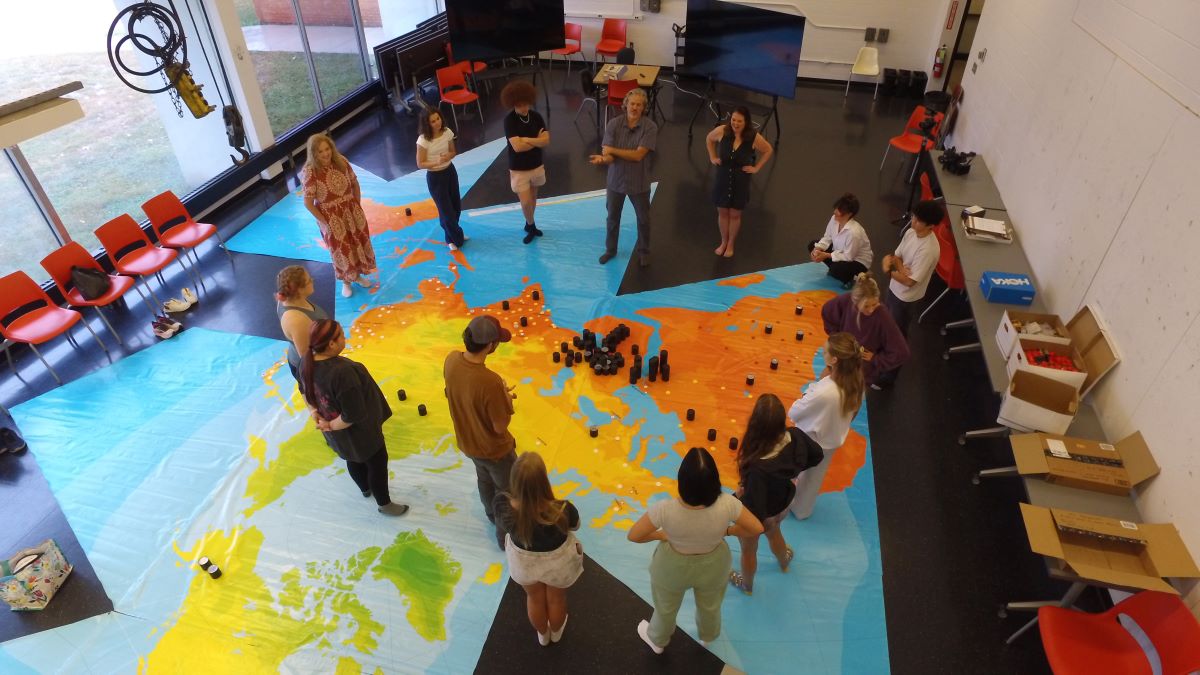
SIU Carbondale students participating recently on the World Game dymaxion map provided by the Buckminster Fuller Institute. Stuart Cowan and Sara Blenkhorn with BFI will present the 2026 Glassman Lecture on Oct. 20 in Morris Library. (Photo provided by Jason Pinkston)
October 09, 2026
SIU’s Glassman Lecture will highlight Buckminster Fuller Institute work
CARBONDALE, Ill. — Explore the enduring relevance of the ideas of noted futurist, architect, designer — and former Southern Illinois University Carbondale faculty member — R. Buckminster Fuller during a special evening presented by the University Honors Program.
“Designing Futures That Flourish: A Special Evening with the Buckminster Fuller Institute at SIU” features the 2026 Michael and Nancy Glassman Lecture, with presentations by Stuart Cowan, executive director of the Buckminster Fuller Institute (BFI), and Sara Blenkhorn, BFI director of innovation. The free, public event is Oct. 20 from 5-6:30 p.m. in Morris Library’s John C. Guyon Auditorium.
The program will include both presentations, followed by a moderated discussion and audience Q&A. A reception with food and refreshments will follow. There also are plans for a separate student discussion during their two-day visit.
 Cowan’s presentation is “Pathways to Planetary Flourishing” and Blenkhorn will present “By Design.”
Cowan brings 25 years of experience in regenerative design, finance, and systems. He holds a doctorate in applied mathematics from University of California, Berkeley, with a focus on complex systems and ecological economics, and co-authored the influential book “Ecological Design.” His previous roles include chief scientist at the Smart Cities Council and conservation economy research director at Ecotrust.
 Blenkhorn founded Canada’s first Circular Innovation Lab, led Vancouver’s Zero Waste 2040 strategy, and has produced more than 50 interactive art installations. Her work has included developing AI interventions with thinkers at Google X and Anthropic, building international coalitions, and helping shape climate policy in Canada.
Fuller’s history at SIU
Often considered the father of the modern sustainability movement, Fuller (1895-1983) was recruited to SIU by then-President Delyte Morris, and Harold Cohen, a professor in the design department. Fuller joined the university in 1959.
“I see this as part of a growing effort to strengthen Fuller’s living legacy at SIU through education, research, sustainability, public programming, and new institutional relationships,” said Elizabeth Donoghue, assistant director of the University Honors Program, SIU Sustainability Council member and president of the Fuller Dome Home Museum in Carbondale.
In addition to the public program, Donoghue is inviting interested academic programs, faculty, classes and student groups to meet with Cowan and Blenkhorn while they are at SIU. Contact Donoghue at elizabeth.donoghue@siu.edu about class visits or other ways of engaging Cowan and Blenkhorn while they are at SIU.
Media availability
Reporters, photographers and news crews are encouraged to cover the lecture. To arrange for interviews, contact Elizabeth Donoghue, SIU Carbondale University Honors Program assistant director and president of the Fuller Dome Home Museum, at elizabeth.donoghue@siu.edu or 618-525-3099.
BFI’s work connects with multiple areas, including sustainability, architecture, art and design, computing and artificial intelligence (AI), engineering, geography, ecology, public policy, business, community development, circular economies, regional planning, and the future of organizations and technology, Donoghue said.
She added BFI’s visit is also significant for the university, which holds important Design Science documents connected to this history.
Fuller “taught and worked here during one of the most productive periods of his life and SIU is where he advanced his Design Science work and introduced the World Game.”
‘This visit brings the organization carrying Fuller’s work forward today into renewed conversation with a university that holds a distinguished place in the development of that work,” she said.
The BFI visit, however. is not the first effort to promote and sustain Fuller’s legacy at the university. In April, SIU hosted a five-day conference featuring programming inspired by Fuller’s vision and legacy.
Facing today’s challenges
Established by members of Fuller’s family in 1983, BFI is an international nonprofit organization founded to carry Fuller’s ideas and approach to design forward, Donoghue said. BFI “supports people and projects applying Fuller’s Comprehensive Anticipatory Design Science to contemporary challenges involving communities, ecological systems, technology, economies, and the future of life on the planet,” she said.
Cowan, co-founder of Autopoiesis LLC, which applies complex-systems models and regenerative frameworks to communities, ecosystems, and organization, will discuss how society can build capacity “to visualize and create flourishing futures, from our communities and bioregions to continents and the planet.” He will explore sensemaking practices and design processes grounded in living systems and examine emerging work in areas including bioregional regeneration, the role of ecosystems in cooling the planet, planetary tipping points, and artificial intelligence in service to life.
Cowan was the architect and founding convener of the Regenerative Communities Network, where he supported 15 bioregions in their work toward resilience and regeneration.
Blenkhorn’s “By Design” presentation centers on “how design and emerging technologies, including artificial intelligence, can help us take responsibility for the systems we have inherited and create new possibilities.”
At BFI, Blenkhorn leads work translating Comprehensive Anticipatory Design Science into collaborative and fundable action. Her experience includes circular economies, social entrepreneurship, coalition-building, interactive art, zero-waste planning, and life-centered approaches to technology and AI.