
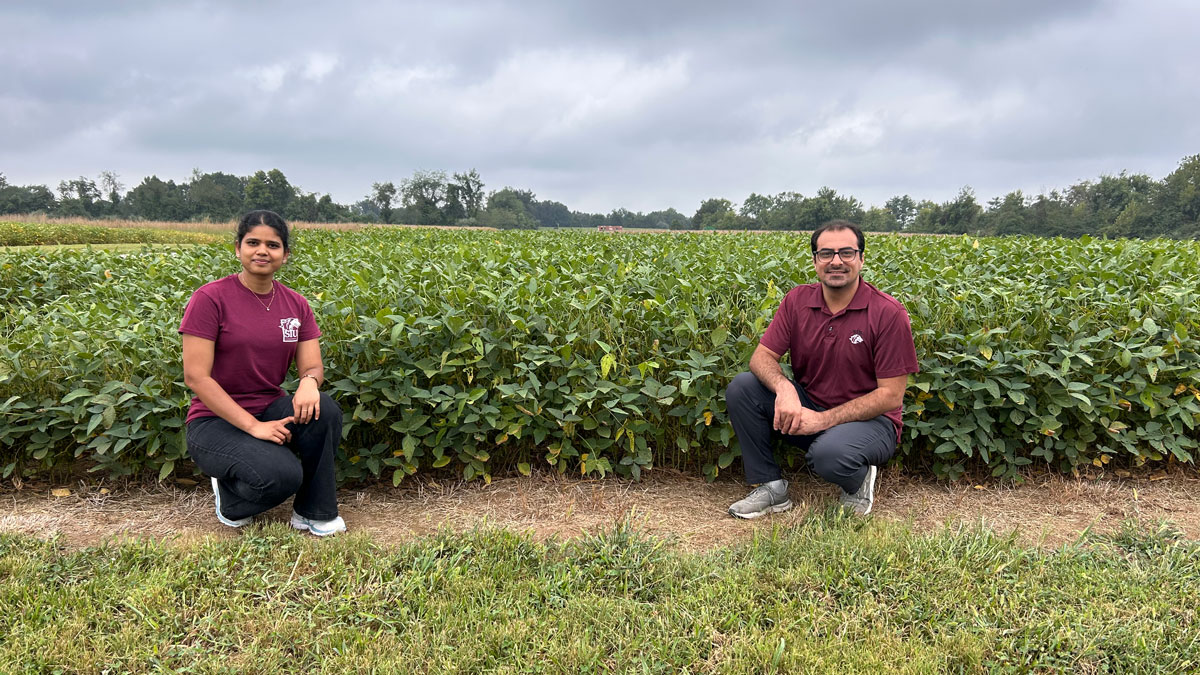
Southern Illinois University graduate students Sowmya Koduru (left) and Moein Javid (right) were selected as Illinois recipients of 2026 Sustainable Agriculture Research and Education (SARE) grants. The funding will allow the students to expand their research to cooperating farm fields. (Photo by Brooke Keltner)
October 01, 2026
SIU grad students receive $40k for agriculture research
CARBONDALE, Ill. — Two Southern Illinois University Carbondale graduate students received nearly $40,000 from the United States Department of Agriculture to support their research projects, surrounding the benefits of malting barley in double-crop soybean systems and efforts to utilize fertilizers more efficiently for winter wheat.
Moein Javid and Sowmya Koduru were selected as Illinois recipients of 2026 Sustainable Agriculture Research and Education (SARE) grants. Since 1988, only 204 projects in Illinois have received SARE funding. The program’s goal is to bring new, sustainable ideas to farms and ranches across the country.
Kristina Boone, dean of the College of Agricultural, Life, and Physical Sciences, is proud to see Javid and Koduru recognized for their research and receive additional funding to help continue their work.
“Putting together a competitive proposal is a great experience and gives them a leg up as they continue their careers,” Boone said. “I also appreciate how hard our faculty work to mentor them in this process. We really are working to develop the next generation of scientists and industry leaders.”
Experimenting with malting barley
Javid, who is pursuing a doctorate in agricultural sciences, is looking into whether winter malting barley could be a more profitable and sustainable alternative to winter wheat in double-crop soybean systems.
“Winter wheat is commonly grown before soybeans in the Midwest, but relatively low wheat prices, high nitrogen fertilizer needs, and its later harvest can limit profitability and delay soybean planting,” said Javid, who grew up in a farming family in Iran. “Malting barley may offer farmers a better option because it requires less nitrogen, can be harvested about two weeks earlier, and may receive a higher market price.”
So far, preliminary research at SIU showed that soybeans following winter malting barley yielded about 8% more than those following winter wheat, Javid said.
Javid received $19,806 in SARE grant funding, which will be used to expand his research from taking place at SIU’s University Farms to working in commercial farming conditions.
“It’s rewarding to see our research idea recognized, and I am excited about the opportunity to expand the project and work directly with farmers,” he said. “This grant will also help us share our findings directly with farmers through field days and other outreach activities.”
Getting the most out of winter wheat
Meanwhile, Koduru is looking to support farmers who do grow winter wheat as a cover crop. She’s researching how to use nitrogen fertilizer efficiently while reducing nitrogen losses to the environment to produce a more favorable yield.
“We are studying fertilizer application timings, nitrification inhibitor rates, and sulfur fertilization to determine which combinations can maintain or improve wheat yield and grain quality while reducing nitrogen loss and improving profitability,” said Koduru who is from India and pursuing a doctorate in environmental resources and policy.
She began her field experiment at SIU's Belleville Research Center in the fall of 2025. The study compared different nitrogen management strategies, nitrification inhibitor rates and sulfur applications. Now with $19,644 in SARE grant funding, Koduru will also expand her research to a cooperating farmer’s field, allowing her to evaluate these practices under different soil and drainage conditions.
However, this experiment will also evaluate several other measures including soil nitrogen, nitrate loss, crop nutrient uptake, wheat yield and grain protein, while assessing the economics of the different management strategies.
“Ultimately, the goal is to provide practical fertilizer recommendations that work under Southern Illinois growing conditions,” Koduru said.