
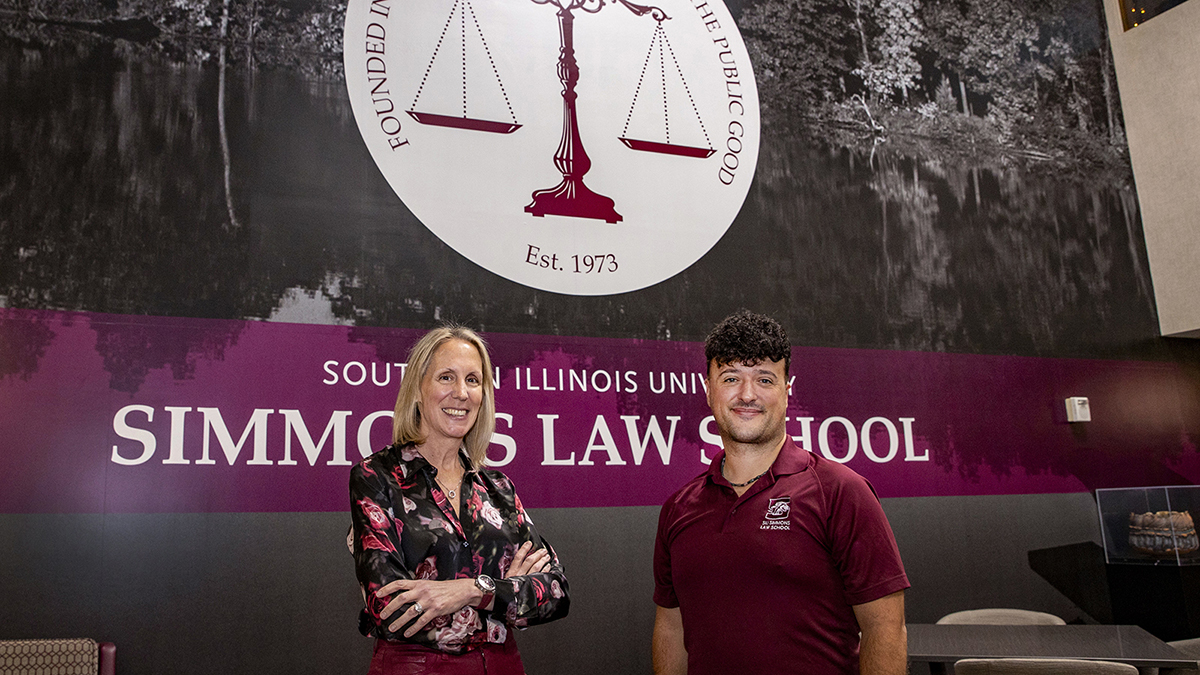
Thomas A. Reichert, right, assistant professor at SIU Simmons Law School, will share insights from his research on how courts resolve trademark disputes during a “Scholars in Conversation at Simmons Law School” with Dean Hannah Brenner Johnson on Wednesday, Sept. 30. Reichert recently submitted his research in a brief for a case expected to be heard by the U.S. Supreme Court during its next term. (Photo by Russell Bailey)
September 25, 2026
SIU Simmons Law prof to discuss upcoming Supreme Court trademark case
CARBONDALE, Ill. — Research by an SIU Simmons Law School assistant professor on how courts decide trademark disputes is part of a case expected to be heard by the U.S. Supreme Court during its next term.
Thomas A. Reichert will discuss his research — and its correlation to a case involving PepsiCo and a small New York-based coffee brewing company — during a “Scholars in Conversation at Simmons Law School” at 5 p.m. Wednesday, Sept. 30, in the law school’s Hiram H. Lesar Law Building formal lounge. The discussion, “Factors and Fictions: Trademark's Confusion Test at the Supreme Court,” is free and the public is invited. Pre-registration is encouraged but not required.
This is the second conversation in a series started by Dean Hannah Brenner Johnson in April 2026 to showcase law school faculty and other scholars who are writing about issues relevant to the legal profession.
“It’s a tremendous professional milestone and still somewhat surreal,” said Reichert, a four-degree SIU Carbondale graduate. “It is rare for years of academic research to intersect so directly with a live Supreme Court case. I am especially proud that scholarship developed here at SIU may help inform how the court approaches a doctrine that federal courts apply hundreds of times each year.
“The most meaningful part is the opportunity for a large empirical record to inform the court's description of how the law actually works,” Reichert said.
Brenner Johnson agreed.
“It’s a law professor’s dream to have their research be so relevant at the level of the Supreme Court,” she said.
The case
The trademark infringement case dates to 2015 when Rise Brewing began selling canned nitro cold-brew coffee under its RISE trademarks. PepsiCo later introduced MTN DEW RISE ENERGY. Rise Brewing sued, arguing that the use of “RISE” would likely confuse consumers. A federal district court and circuit court ultimately sided with PepsiCo, prompting Rise Brewing’s appeal to the U.S. Supreme Court. Rise Brewing filed its merits brief on Sept. 8, with several supporting and neutral briefs filed Sept. 15. PepsiCo's brief is currently due Nov. 4.
The Supreme Court has not announced a date for oral arguments.
Reichert’s amicus, or friend of the court brief, doesn’t take a side in the issue. The Supreme Court is deciding a narrower question — whether the strength of a trademark “is a question of fact when courts conduct the likelihood-of-confusion analysis,” Reichert said. He explained that 12 federal circuit courts treat trademark strength as a factual question while the Second Circuit Court treats it as a legal question.
“Although that sounds technical, the answer affects who decides the issue, how much deference appellate courts give the decision, and whether courts may resolve trademark cases without a jury,” he said.
Research provides ‘doctrinal framework’
Prior to joining the law school in 2025, Reichert practiced patent and trademark law for two private law firms. Reichert said his research of approximately 15,000 opinions from 1970 through 2025 examines how courts and the Trademark Trial and Appeal Board decide likelihood-of-confusion cases.
The Supreme Court case is framed as a dispute over who decides trademark strength, Reichert said, explaining that his research “suggests that the deeper question is how courts turn several factual findings into a legal judgment.”
The brief’s purpose is to give the court information and “a doctrinal framework that the parties can use regardless of which side ultimately prevails,” he said.
“My brief describes that distinction as: ‘Assessment is fact; composition is law’. Assessing how strong a mark is, involves factual questions about consumer perception. Determining what that finding legally does when combined with similarity, proximity, and the other factors is a question about the content and operation of the legal standard.”
When the Supreme Court granted review in late June, Reichert said he recognized the question before the court “directly intersected with several years of my research.” He authored the neutral amicus brief so the court “would have the benefit of the empirical record concerning how the likelihood-of-confusion test operates in actual cases.”
Sheila Simon, a longtime associate professor at the law school who recently retired, served as the counsel of record in filing the brief on July 20.
Importance of trademark cases
Reichert said trademark cases are important because trademarks help consumers “identify the source of goods and services, while allowing businesses to protect the goodwill they have built around their brands.” The likelihood-of-confusion test is the central liability standard in trademark infringement cases.
The Supreme Court’s decision “could affect who resolves important parts of that test, when a case may be decided on summary judgment, and how appellate courts review the result,” he said. “Those procedural questions can shape the outcome of a case just as much as the substantive trademark rules.”
Plans to attend oral arguments
Reichert, originally from Galesburg, earned bachelor’s and master’s degrees in civil and environmental engineering, a Master of Business Administration, and a cum laude law degree, all from SIU.
Alongside other SIU law alumni, Reichert will be sworn in to the Supreme Court bar on Jan. 19, 2027, and he plans to attend whenever oral arguments in the case are heard. Reichert doesn’t expect to present an argument before the Court; attorneys representing the parties ordinarily handle that. But being present for arguments, particularly so close to his own admission to the Supreme Court bar with other SIU alumni, “would make the experience especially meaningful,” he said.
He credits SIU for his career — one that finds him in the same classroom setting he was in just a few years earlier.
“Anytime I have asked for more out of my life and career, SIU has said yes,” he said. “It said yes to me as a student, and it has now said yes to me as an academic and professor.
“Returning to teach here, in the same institution and sometimes the same classrooms where I was once a student, has been a wonderful experience. I now have the opportunity to invest in students in the same way that SIU and its faculty invested in me.”