
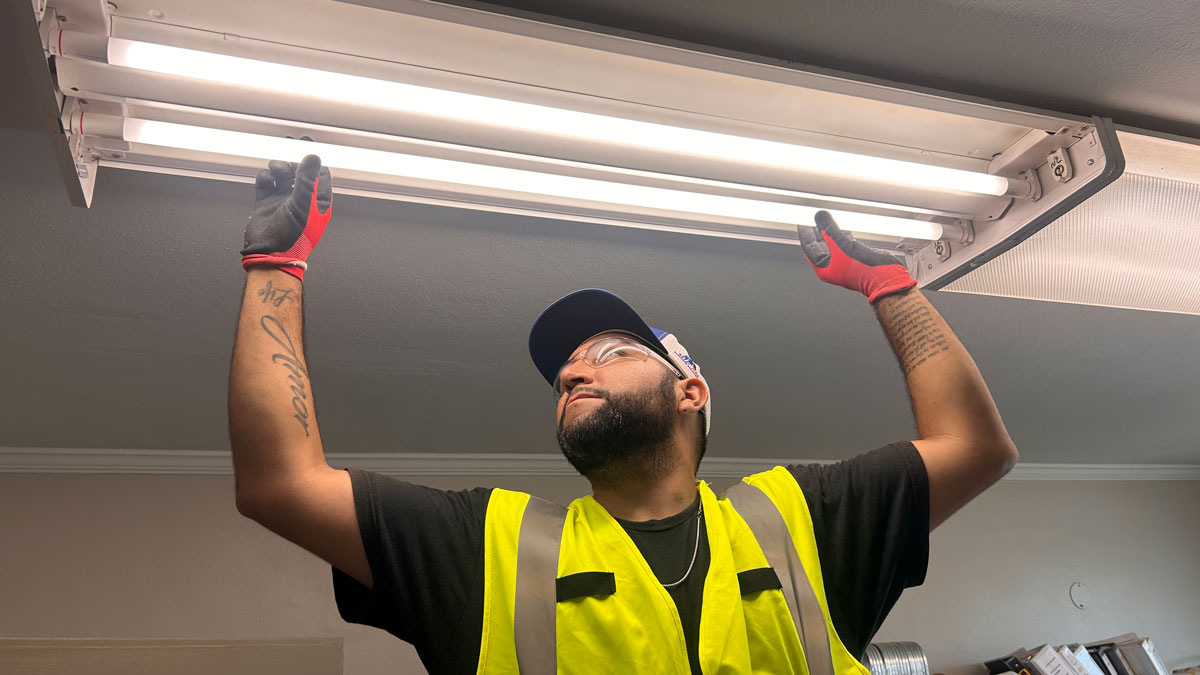
Elliot Reyes of Johnson Controls installs an LED linear tube as part of a $9.9 million energy- and cost-efficient lighting project at SIU Carbondale. (Photo by Brooke Keltner)
August 17, 2026
Shining the light: SIU undergoing major lighting renovation on campus
CARBONDALE, Ill. — Work is underway at Southern Illinois University Carbondale to replace obsolete fluorescent lighting with new LED linear tubes and occupancy controls in 33 academic buildings — the first major campus indoor lighting renovation in 20 years.
The $9.9 million project, approved by the SIU Board of Trustees in April, is expected to yield energy savings of about $570,000 in the first year. In addition, the project will also earn about $150,000 in incentives from Ameren’s Illinois Energy Efficiency program when completed in early 2027. said Mark Owens, SIU Carbondale’s Facility and Energy Management (FEM) director.
“This initiative is part of SIU Carbondale’s ongoing commitment to sustainability, which is one of the pillars in the Imagine 2030 Strategic Plan. The new light sensors will be an important feature that brings the university significant energy and cost savings. As Salukis we are coming together to embrace changes that benefit our campus.” said Susan Simmers, vice chancellor for administration and finance.
Extensive project
Project construction has been underway during the day shift this summer and work will switch to night shift from 5 p.m. to 12:30 a.m. with the start of SIU’s fall semester.
Light switches will change from toggle to push button switches featuring passive infrared occupancy sensors that will automatically shut lights off after a room is vacant for 15 to 30 minutes, depending on the type of room space. Most spaces, like offices and classrooms, will require people to turn lights on at the switch. Where switch access or safety are concerns — in spaces such as corridors, restrooms, library stacks and laboratories — the lights will automatically turn on as soon as occupancy is detected. There should be no significant changes to light quantity or quality.
The work will impact the following buildings: Advanced Energy Institute, Agriculture, Allyn, Altgeld Hall, Anthony Hall, Applied Sciences and Arts, Davies Hall, Engineering Complex, Faner Hall, Forestry (Paul Simon Public Policy Institute), Simmons Law School, Laundry-Applied Science, Lawson Hall, Life Science II & III, Lindegren, Micro Imaging, Morris Library, Neckers, Parkinson Hall, Pulliam Hall, Pulliam Industrial, Quigley Hall, Rehn Hall, Service Building 2, Shryock Auditorium, Student Services Building, Wham, Wheeler Hall, and Woody Hall.
Sustainability benefits
The ultra-efficient LED tubes will reduce the electricity use of a typical light fixture with two fluorescent lamps by 65% from 46 watts down to only 16 watts. The occupancy controls will turn lights off in vacant areas to reduce burn time, saving additional energy and extending their service life — potential added savings of over 50% in some offices and classrooms and up to 85% in some library areas. The conversion to LED and occupancy controls combined are expected to save 4.8 million kWh of electricity annually, reducing the main campus electricity district purchases by 7.4% compared to fiscal year 2026. This saved electricity will prevent 2,774 metric tons of carbon dioxide equivalent emissions annually — equal to the yearly greenhouse gas emissions of 647 gasoline-powered passenger vehicles or the amount of carbon sequestered in a year by 2,782 acres of U.S. forests.
Replacement lighting necessary
Owens said the project was motivated by several factors including:
- Upgrades needed to replace obsolete and costly fluorescent lighting.
- LED tubs will last up to three times longer than fluorescent tubes along with reduced maintenance costs.
- Skyrocketing utility rate increase of 47% from fiscal year 2024 to 2026.
- The 2024 Illinois Clean Lighting Act banned the sale and distribution of mercury-containing screw-base compact fluorescent lamps in 2026 and pin-based fluorescent lamps in 2027.
- Available energy efficiency incentives.
- An Illinois Energy Code requirement that renovated lighting systems meet efficiency requirements and that lights automatically turn off when not in use.
To find out more about the project, or to file a service request if the lights in your area are not working properly, visit facilities.siu.edu/utilities.