
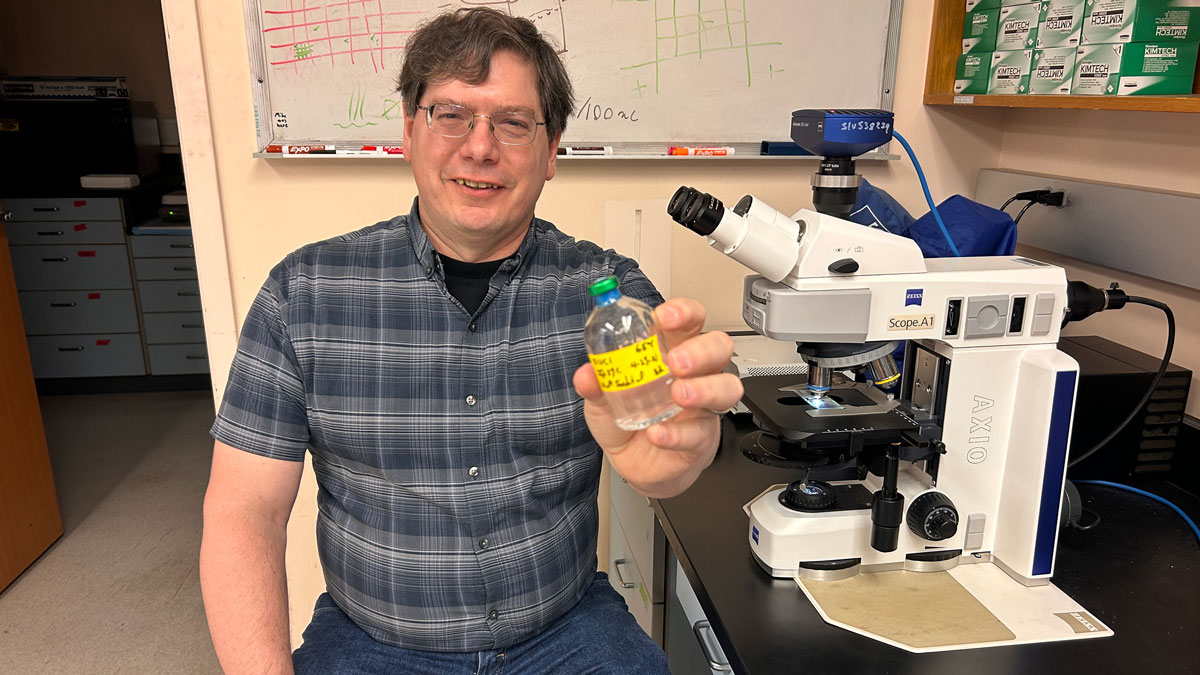
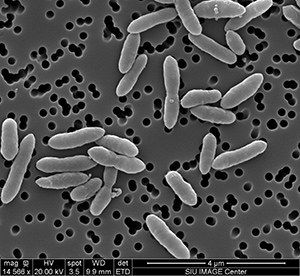
Scott Hamilton-Brehm, an associate professor in SIU Carbondale’s biological sciences program, holds a bottle containing SIUC-1 cells. The novel microbe is a representative of a phylum called Atribacterota. (Below) A glimpse of SIUC-1 shown in microscopic view. (Photo by Brooke Keltner)
July 30, 2026
SIU Carbondale researchers name new microbe after the university
CARBONDALE, Ill. — A little giant has been found deep in an underground community where thriving means living in hot, dark spaces with no oxygen. This might sound like the movie trailer for the latest fantasy meets sci-fi blockbuster, but it’s the description of a new microbe named after Southern Illinois University Carbondale.
Scott Hamilton-Brehm, an associate professor in the School of Biological Sciences, discovered a novel microbe and named it Caldatribacterium inferamans strain SIUC-1. This translates to “the mysterious hot-living bacterium that loves the underworld.” And it has the potential to unlock mysteries about life beyond Earth.
The microbe
Hamilton-Brehm was working in Nevada’s Desert Research Institute on a NASA-funded project called Life Underground when he discovered the microbe.
He plunged a fishing line nearly 2,500 feet into the Earth’s harsh environment via a borehole, collecting water samples where microbes could colonize a sponge.
“There we are with a fishing pole, a saltwater fishing rig, and reeling back sponges in the middle of the desert,” he said about conducting the experiment. “If anyone saw us, they would have thought it was pretty comical.”
In all seriousness, the project centered around learning about Earth’s early history as well as life on other planets. NASA’s position is that “if life exists, or ever existed, on Mars or another planetary body in our solar system, it would be found in the subsurface.”
“We are so biased to sunlight-driven life forms, and we just don’t know too much about the ones that don’t depend upon sunlight,” Hamilton-Brehm said. “These life forms are very primitive, but they could be found on other planets. It doesn’t have to be Earth.”
In the lab
Soon after the NASA project, Hamilton-Brehm accepted a position at SIU and brought the water samples with him. This is when the next phase of research began. One of his first students, Amanda Blocker, joined the lab in 2017. At the time, Blocker was an undergraduate student pursuing a degree in microbiology. This research provided her with an opportunity to learn more about different life forms and to narrow down her future education and career path interests.
“This project specifically started out very exploratory, so we didn’t really know what to expect,” Blocker said. “The endless possibilities for discovery were very exciting.”
Together, Blocker and Hamilton-Brehm first worked to grow any microbes in the water samples by feeding them diverse types of sugars. Only the sample given xylitol seemingly had one microbe that grew. Those who like to chew gum have something in common with this microbe. Xylitol is a sugar found in citrus plants that’s often used in chewing gum because it kills bad-breath germs.
“This microbe from deep underground, who has not seen sunlight and probably has never seen sugar from plants, is eating it,” Brehm-Hamilton said. “That begged the question, what are we dealing with here? It began the mystery.”
Internal Support
To support the lab, Blocker applied for an internal REACH award through SIU’s Vice Chancellor for Research office. This grant funded the purchase of reagents to begin full characterization of the microbe, including determining optimal growth conditions by testing temperature, pH, and nutrients.
 “Microbes can be very finicky sometimes, so it’s important to know what makes them happy or upset so we can effectively do our research,” said Blocker who is pursuing a doctorate in microbiology at the University of Chicago. “Careful hands, sterile technique, attention to tiny details, and patience are the cornerstones of microbiology research.”
During sequencing of its genome, Blocker and Hamilton-Brehm realized they had found something rare and special. The microbe’s genetics did not match with any of the major clades known to science. It was a representative of a phylum called Atribacterota, previously known as OP9, cementing Blocker and Hamilton-Brehm among the few researchers in the world who have grown and studied an Atribacterota.
Scientists classify living organisms by their genetics from generalized to specific; it goes phylum, class, order, family, genus, and species.
“Our microorganism had a place in the tree of life,” Hamilton-Brehm said. “While this phylum had been detected ubiquitously before by sequencing, at that time, no one had a cultured representative of this group. It was brand new and we knew nothing about it.”
Collaboration with other research universities
One of the first characteristics that Hamilton-Brehm and Blocker learned about SIUC-1 is that it’s not an isolate, meaning a microbe on its own. This novel microbe had a partner associated with it, making SIUC-1 difficult to isolate for further research. The duo decided to collaborate with two other Carnegie classified research universities: Brian Hedlund, distinguished professor in life sciences at the University of Nevada, Las Vegas, and Jeremy Dodsworth, department chair of biology at California State University, San Bernardino.
Those universities also found a microbe like SIUC-1 but in a hot spring in northern Nevada called The Great Boiling Spring. This surface microbe, Caldatribacterium saccharofermentans, also had a partner.
Together, the researchers concluded that Caldatribacterium could not make folate (vitamin B9) for themselves. Instead, they receive this vitamin from the partner, and in return, feed their partners acetate (vinegar) and hydrogen. Essentially, these microbes live in a community together, helping each other survive.
“They don’t have eyes, they don’t have arms, they are not people,” Hamilton-Brehm said about the microbes having a partner. “But, on a chemical level, they are very specific with who they strike up these relationships with.”
Now, knowing that Caldatribacterium need folate to thrive independently, the collaborative team isolated their microorganisms from their folate providing partners.
Changing scientific procedure
This love of folate could change a long-standing microbiology procedure. Scientists feed microbes vitamin mixes, and the standard method is to include folate. Even when Hamilton-Brehm and Blocker fed SIUC-1 their commercial vitamin mix, containing folate, it would not grow on its own. It needed its partner — another puzzling mystery for the team to solve.
“Questioning the vitamin mix is like questioning gravity,” Hamilton-Brehm said. “Scientists rely on these mixes to be what they should be. To now say that scientists have been doing this 63-year-old procedure wrong is a bit controversial.”
Blocker graduated from SIU by this time, leaving Hamilton-Brehm and other undergraduate students over the years to carry the torch to determine how to grow SIUC-1. The University of Nevada, Las Vegas and California State University, San Bernadino determined that how a vitamin mixture is prepared can remove or diminish the vitamin. For example, scientists heat glassware and solutions to sterilize them, but conventional wisdom says these hot temperatures break down vitamins’ potency. Meanwhile, other scientists use filters to sterilize their solutions.
“These different processes affect the composition and the concentration of the vitamins,” Hamilton-Brehm said. “Everyone’s doing things a little differently, so it means not all vitamin mixes are created equal.”
Instead, collaborators Hedlund and Dodsworth made their own vitamin mix, adding each individual vitamin — as Hamilton-Brehm likes to say, “identifying the secret to the sauce.” The collaborative team found that the most common methodologies accidentally remove folate, which contributes to the difficulty that scientists have growing microbes in labs throughout history.
“On a good day, around 95% of microbes cannot be grown by the scientific community,” said Hamilton-Brehm. “While the vast majority of microbes are ‘good guys’ and not harmful to humans,
to have such a high number of microbes unable to be grown in the lab really means there is something fundamental we don’t understand.”
The findings
SIUC-1 is a rare representative of its group because it can be grown in the lab. It is a thermophile, a microorganism that thrives at 150 degrees Fahrenheit — a temperature that would kill other microbes. In addition, the novel microbe has three lipid membrane-like layers compared to other microbes, which typically have one or two.
“This microbe has two normal cell membranes and then an extra layer,” Hamilton-Brehm said. “Meaning that there are an outer, middle, and inner lipid-like membrane layers. It’s an extra feature, unlike other bacteria. We don’t know what it is, or why it’s there.”
All three research universities and government agencies worked together to publish their findings: “Isolation of Genome-Predicted Caldatribacterium (Atribacterota) Reveals Pervasive Microbial Cultivation Problem Due to Folate Precipitation,” in the Nature Communications journal.
“This is the type of research you would expect at an R1 university,” Hamilton-Brehm added. “Microbes are little giants that can do fantastical things, and we don’t give them enough credit. We should be leaning into them. They help against disease, help plants grow, survive the depths of the Earth, and are the true engineers of this planet.”
This microbe has already been deposited into two international culture collections. This means researchers worldwide can order and use this microorganism with the strain name SIUC-1 in their own labs to study it further.