
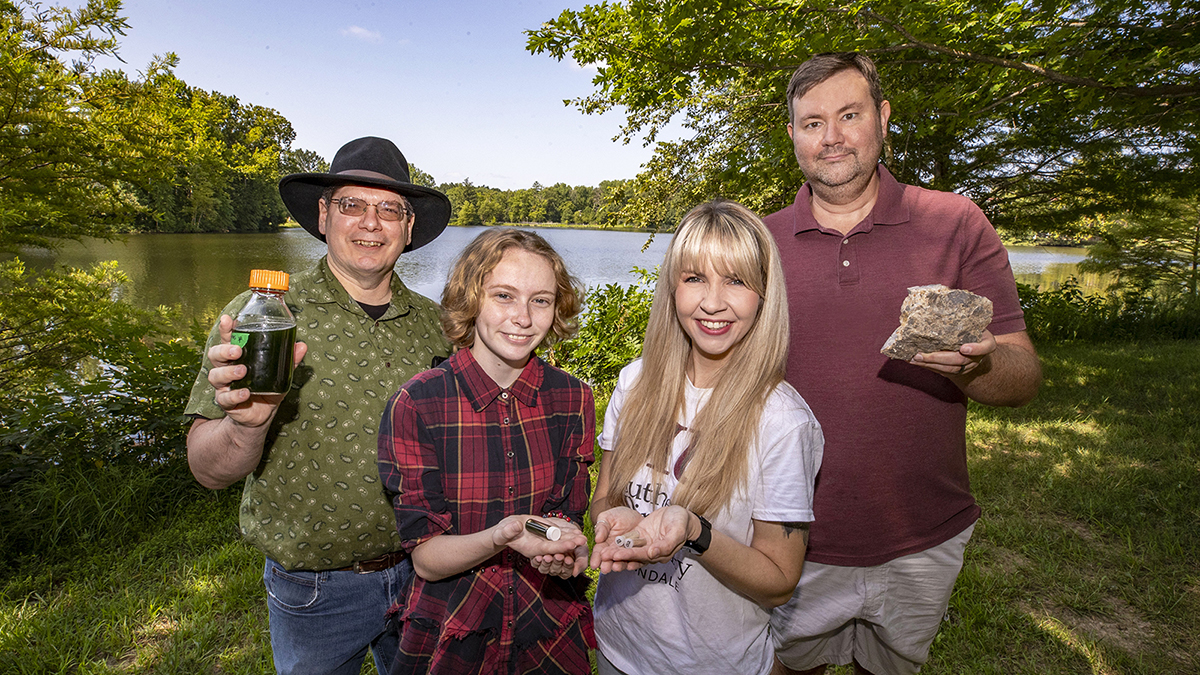
(Top) SIU associate professors Scott Hamilton-Brehm, left, and Daniel Hummer, right, along with graduate students Mercedez Hanlon and Kristina Kohl, middle left and right, were able to successfully double the concentration of rare earth elements. (Below) Hanlon, left, and recent alumnus Alex Bechtel helped transform a cow trough into a flowing riverbed to facilitate the experiment. (Top photo by Russell Bailey; bottom photo provided by Hamilton-Brehm)
July 27, 2026
SIU Scientists use algae to double the concentration of rare earth elements
CARBONDALE, Ill. — Rare Earth elements are the latest resource that countries across the world are racing to mine and refine. We’ve seen this play out before, whether it’s land, gold, or liquid gold — oil. The quest can lead to international conflict and environmental harm.
Researchers at Southern Illinois University do not want history to repeat itself. Instead, they may have found a substantial rare earth site in their own backyard and a sustainable way to extract it using — of all things — algae.
What’s so important
Rare earth elements are used for everyday products, such as smartphones, computers and electric vehicles. But graduate student Kristina Kohl says their importance extends beyond convenience.
“A lot of people think of electronics when it comes to rare earth,” said Kohl, who is from Herrin, Illinois, and a master’s student in the geology program. “They say we don’t need to mine for these elements because ‘I can live without my phone.’ A lot of people don’t realize how big of a role they play in producing equipment for our national defense systems.”
Right now, China dominates the rare earth trade as the country mines about 60% and processes and separates about 90% of global rare earth elements.
The United States is second in rare earth mining, with sites in California and Georgia.
As a matter of national security, the federal government is monitoring Chinese rare earth dominance as the U.S. takes steps to reduce reliance on outsourcing rare earth elements.
Not so rare after all
As it turns out, rare earth isn’t so rare after all. So, what’s the competition about?
“You could go out and scoop some dirt from the ground and probably find some rare earth elements,” Kohl said. “Finding them in great enough concentrations to make it economically viable is what makes them truly rare.”
Kohl joined Daniel Hummer, an associate professor of geology, at a site that could potentially lead to a third rare earth mine in the United States, called Hicks Dome in Hardin County, Illinois.
Hummer says this location is the site of a crypto volcano — essentially, a volcano that failed to penetrate the Earth’s surface, causing the magma to harden underground.
“It seems the magma came from very deep in the earth, shot up, and formed these ‘fingers’ of dark colored rock where we’re finding rare earth elements,” said Hummer, who specializes in mineral crystallization. “We’re also finding rare earth in surrounding rock called breccia, where very hot water carrying minerals came out of the magma and snaked its way through shattered rock.”
Rare earth meets algae
How did the idea of mixing rare earth with algae come about?
Scott Hamilton-Brehm, an associate professor of microbiology at SIU, says plants can absorb minerals from the ground and incorporate them into their bodies. However, plants have several limitations, such as taking up land space, the time for a seed to sow into a plant, and the subsequent growing seasons after the plant matures.
“You need a liquid type of organism that can absorb the minerals,” Hamilton-Brehm said. “This is where microalgae come in. They’re a liquid plant. They require sunlight, they need a source of CO2, and they absorb metals and minerals.”
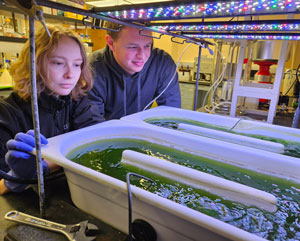 To conduct their experiment, Hamilton-Brehm and his students created a mini riverbed by filling a cow trough with 50 gallons of water and installing a pump that circulated the water to mimic a river current. Then LED lights hovered over the trough to act as the sun.
Kohl and Hummer pulverized rock samples containing rare earth into a fine powder and added it to the flowing “riverbed.” Then Hamilton-Brehm’s team added the microalgae to the water. After a few short weeks, the yet-to-be explained happened.
“When we received the analysis from the state lab, it became evident that the algae did interact with the rare earth,” Hamilton-Brehm said. “We don’t know how. We don’t know why. We’re going to have to figure it out.”
Sustainable
The algae did more than absorb the rare earth metals — its concentration more than doubled. The researchers made this discovery after separating the rare earth from the algae through a patented process which breaks down organic molecules. This is a win-win.
“You’re getting your rare earths but in addition you’re left with dissolved algae,” Hamilton-Brehm said. “This can be used for bio-stimulants, which are agricultural additives that support plant growth. Or you can extract the lipids out of it and make biodiesel. Now you’re talking about a sustainable process that could be profitable at the industrial level.”
On top of this, using algae to refine the rare earth metals is more environmentally friendly than the current standard where chemicals such as sulfuric acid are used to dissolve the minerals around the rare earth elements.
The other sustainable impact is that rare earth elements are often found in coal slag and electronic waste. This algae process could be used to clean the environment and extract rare earth at the same time.
Next steps
The next steps are to conduct more experiments with different types of algae to see if it affects the rare earth concentration levels.
Hamilton-Brehm and Hummer are working together to write a proposal to the National Science Foundation for grant funding to support this lab work.
Hummer believes discoveries like this are possible when departments across campus work together.
“I think these interdisciplinary projects are incredibly valuable,” Hummer added. “While they do happen on campus, I think that they should happen more. It exposes students to new topics and career options, and it leads to more creative thinking and collaboration among faculty.”