
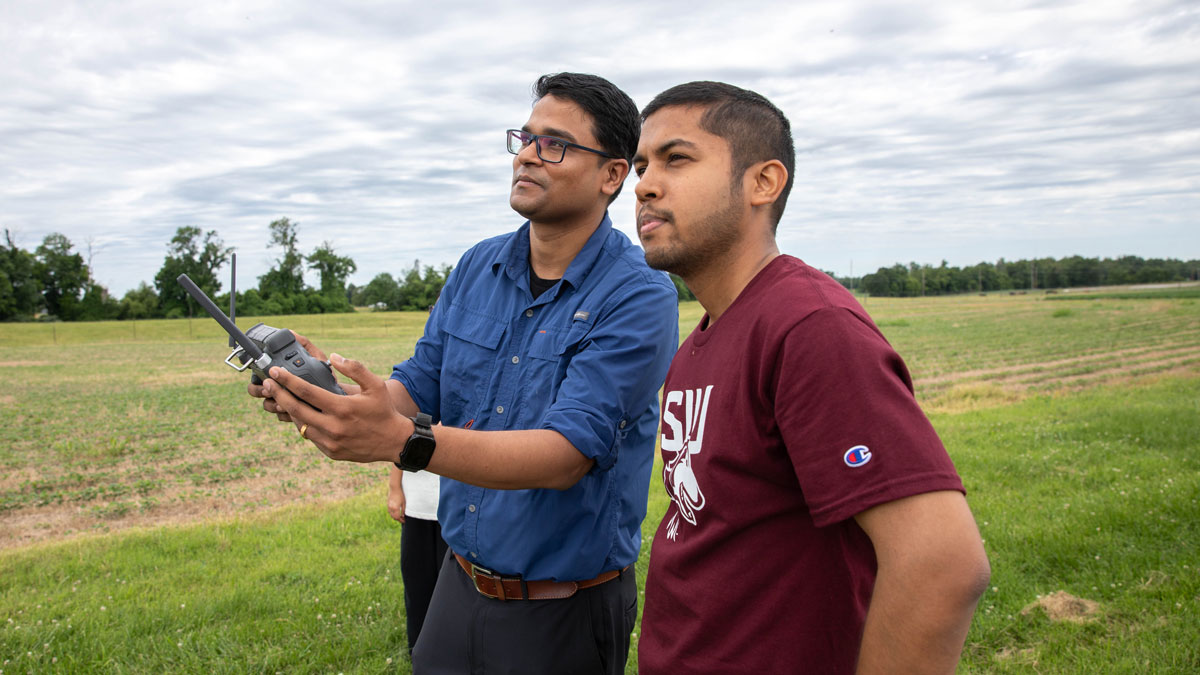
(Above) Billy Ram, assistant professor of precision agriculture, and graduate student Samuel David held a drone demonstration for local farmers during SIU’s Ag Field Day. (Below) An example of the drone’s field mapping capabilities, helping farmers to collect data about their crops. (Photo by Yenitza Melgoza).
July 21, 2026
SIU showcases drone, AI capabilities to farmers during Ag Field Day
CARBONDALE, Ill. — Blue skies and sunshine marked the perfect weather for SIU’s Ag Field Day on July 14 where a drone and artificial intelligence (AI), some of the latest technology to sweep the farming industry, were among the star performers.
Southern Illinois University Carbondale rebooted this research-focused event after a three-year hiatus. The research on display is from graduate students mentored by faculty and supported through grant funding from the Illinois Nutrient Research and Education Council, the Illinois Soybean Association and the Illinois Farm Bureau, each of which had representatives on-site.
Dipanjan Mazumdar, interim associate dean for academic and student affairs and associate professor in the School of Physics and Applied Physics, said Ag Field Day is an opportunity to highlight SIU’s R1 research and inform farmers about the latest trends in the industry.
“This is a great community outreach with our farmers and agriculture partners who help fund some of our research projects,” he said. “University Farms is SIU’s largest research facility in terms of scope and size with 600 of the 2,000 acres being dedicated to research. Our college is producing quality research that can improve farming practices, and we want to share that information.”
Attendees watched a drone demonstration and experienced ag research firsthand through in-person field talks on topics such as:
- Novel cover crop and herbicide management for controlling waterhemp in no-till and strip-till soybean fields
- Cover crop biomass and weed suppression trials
- An update on the next generation of cover cropping and sustainable intensification of corn and soybean rotation
- Impacts of conservation practices on water equality
Drones: Seeing farmland from above
Billy Ram, assistant professor of precision agriculture, and graduate student Samuel David teamed up to focus on a multi-rotor drone and its field-mapping capabilities.
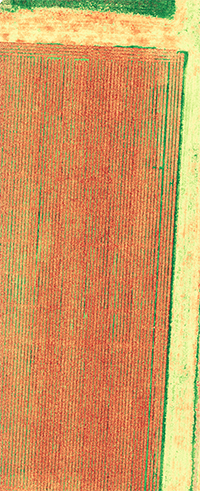 “It’s very difficult to look at a field from eye level and identify issues, especially when a farmer has thousands of acres worth of crops,” Ram said about the convenience of this technology. “Drones allow farmers to see areas where crops are not experiencing the growth that they should. Maybe the plants are fighting for nutrients, the soil has a problem, or the plants are too compact.”
Once in the sky, drones can collect data through three different types of maps, each with specific uses:
- LiDAR – best for topographic imaging.
- RGB – helps with visual scouting.
- Multispectral – aids in crop health analysis.
Farmers can use the data collected from these unmanned aerial vehicle generated maps as decision making tools to improve crop drainage, perform stand counts, detect weeds, monitor for diseases, and recognize stress and nutrient deficiencies. However, when AI is added to this workflow, the information becomes even more precise and useful.
“These models can tell the farmer which types of weeds are present in their fields,” Ram said about the specificity of the AI models. “It no longer becomes crop versus weed but identifies the type of weed such as waterhemp or ragweed. The model can even tell farmers which percentage of their field is weeds. This is useful information for mitigation.”
With this precision, farmers can pinpoint the use of herbicides on the weeds, which in turn, saves time and expensive resources.
While many of these mapping programs can be costly, Ram wants the farming community to know that free, user-friendly options are available and obtaining a small unmanned aerial system (sUAS) pilot license is a simple process.
“Our goal is to share details about free resources with farmers,” he said about the college’s outreach through Field Day events. “We also want to show them how easy it is to fly a drone and become licensed. All it takes is passing a test through the Federal Aviation Administration showing you understand airspace rules, safety procedures, and drone regulations.”
Support from the Illinois Soybean Association
The Illinois Soybean Association (ISA) is supporting this drone research and outreach. Abigail Peterson, the group’s director of agronomy, said ISA is continually looking for ways to improve pest management, stewardship, and conservation as well as introduce farmers to new technologies.
“We want to be ahead of the game for farmers,” she said about the organization investing in research efforts across the state. “Drone technology and mapping are an interest that we’re going to keep on funding through research. We want to push the envelope on what’s next.”
She encourages farmers to attend Field Days like this to learn more about the possibility of slowly incorporating drone technology into their farming processes to supplement their existing equipment.
“Come to these events and ask questions based on your goals, whether it’s field monitoring, mitigation issues or creating next year’s planting maps,” Peterson said. “Maybe use some free options, start small and build your way up.”
Next generation of farmers are drone ready
The next generation of farmers will learn about drones and their multi-use applications while in secondary education. Steven Still, an associate professor in agriculture education, said his SIU students are future high school ag teachers, who are learning this technology themselves. This way ag education graduates can pass on the skills when leading their own classroom.
“I want my students to use this technology and teach it to their future students,” said Still. “That’s the whole crux of this matter. Drones and AI are where the field’s going, it’s where the technology is going.”
As advancements are being made, SIU is adding new classes to its agricultural programs such as AI and Ag, which will be available in fall 2026.
“Depending on the student’s interest, there’s a wide variety of careers in agriculture, including drone technology,” Still added. “We need students who can fly drones, program and code the AI models, interpret the data, calculate the spray ratios. It’s a wide-open field right now.”
For more information about SIU’s Agricultural programs, click here.