
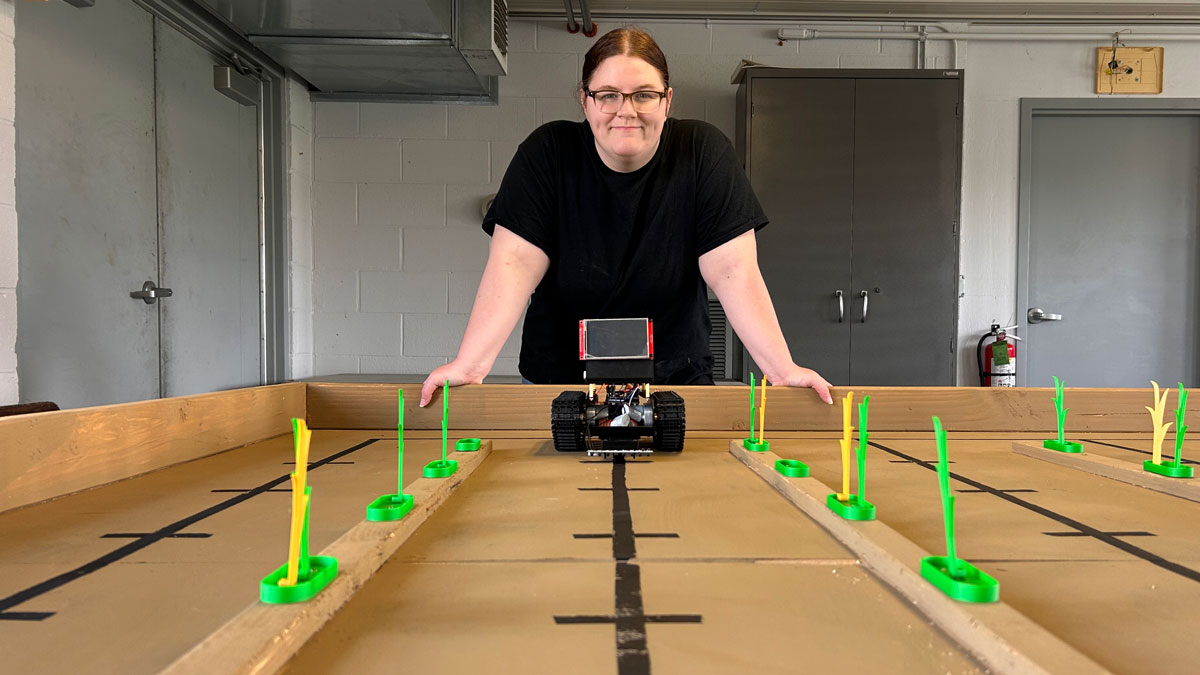
Joy Howard, president of the Agricultural Robotics Club, helped design and program a robot that can navigate simulated corn crops and identify double stalks, an issue that needs attention from farmers. The club will compete in the upcoming American Society of Agricultural and Biological Engineers’ Robotics Student Design Competition. (Photo by Brooke Keltner).
June 29, 2026
SIU students competing in international agricultural robotics competition
CARBONDALE, Ill. — The old agricultural adage goes, “knee-high by the 4th of July.” It’s a visual cue indicating whether farmers will have a bountiful harvest in the fall based on the height of their corn stalks.
This July, members of Southern Illinois University Carbondale’s Agricultural Robotics Club are focused on corn stalks that are planted too close to each other. Another big difference – the corn stalks are a few inches tall and 3D-printed.
The club will be competing in the American Society of Agricultural and Biological Engineers’ Robotics Student Design Competition held in Indianapolis, Indiana, July 12-15.
The competition
The competition challenges undergraduate and graduate students from universities around the world to build a robot that can complete a simulated agricultural task. This year, the robot must travel through a miniature corn field and correctly identify when there is a single corn stalk, a double corn stalk, or no corn stalk at all.
“When you’re really planting crops, you want the corn stalks to be spaced from each other,” said Joy Howard, who’s pursuing a bachelor’s degree in microbiology and minor in agronomy. “This way the corn stalks are not competing for resources. If corn is planted too close to each other, farmers get rid of the weaker stalk and keep the stronger one.”
In the simulation, when there are double corn stalks, the weaker stalk is yellow, and the stronger stalk is green. This means their robot needs to have the ability to navigate the corn field rows, count the corn stalks, and determine if the corn stalk is weak or strong based off its color — removing individual stalks when necessary for the overall health of the simulated field.
In the advanced competition, participants must go a step further and have their robots plant a corn seed when no corn stalk is detected.
Sprouting ideas
Howard and Nathan Wellendorf began conceptualizing this robot in March, making decisions about design and coding.
“For the chassis, we decided on a tank-style rather than wheels because it will be easier for the robot to turn,” Howard said. “We knew that the robot needs to navigate the corn field, so we needed infrared sensors, which follow lines.”
Next, the team began ordering robot parts, 3D-designing and printing their own parts, as well as creating computer code and simple AI models.
“Neither Nathan nor I have much experience in robotics, so it’s been a lot of trial and error,” said Howard, who is president of the Agricultural Robotics Club, which is in the process of becoming a Registered Student Organization.
A trial-and-error situation took place when the duo began testing the robot on their mock competition board. As they practiced, one of the drivers that controls a motor could not handle the amount of electricity needed to operate for long periods of time.
“The driver was smoking pretty bad,” Howard said. “We had to get a new driver that could handle the voltage that we were giving it. It was a challenge we had to figure out.”
Cultivating Guidance
Howard and Wellendorf leaned on Billy Ram for advice throughout the robot building process. Ram is a new assistant professor in the School of Agricultural Sciences and started the Agricultural Robotics Club after joining SIU in the fall and realizing the need for one.
“My advising style is introducing Joy and Nathan to the tools they need and letting them solve the problems on their own,” he said. “If you give them a good direction, they can learn. They can come up with the right methods to solve their problems.”
Ram’s classes focus on precision agriculture, or farming that uses GPS, AI and robotics to collect data and make data-driven farming decisions. He emphasizes the importance for agriculture students to have an interest in both mechanics and AI as farming equipment becomes more technologically advanced.
For example, John Deere now sells a sprayer with 36 cameras that can detect whether a plant is a crop or weed in real time. The machine only sprays weeds with herbicide and determines the amount of spray needed to kill it, minimizing the use of chemicals. The company is pushing the envelope even further and has customers testing fully-autonomous tractors that can be monitored and controlled from a smartphone or tablet.
“Many students have seen their parents and grandparents using mechanical tractors and they know how to fix them if there’s an issue,” Ram said. “But the new tractors and machinery coming out are highly intelligent with multiple sensors and cameras. To be workforce ready, students need to be skilled in mechanics, AI and robotics.”
On top of offering guidance on building and programming the robot, Ram offered advice about the competition itself as he once participated as a student, and this will be his first year as mentor.
Reaping the benefits of hard work
If all goes to plan on competition day, Howard and Wellendorf’s robot will navigate up and down the simulated corn field rows. The camera attached to it will detect the corn stalk count and send a signal to a screen, which will flash the color of the corn stalk. If the robot detects a yellow stalk, it will trigger a spinning motor to “cut” the extra corn stalk, which is magnetically connected to its 3D-printed stand.
While Howard and Wellendorf carry out some final tasks to complete the robot, the team looks forward to the competition and hopes to return next year with new club members.
“I’m nervous and excited at the same time,” Howard added. “Even though we’re a small team and new to the competition, I think we will hold our own against the other universities and come back next year even stronger.”