
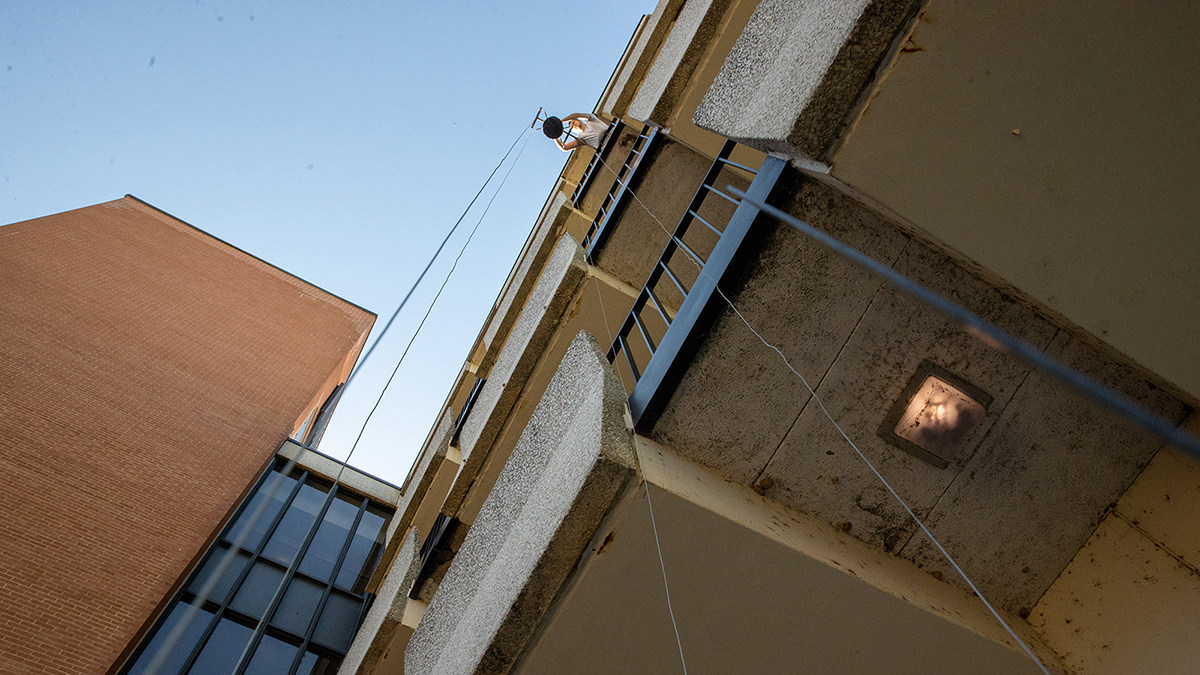
Brady Villiger releases a dummy drone equipped with an airbag system he designed, guiding it down wires from a fourth-floor balcony (top). As a graduate student in SIU’s School of Mechanical, Aerospace, and Materials Engineering, Villiger built and tested the system to help protect people below if a drone fails in flight. (Photos by Russell Bailey; video by Todd Duermyer, University Communications and Marketing)
June 17, 2026
Safer skies: SIU master’s student designs drone airbag to protect people below
CARBONDALE, Ill. — When Brady Villiger's experimental drone plunged toward a concrete testing platform on the Southern Illinois University Carbondale campus during a recent drop test, nearly a year of research and design was on the line. In the split second before impact, a compact airbag autonomously deployed beneath the dummy aircraft, cushioning the fall and proving the concept worked.
That successful test gave Villiger, a master’s student in the School of Mechanical, Aerospace, and Materials Engineering, the validation he needed for his novel invention: a self-deploying airbag powered by a chemical reaction. The research was conducted in SIU's Aerospace Controls Research Lab (ACRL), directed by Villiger's mentor and co-author, Assistant Professor Hossein Eslamiat. This study was published March 12 in Drones, an international, peer-reviewed, open-access journal focused on unmanned aerial vehicle design and applications.
Tests showed the system reduced impact force by about 66% and inflated in as little as 0.033 seconds. According to the researchers, that lowered the impact below the range associated with skull-fracture risk — an important advance as drones have evolved from a niche hobby and specialized military tool into a mainstream, multibillion-dollar global industry.
Drones are now used for everything from aerial photography and infrastructure inspection to farming, emergency response and military surveillance. As their civilian use expands, so does concern about what happens when one fails in midair. The researchers say improved safety systems could reduce the risk of injury to people below, protect property, extend the life of drones and payloads, strengthen public confidence in drone operations and, over time, support wider commercial use as regulators consider more flights over people and in urban environments.
“Brady has been working on a very special project,” said Eslamiat, whose own research focuses on the safety and stability of small unmanned aerial systems for civilian use. “It is a chemical-reaction airbag for drones that, to the best of our knowledge, is the first of its kind. His recent drop test was a complete success, after so many iterations, and gave him the data he needed. He has been working on this tirelessly and learned a lot during this interesting research process.”
From the drawing board to the drop test
What sets Villiger’s design apart is not just the airbag itself, but how it inflates. Earlier drone-airbag concepts generally relied on compressed-gas canisters. The SIU design uses a chemical reaction, allowing faster deployment while reducing the bulk of pressurized systems. The paper identifies that speed as a key advantage, especially in low-altitude failures, when a drone may have only moments before impact.
The concept grew out of Villiger’s interest in aviation, robotics and safety systems. As a student at Mountain Home High School in Arkansas, he competed on the school’s Hall of Fame FIRST Robotics team, Team 16 Bomb Squad. Later, his work as a U.S. Air Force aircraft mechanic deepened his interest in aviation hardware and safety. He earned his bachelor’s degree from SIU in 2023 and began shaping the airbag concept as part of his master’s thesis work in 2024.
When he began full design work in January 2025, Villiger quickly ran into the central engineering problem: how to generate inflation gas fast enough to protect a falling drone without adding too much volume and weight to the drone. His first approach used explosives to manufacture a detonator, but the method fell short. According to the paper, the explosive compounds did not produce enough gas to fully inflate the airbag, and even controlled blasts repeatedly damaged the bag itself.
“This proved to be much more hassle than it was worth and took many hours before I made the switch to use black powder charges instead,” Villiger said.
That switch resolved the gas problem but created another. Black powder burned hot enough to generate the required volume, but at temperatures far above what the airbag's Nylon 6 fabric could safely tolerate. Villiger solved this by containing the reaction in a sealed chamber and using heat-reducing and protective materials to keep deployment fast without destroying the bag in the process.
The system also had to know when to fire. Using onboard sensors, the final design detects both freefall and altitude change, deploying only when both conditions confirm the drone is truly in trouble — not simply descending normally. In testing, that gave the system about 1.56 seconds to detect the fall and fully inflate before impact.
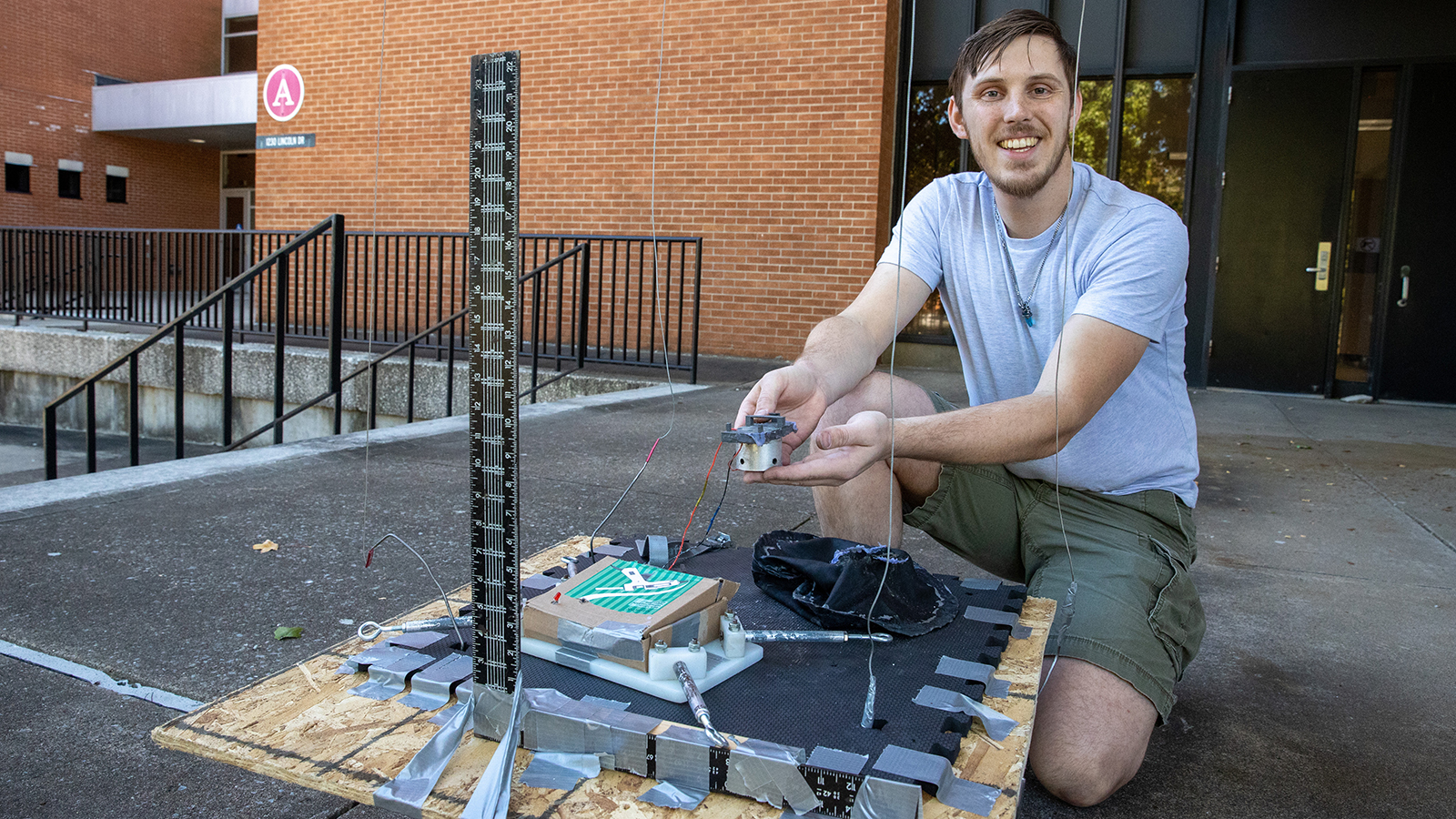 Villiger also refined the airbag’s shape and structure, ultimately choosing a 12-inch, disc-shaped design that covered the underside of the drone while using less gas and material than earlier versions. A two-part mounting system allows it to be attached to existing drones without redesigning the
“This was not an easy project,” Eslamiat said. "Designing a lightweight, chemical-reaction airbag that deploys quickly and survives repeated tests takes a lot of creativity and patience. Brady showed both. He pushed through setbacks, refined the design, and in the end, we saw a system that really works."
All testing took place on SIU’s campus, where Villiger conducted controlled drop tests using a dummy drone so no valuable equipment would be damaged. He gathered detailed measurements of acceleration, rebound height, and calculated impact force in both protected and unprotected drops, then compared the results. The data showed that the airbag significantly softened impacts and reduced the forces transmitted to both the drone and the surface below.
Ready for what’s next
Villiger credits SIU’s resources with making his research possible. “Dr. Eslamiat has been a massive help to me throughout this project,” he said. “He kept me motivated and in high spirits when I hit a wall in my research. I could not have gotten this far without him.”
The university provided the lab space, equipment, and testing facilities in the ACRL needed to design and refine the system — from electronics and data-acquisition tools to safe drop-test setups. The project also reflects the kind of work students can do in SIU's MAME graduate program, where master's and PhD students take on real-world problems no one has solved yet.
“Beyond the technical achievement, this project highlights capabilities of SIU, our college, and our school,” Eslamiat said. “Brady’s work shows the kind of hands-on, forward-looking research our graduate students can do here. Chemical-reaction airbags for drones may seem like a niche topic, but they speak directly to how we make future airspace safer. That’s the kind of impact we want SIU engineering to have."
Looking ahead, Villiger sees enormous potential for his design. “Ideally, mass drone delivery could be an option with a safety system like this — or multiple safety systems in place — that allows companies to fly UAVs in urban areas without risk of fatality or major injury.” His design is intentionally adaptable so it can be integrated with a wide range of UAVs.
After earning a Master of Science degree this spring and preparing to transition from the Air Force Reserve to active duty, Villiger reflected on his SIU journey and the lasting impact he hopes his drone research will have.
“It has been a long path to get here,” Villiger reflected. “But seeing the system work and knowing it could help make drone operations safer has made every challenge worth it.”