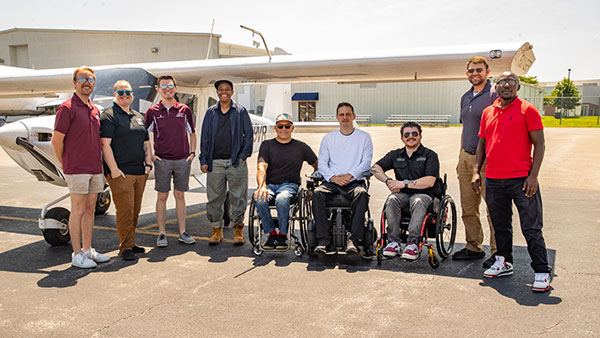
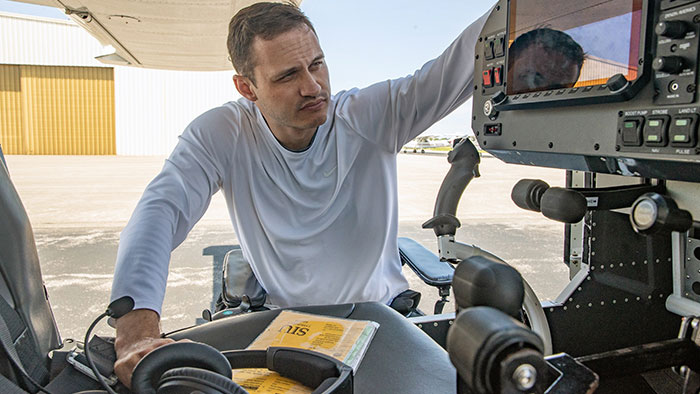
(Above) Able Flight student Austin Trzop looks into the cockpit of one of the Vashon Ranger Light Sport airplanes used in training students with physical disabilities to become licensed pilots. (Bottom photo) The third SIU Aviation Able Flight class is (from left) SIU Aviation’s Keith Glass, Victoria Mathieu and Luke Trout, and students Aeri Wheeler, Ryan Baker, Austin Trzop, Ethan March, Methode Nezerwa and Jeffrey Garrett. (Photos by Russell Bailey)
June 15, 2026
Clear skies: Able Flight, SIU Aviation offers a flight plan for student pilots with disabilities
CARBONDALE, Ill. — With plans to one day fly a helicopter as a search-and-rescue pilot, Ethan March believed that goal might be shattered when he fractured his spine after falling from a roof while installing solar panels — an accident that left him paraplegic.
But March, who is one of six students in Southern Illinois University Carbondale’s 2026 Able Flight cohort, said the opportunity to one day realize his dream of flying remains “in the front of my mind.”
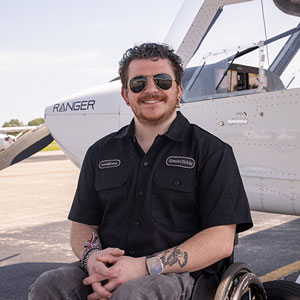 “This program is a very good service to people with disabilities in allowing them to accomplish something that most of them, myself included, never thought would be possible due to their disability,” said March, who is from Portland, Maine.
Able Flight is a national incorporated nonprofit program for people with disabilities to become licensed pilots certified to operate light sport aircraft. Students receive scholarships through Able Flight and have been staying in university housing since late May.
“What they are doing is really amazing,” said March, adding that he would like to see the program one day expand to include helicopter training. “A lot of people don’t realize how disheartening it is to lose so much independence, so much ability. There are a lot of things you begin to think about in a different way — but the ability to fly with Able Flight flips the whole thing on its head.”
Media availability
Reporters, photographers and camera crews interested in interviewing SIU Aviation training staff and Able Flight students should contact Victoria Mathieu, associate instructor, SIU Aviation, at 618-453-9238 or victoria.mathieu@siu.edu to make arrangements.
Program’s 20th anniversary
The training can take up to eight weeks. For March’s cohort, including Ryan Baker, Jeffrey Garrett, Methode Nezerwa, Austin Trzop and Aerin Wheeler, the session is expected to conclude in late June or early July, depending on weather.
The students complete the program by taking check rides and in late July, they will receive their pilots wings at EAA AirVenture Oshkosh in Wisconsin.
This is SIU Aviation’s third year with the program, which will soon be renamed Able Flight at SIU. A $2 million campaign is underway to create the Charles H. Stites Able Flight at SIU Endowment Fund to provide permanent support for scholarships, adaptive flight training and program operations. Stites, who founded Able Flight in 2006, formally transferred ownership of two specially adapted Vashon Ranger Light Sport airplanes to the university, along with donating funds for program expenses at SIU for a minimum of seven years. The program had 103 people earn pilot certificates prior to this year.
Tight-knit group
“Everybody is encouraging and we are working together as a team and studying together,” Trzop, of Cleveland, Ohio, said. Baker has drawn up posterboards of the flight panel for the group and Garrett, who earned his private pilot’s certificate more than 20 years ago prior to his injury, “is a great source of knowledge.” The six students are each deciding on a pilot call sign, or nickname.
A former athlete who is a member of the Ohio Buckeye Blitz wheelchair Rugby team, Trzop’s activities last summer included skydiving, kayaking, arm cycling and flying in a Cessna 172. That flight prompted Trzop, who was injured in a diving accident, to believe he could achieve getting a pilot’s certificate.
Trzop is pursuing a mechanical engineering degree at the University of Akron and possibly a career in aviation engineering.
“I would like to work my way into aviation, especially after getting here and working and flying,” he said. “I’m really enjoying this.”
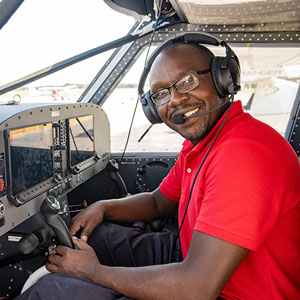 For Methode Nezerwa, earning a sport pilot certificate would be an initial step toward his goal of becoming an emergency medical services pilot. Being able to fly as another example of independence and facing challenges, he said.
“This will make me more independent,” said Nezerwa, who lost a leg as a child from the civil war in Rwanda. Now a U.S. citizen, Nezerwa, who has a background as a pharmacy technician, lives in Aurora, Colorado. He earned a Master of Science in Clinical Pharmacy degree from the University of Colorado two years ago.
He credits the program’s resources, organizational structure and instructors with helping him. He admitted takeoff on his first flight left him a bit scared, but Nezerwa said he was much more comfortable with his second flight. And he’s looking forward to his “next step” in program and getting a private pilot’s license.
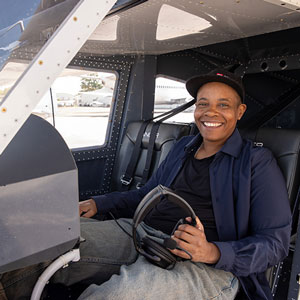 Aerin Wheeler, who is from Los Angeles, was an athlete and overachiever in school, and she sees the Able Flight program as another way to challenge herself and regain confidence. Inspired by her own experiences in accessing health care, Wheeler studied public health and health care finance in college, and began a non-profit organization aimed to help minimize barriers for people living in inner cities.
“I’m learning a lot. It’s definitely a challenge especially during this accelerated program but it is an amazing gift,” she said. “I’m cultivating more self-awareness and I feel like there are translatable skills that I’m acquiring just within the first few hours that I think I will be able to take with me outside of aviation.”
Piloting her first takeoff was “really, really scary at first,” but Wheeler credits SIU’s certified flight instructors, along with preflight and understanding how the plane works in making her feel more comfortable. She always had an interest in aviation with a grandfather who was an aeronautical engineer for NASA and the Federal Aviation Administration.
“I’m really grateful for the program and grateful for the opportunity to challenge myself in this way,” she said.
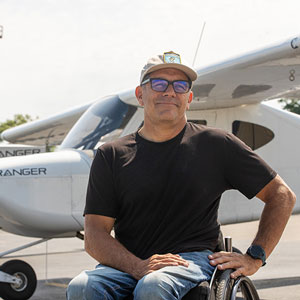 For Ryan Baker, the feeling and perspective of the airplane leaving the runway during his first flight was a thrill.
“We were not going exceedingly fast, but the speed is irrelevant,” said Baker, who is from San Diego. “It’s about the perspective of being at that altitude.”
Paralyzed the day after his high school graduation in a car accident, Baker said he didn’t believe he could pursue aviation after his injury. He learned of Able Flight several years ago, but couldn’t pursue his dream at that point because of the time commitment the program requires.
“It’s an investment on our part as well to be here and to commit and to be away from friends and family and away from work for a little bit to chase this dream of flying,” Baker said. “You cannot come here and then decide that ‘oh, I have to go to my best friend’s wedding for a week’.”
Baker said he wouldn’t miss this opportunity. Each step “is a new and exciting adventure and an opportunity to learn something different,” he said.
Garrett is training to become the program’s first student to become a light sport pilot certified flight instructor (CFI). He earned his private pilot’s certificate while a high school sophomore more than 20 years ago. He was a cadet at the U.S. Air Force Academy when a rock climbing accident left him with multiple injuries. He returned home to Tennessee and earned bachelor’s and master’s degrees in mathematics and teaching education, respectively, and worked as a high school math teacher, assistant principal and even bus driver.
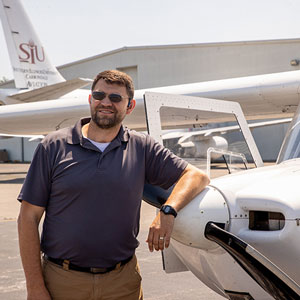 Garrett began teaching aviation classes to students at Cleveland High School in Cleveland, Tennessee, in 2023. His students utilize flight simulators, but they cannot earn up to 2.5 hours in their logbooks since Garrett isn’t a flight instructor.
Able Flight allows people with disabilities “the opportunity to move forward with aviation,” said Garrett, who has partial left leg paralysis and shortened left arm.
Now sitting in the plane’s right seat for this course, Garrett admits that the perspective provides a “completely different feel.”
Earning a light sport CFI will give Garrett “a better understanding of the regulations and the endorsements, and I will be able to take students up in an actual aircraft rather using the simulators,” he said.
A ‘passion project’
Victoria Mathieu, associate flight instructor with SIU, has worked with all three cohorts of Able Flight students since it came to SIU in 2024. A project like this “opens up the sky for people who might not have had opportunities to fly,”,” she said. “I love flying, ever since my first one. I couldn’t imagine not flying.”
Mathieu said Able Flight has “kind of become my passion project,” she said, noting Stites’ upcoming retirement and SIU Aviation taking over the program.
“It’s a lot of responsibility and there are big shoes to fill with Charles stepping down,” she said. “I’m happy to take it on. It’s a great program.”
(Editor’s note: Nezerwa is pronounced Nez-er-Rwa.)