
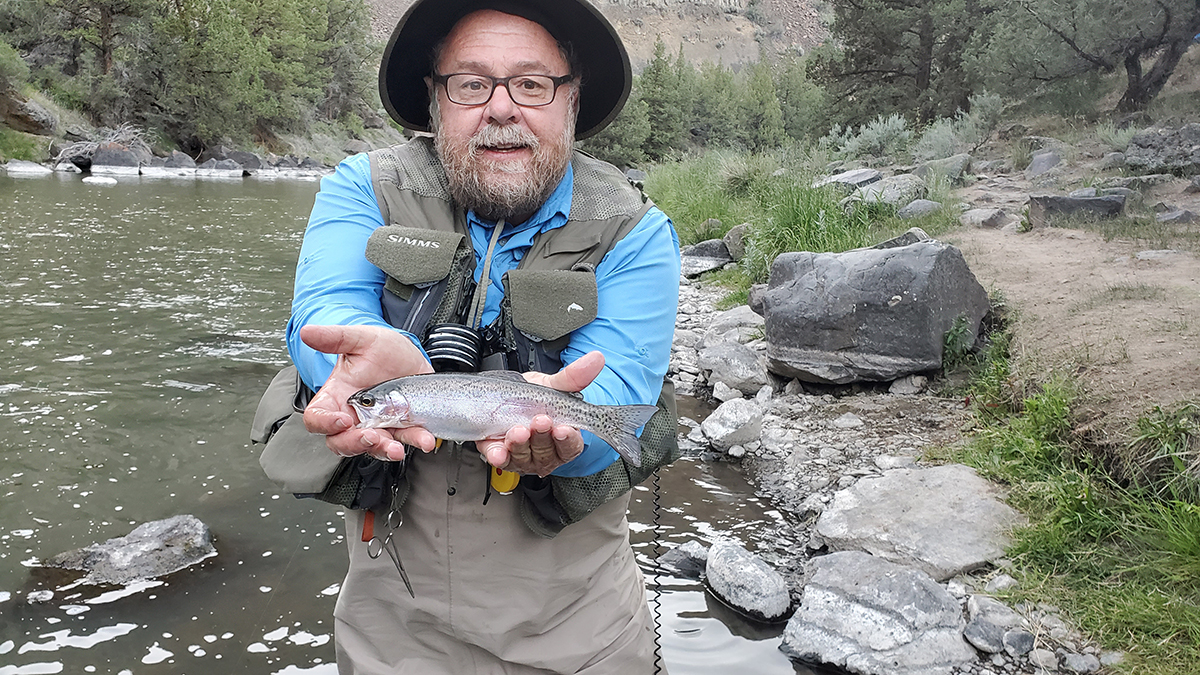
Ed Heist, associate director of the Fisheries and Illinois Aquaculture Center at Southern Illinois University Carbondale, clipped the tail fins of rainbow trout in the Missouri Trout Slams. He and Amy Buhman (below), a master’s student in SIU’s zoology program, conducted DNA testing to trace the lineage of these fish. (Top main photo provided by Ed Heist, and bottom photo taken by Brooke Keltner).
June 11, 2026
SIU professor debunks legend surrounding redband trout
CARBONDALE, Ill. — There’s a legend in the Missouri Ozarks that a train from the Wild West carrying the now rare McCloud River redband trout derailed. To save the fish, the railroad workers released them into the nearby rivers. These fish were supposedly the ancestors of today’s rainbow trout.
Now nearly 150 years later, researchers at Southern Illinois University Carbondale are debunking that myth.
Ed Heist, associate director of the Center for Fisheries, Aquaculture, and Aquatic Sciences, found rainbow trout in Missouri are descendants of coastal rainbow trout and steelhead trout from the Sacramento River drainage in California – not the redband trout.
Origins of the myth
It’s easy to understand how this myth became widely recognized as fact. There’s some truth to it. Heist says in the 1880s, fish culture facilities in California like Baird Station began fertilizing fish eggs and sending them to the Midwest and East Coast. The hatched fish were released to populate rivers for civilians to catch and eat.
“Rainbow trout are native to the West Coast of the United States, Canada, and Russia,” Heist said. “There are no trout that are native to Missouri.”
But you’ll find plenty of rainbow trout in the spring-fed creeks in Missouri near limestone caves, which cool the water to a preferred 56 degrees. So, if they aren’t descended from the train-derailed redbands, just where did these trout come from?
Solving the mystery surrounding the origin story of these fish became a passion project for Heist, who is also an avid fly fisherman.
Tackling Research
In 2021, Heist and a group of volunteer anglers began fly fishing in the nine streams that make up the “Missouri Trout Slam,” where special regulations protect the wild rainbow trout. The team also fished in one additional stream that contains wild trout but has no public access. Together, they would catch rainbow trout, clip a small piece of their tail fin – which grows back – and release the healthy fish back into the streams.
Heist says that wild rainbow trout are very wary to avoid predators. In comparison, recently stocked trout in parks where fishermen buy a daily permit to harvest have not developed these survival skills and behave very differently. These hatchery-raised fish are familiar with human contact and often believe fishermen are their caretakers ready to feed them.
“These trout are wild animals with wild instincts,” he said about the difficulty of catching wild trout. “You’re trying to fool this fish into believing that this fly you’ve tied is a real live insect, and you have to present it to the fish like it’s real.”
This creates a challenge even for fishermen who have spent countless hours wading and casting in the waters. Heist and the volunteers clipped anywhere between two and 50 fish from each stream. The Missouri Department of Conservation also contributed. The agency clipped fins as they surveyed streams and sent the samples to Heist. In addition, the team clipped fins from four Missouri hatchery strains as well.
Genetic testing
All samples were brought to SIU, where Amy Buhman, a staff researcher and master’s student in SIU’s zoology program, helped with lab work. The first step was isolating the DNA.
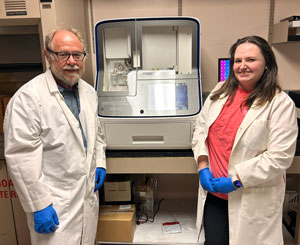 “We take the tissue (clipped fins) and we digest it down,” said Buhman of Murphysboro, Illinois. “Essentially, we clean the tissue down to just the DNA.”
Once the DNA is isolated, researchers first analyze highly variable DNA sequences called microsatellites.
“It’s like a fingerprint,” said Buhman, who also earned her bachelor’s degree in zoology at SIU. “Every trout is different. We can identify parents and offspring and use this process as paternity testing.”
It’s so precise that Heist and Buhman can identify which of the 10 streams an individual fish is from. Over time, each population of rainbow trout adapted to their river’s specific conditions.
“For example, in a larger stream, it’s better for the trout to grow a bit larger before the fish reproduces and it will have a larger reproductive output,” said Heist. “Then in the smaller stream, the fish tend to mature at a smaller size and reproduce more quickly.”
Casting for collaboration
The team then reached out to two researchers – Mac Campbell, who published a paper describing McCloud River redband trout as a distinct subspecies, and Jeff Rodzen, a former biologist for the California Department of Fish and Wildlife. Campbell and Rodzen previously collected DNA samples from a broad range of trout in California, including golden trout, redband trout, coastal rainbow, and coastal cutthroat trout. These colleagues analyzed hundreds of more conservative markers called Single Nucleotide Polymorphisms (SNPs) or “snips.” The SNPs signaled deeper insight into the evolutionary history of these various trout species, identifying the subspecies and geographic origin of the Missouri trout relative to their Californian ancestors.
Reeling in surprises
Heist and Buhman found rainbow trout in Missouri share DNA characteristics with coastal rainbow trout from the Sacramento River drainage in California. The big surprise though? The researchers discovered regions of inverted chromosomes only found in steelhead trout.
Heist explains that steelhead trout and rainbow trout are the same species with different life histories. Rainbow trout live safer, freshwater lives. Steelhead trout, though, live riskier lives by traveling to the ocean for food and then swimming back upstream to reproduce, battling waterfalls and other obstacles on the way.
“Scientists have been looking for a genetic switch or difference between steelhead and rainbow trout for a long time,” Heist said. “It’s a very, very subtle difference in a couple of regions of chromosomes that get inverted, where steelhead are more likely to have this inversion.”
Historical reality
Heist says, from 1880 to 1887, rainbow trout eggs were shipped from Baird Station to the newly established Brown’s Spring Fish Hatchery near St. Joseph, Missouri. The fish were raised and then stocked in rivers throughout the state.
“The legends are more romantic than the reality,” Heist said. “The myths are out there, and they are completely wrong. This has led to fishermen believing they’re catching a McCloud River redband trout, but it’s simply not the case.”
Heist and Buhman have published their findings in “Origins and Population Genetics of Self-Sustaining Rainbow Trout in Missouri” in the Transactions of the American Fisheries Society.
The team shared these findings with the Missouri Department of Conservation and recommends the agency not stock these streams with hatchery-raised fish as current rainbow trout continue to adapt to their river conditions.
“I’m hoping this research will be helpful for conservation efforts in the future to keep these populations going,” Buhman added. “When you put hatchery fish into streams, you can drive down the fitness of these locally adapted fish.”