
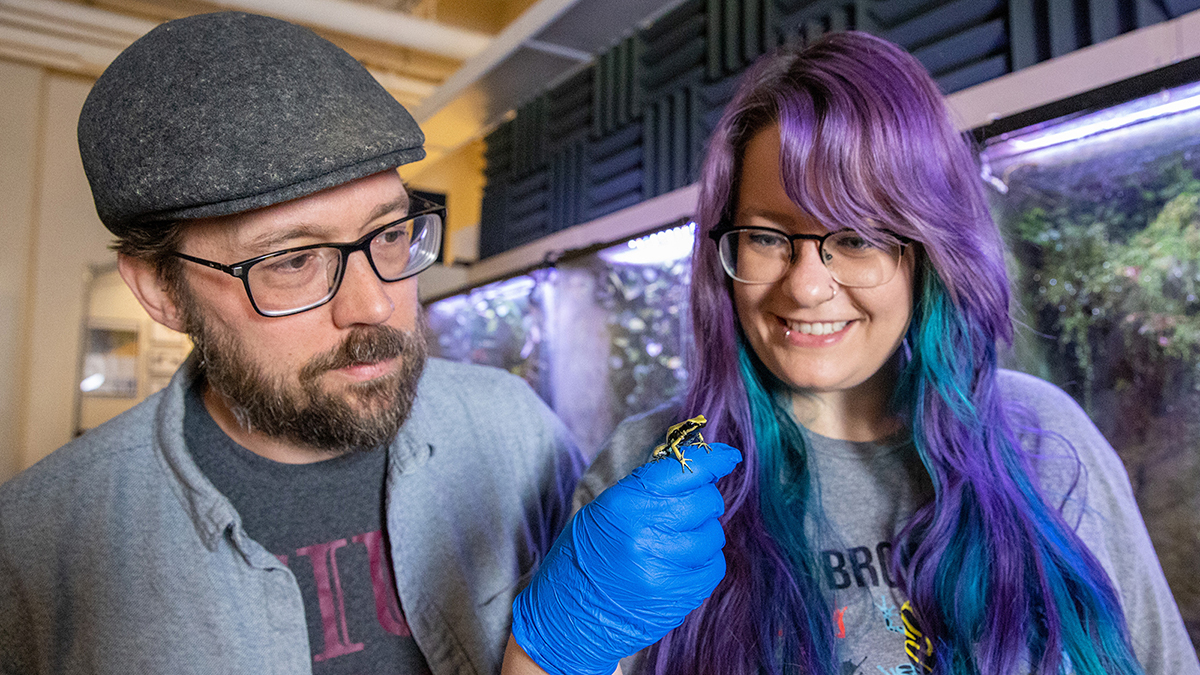
Jason Brown, associate professor in SIU Carbondale’s School of Biological Sciences, (left) helped describe three new species of poison frogs from the Amazon rainforest this year, including the Inti Poison frog held by recent doctoral graduate BreAnn Geralds (right). The other two species are the elusive Yaminawá Poison Frog (middle) and the Taboca Poison Frog (bottom) now known for its distinct black band around its throat. (Top main photo by Russell Bailey, University Communications and Marketing; middle photo by Rudolf von May, and bottom photo by Paulo Melo Sampaio.)
June 02, 2026
SIU Carbondale researchers name three new species of poison dart frogs
CARBONDALE, Ill. – Traveling deep into the South American rainforest where sunlight is blocked by a canopy of treetops, medical crews are days away and reached by a satellite signal, and the occasional jaguar paw print is a reminder that danger is lurking in the shadows.
This is just a glimpse of the journeys that Southern Illinois University Carbondale researchers embarked on, which led to describing three new species of poison dart frogs from the Amazon rainforests of Peru and Brazil this year.
Leading this research is Jason Brown, an associate professor in the School of Biological Sciences, whose passion for poison frogs has metamorphosed into a career spanning 23 years and counting.
“As a teenager, I kept several species of poison frogs as pets,” Brown said. “I became obsessed with creating naturalistic terrariums that were tiny replicas of the rainforest.”
Jumping into reality
Trips to the rainforest turned from a boyhood daydream to reality. Brown made these visits to track down poison dart frogs in their natural habitats and collect data for analysis such as genetic samples, measurements, photographs, as well as noting color markings, and behavioral tendencies. Other observations included where in the forest these frogs live, how many eggs females lay, and if males or females take on any parental roles caring for their tadpoles.
Throughout the years, several SIU students have joined Brown on these treks, including recent SIU graduate BreAnn Geralds, who is listed as an author on two of the three recently published journal articles describing the three new species of poison dart frogs:
- Ranitomeya ichapama (common name: Yaminawá Poison Frog)
- Ameerega kuriiniti (common name: Inti Poison Frog)
- Ranitomeya hwata (common name: Taboca Poison Frog)
The publications of these species descriptions in scientific journals are a key step to recognizing them as a new species to science and is required by the International Commission on Zoological Nomenclature, which is the group who oversees the naming of animals.
Yaminawá Poison Frog
Brown describes this small frog as “incredibly rare.” Despite knowing about its existence for more than 20 years, the frog’s elusive nature made it difficult to study and collect enough genetic data to determine whether it belonged to its own species or not.
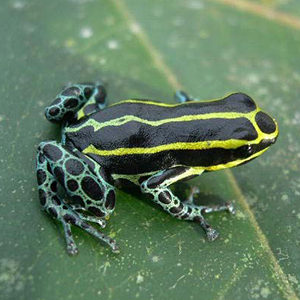 In fact, scientists have only collected six of these frogs while doing biodiversity surveys in their habitat, the lowland forests in western Brazil and southeastern Peru. Brown borrowed three of these specimens from museums – one of the only ways to learn more about the frog.
“When samples are difficult to obtain, it can be hard to determine if something is a new species or a strange morph of something we already know,” Brown said. “When they are super rare like this frog, it takes decades to collect enough data to make this determination.”
After years of research, Brown and Geralds discovered its genetics and so-called “DNA fingerprint” are unique allowing them to describe this frog as its own species. Visible characteristics that set the frog apart are its bright yellow color pattern.
“It has a thin yellow stripe down the middle of its back and at the tip of this frog’s nose – the yellow stripe splits and makes an oval on the frog’s snout,” Brown said. “No other frog in this group consistently has this feature.”
The scientific name, Ranitomeya ichapama, and the common name, Yaminawá, honor the indigenous Yaminawá people who live in the area where the frog is found. In their native language “ichapama” means “rare” or “few.”
Inti Poison Frog
For the past 50 years, this frog had a case of mistaken identity. Scientists considered it a morph of Ameerega bassleri, another poison frog species. Even pet stores in North America, Europe and Japan labeled and sold the frog under that species name.
Now, with Brown and Geralds’ help, the frog species is receiving its own name and identity. This amphibian is a medium-large frog with golden coloration, has its own lineage dating back millions of years, and distinct acoustics.
“Inti Poison Frogs have a call sound that is statistically unique,” said Geralds, who earned her doctorate in zoology this May. “We can see differences in the notes and frequencies. This is important because only males make these calls for mating.”
The frog’s yellow-golden back also stood out and sparked the idea behind its scientific name, Ameerega kuriiniti, recognizing the Kichwa-Lamista indigenous people. Kuriinti is derived from two Kichwa words, “kuri” which means “golden” and “inti” meaning “sun.”
The common name, Inti Poison Frog, is also a nod to the Kichwa-Lamista and their language. Here, the ‘inti’ or sun refers to the species’ call or song, which is performed most intensely during twilight hours when the sun rises and in the evening when the sun sets.
“I hope that the decision to name these frogs using the Kichwa language reflects the utmost respect,” said Geralds, who also received her bachelor’s degree from SIU. “We get to pay homage to the people, land, and these beautiful frogs.”
Taboca Poison Frog
While the other two poison frogs’ bright coloring contributed to their being described as their own species, this frog sports a distinct black band on its throat as a defining feature. Brown notes the frog also has its own unique DNA fingerprint shared only by this species.
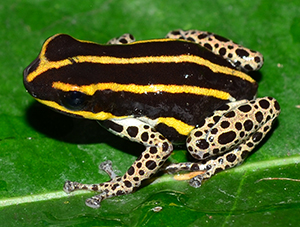 “Like the Yaminawá and Inti poison frogs, from a genetic perspective, this frog has been genetically unique for millions of years,” Brown said. “
Another aspect that sets this species apart is its mating practices. This frog likes to find refuge in Guadua bamboo, which is used for its reproduction. Unlike close relatives, which are monogamous, the Taboca male frog appears to prefer multiple females per breeding site.
In keeping with highlighting the indigenous people of the Amazon rainforests, this species’ scientific name, Ranitomeya hwata, is also derived from a native language. This time, it honors the Manxineru people, who use the word “hwata” as a generic term for bamboo.
Meanwhile, the common name, Taboca poison frog, uses the Portuguese word “taboca,” a term referencing the specific type of spiny bamboo where these frogs tend to dwell.
A major leap
Both Brown and Geralds agree that describing and naming these three new poison frog species is a major leap in unlocking more knowledge about biodiversity in the Amazonian rainforests and supports the need to protect the animal kingdom and environment from deforestation.
“How do we know what we’re losing, if we don’t know what’s there?” Geralds asked. “How do we know what’s at risk? We must continue doing this type of research to truly grasp what the rainforest offers, and poison frogs play a small but vital role.”
But the work is far from done. What’s the population of the elusive Yaminawá Poison Frog? How many species of frogs in the Amazon rainforest have yet to be found? How many species are currently being misclassified?
“We need to continue doing this research to not only define and describe these new species but also discover their potential value to society like for medicinal uses.”