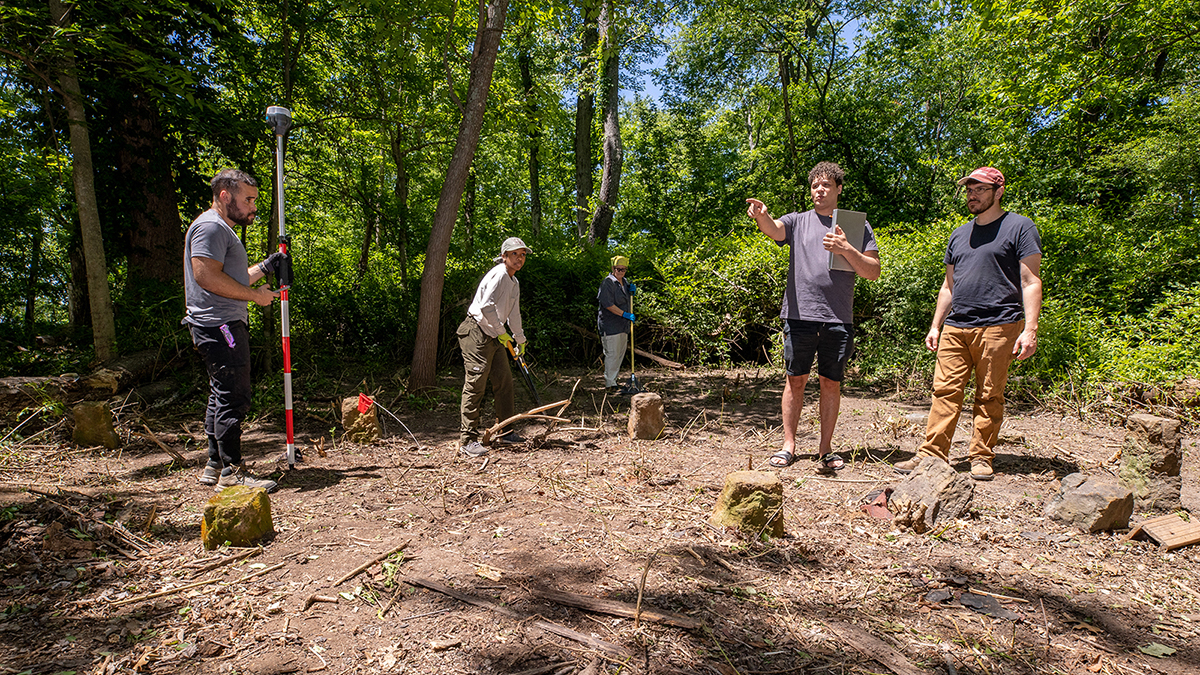
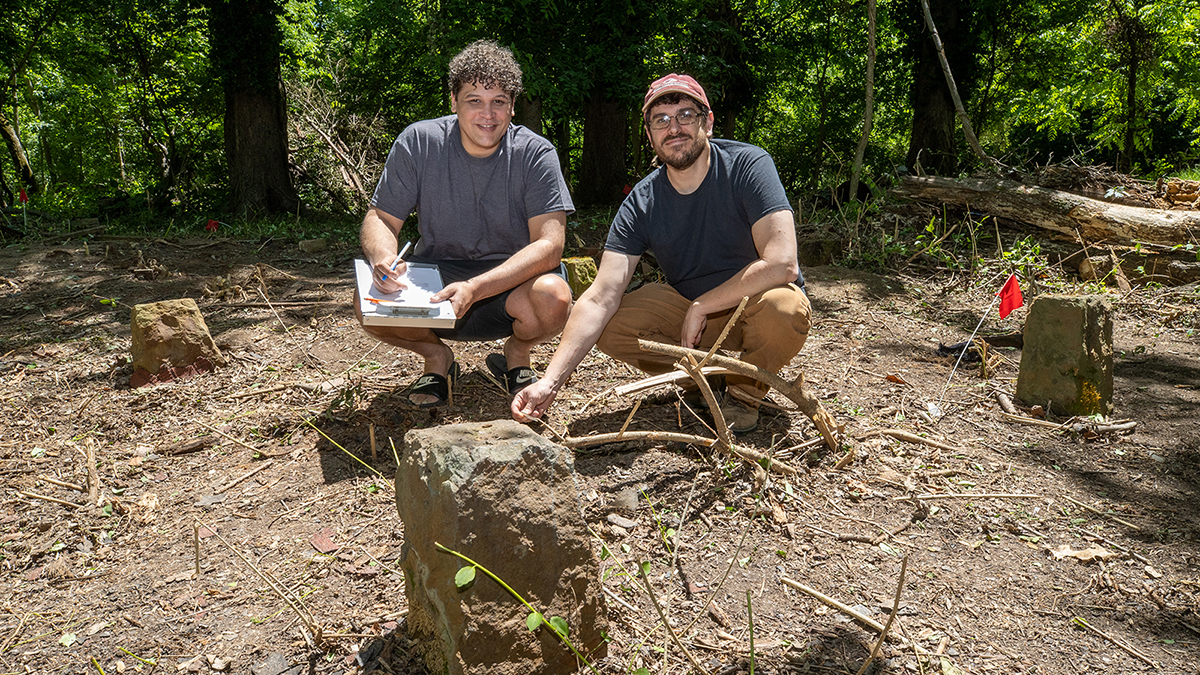
Brendan Jennings (left) and Matthew Greer, an assistant professor in SIU Carbondale’s anthropology program (top photo) are with sandstone foundation stones on Jenning’s property in the unincorporated Lakeview community at what is believed to be the oldest continually inhabited Black community in Illinois. SIU’s 2026 Archaeology Field School, which includes from left, Paulo Mendes Da Cunha, Ariel Creal, and Brenda Smith are investigating the farmstead that belonged to Jenning’s ancestors dating back to the 1840s. (Photos by Russell Bailey)
May 19, 2026
SIU’s Archaeology Field School seeks insight into one of Illinois’ earliest Black communities
CARBONDALE, Ill. — A Southern Illinois University Carbondale student archaeology team is spending six weeks unearthing history to help tell the story of what is believed to be the oldest continually inhabited Black community in Illinois.
For Brendan Jennings, it’s an “incredible opportunity” not only for descendants of the unincorporated Lakeview community in Saline County, but also to bring to light Southern Illinois’ history literally on his property.
“So much of this community’s story has been preserved through oral history and family memories,” said Jennings, whose property is part of the initial phase of a project this is examining a farmstead dating back to the early 1800s. “Having SIU conduct archaeological research gives us the opportunity to uncover and document pieces of history that may otherwise be lost forever. It also helps bring attention to the importance of preserving historically significant Black communities. We consider this a great leap forward for us.”
Ten students in SIU Carbondale’s Archaeology Field School have been at the location since May 18. The field school will run through June 26, said Matthew C. Greer, an assistant professor in anthropology. The field school will share initial findings with Lakeview descendants and the public during Lakeview’s annual homecoming celebration at 2 p.m. Saturday, May 23, at the Lakeview Cemetery.
Much of the work will focus on a farmstead inhabited by multiple generations of the Allen family from the 1840s to the 1950s, along with initial surveys of other sites in the settlement that might predate the Allen farmstead. Students will also use ground penetrating radar (GPR) to help descendants better understand the size and layout of the Lakeview Cemetery, Greer said.
Media availability
The work by the 2026 SIU Carbondale Archaeology Field School in Saline County presents a great opportunity for reporters, photographers and news crews to visit the site in Carrier Mills on weekdays from 9:30 a.m. to 3:30 p.m. through June 26. To arrange for a specific time for interviews, contact Matthew C. Greer, assistant professor in anthropology, in advance at matthew.greer@siu.edu and follow up at least one day ahead of time to finalize arrangements.
Lakeview community origins
Located southeast of Carrier Mills, Lakeview was established between 1818 and 1820 by runaway slaves and freed men, and the settlement has the oldest predominately Black cemetery in the state. The project is the culmination of nearly two years of focused planning built on more than 30 years of combined research from multiple individuals and past efforts to preserve Lakeview’s history, said Jennings, whose family’s roots there date to at least 1843 and possibly earlier.
Community interest and support have played a major role in encouraging this effort, Jennings said.
“We are the earliest African American families in the settlement,” he said. “Lakeview itself is believed to have origins reaching to possibly the War of 1812, and we are hoping this dig can prove that. The community has a deeply important place in Southern Illinois Black history, and many descendants still maintain connections to the area today.”
Searching for clues
The property is “directly connected to the larger history of Lakeview and the families who helped establish and sustain the community over generations,” Jennings said.
“We believe it is one of the oldest homesteads in Lakeview as we were told from family stories there was a much larger and older house that once existed on my property,” he said, adding that his grandmother and father were both Lakeview historians.
Greer’s team will examine the backyard of the old house trying to find foundations of the original house.
Jennings said it is encouraging to see descendants, local residents, historians, and SIU working together “toward a shared goal of documenting and honoring the community’s legacy.”
“It is our desire to preserve the history of Lakeview before more of it disappears,” he said. “Many historically Black settlements across the country have been overlooked or under-documented, despite their importance. I felt a responsibility to help preserve these stories, spaces, and histories for future generations and to continue my dad's work after he passed away.”
Students involved in this year’s field school are (all are SIU Carbondale students except where noted):
- Isaac Anthony, anthropology.
- Abby Barrett, anthropology.
- Ariel Creel, teaching assistant and doctoral student, anthropology.
- Remus Crowley, anthropology.
- Nico de Guzman, anthropology, University of Illinois Urbana-Champaign.
- Katy Grasher-Jones, anthropology and philosophy.
- Langdon Jerrell, anthropology.
- Jack Maresco, anthropology.
- Lauren Naugle, anthropology and sociology.
- Emily Reese, library specialist, SIU Carbondale Library Affairs with a bachelor’s degree in anthropology from Southeast Missouri State University.
- Brenda Smith, teaching assistant and master’s student, anthropology.
- Elle Truelove, history and anthropology.
‘Unique educational experiences’
Greer is excited about the collaboration and “doing publicly engaged archaeology that helps a local community tell the story of their history.”
Previous field schools focused primarily on teaching students how to excavate sites after they have been found. This year’s field school — which could return to the area for several more years — brings new perspectives and “creates unique educational experiences,” Greer said.
“Because the descendants would like us to identify some sites that predate the Allen farmstead, we will spend a week or two teaching students how to find archaeological sites,” he said. “Because we will be working so closely with the descendant community, the students will learn how to work collaboratively with local stakeholders and how to present archaeological findings to the public.”
Jennings hopes the research helps Lakeview descendants feel an even stronger connection to their family roots, provides recognition for the generations of families who built the community, and creates opportunities for education, preservation and future historical research. He added the cemetery organization is accepting mail-in donations for the 2026 Lakeview and archaeological study at 340 Irvin Road, Carrier Mills, Illinois, 62917.
“For many families, this history is deeply personal, and having physical evidence connected to those stories can be incredibly meaningful,” he said.