
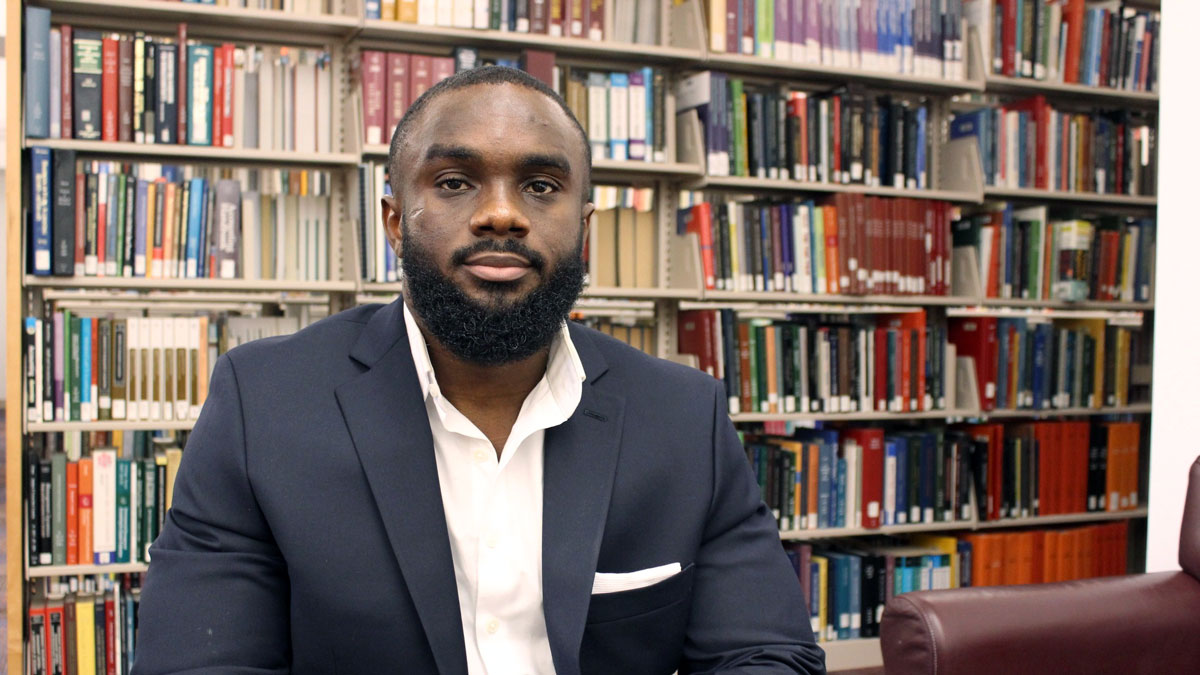
SIU doctoral student Michael Edidem (above) received the SIU Carbondale Graduate School’s 2026 Outstanding Thesis award for his research on mapping water infrastructure. (Photo by Brooke Keltner; photos of Mohammad Al Rjoob and Shalini Guha provided)
May 01, 2026
SIU Carbondale recognizes outstanding thesis, dissertation winners
CARBONDALE, Ill. – Southern Illinois University Carbondale’s Graduate School is recognizing two former graduate students and a former doctoral student for their outstanding research and contributions to their fields.
Each year, the Graduate School selects winners for the Outstanding Thesis Award and the Richard and Donna Falvo Outstanding Dissertation Award. These are authored by students who graduated in the immediately preceding year.
This year, the Outstanding Thesis Award goes to two researchers, Michael Edidem and Mohammad Al Rjoob, while Shalini Guha earned the Richard and Donna Falvo Outstanding Dissertation Award. All three recipients received certificates on April 9 during the Creative Activities and Research Presentations Forum.
Maria Claudia Franca, a professor in the communication disorders and sciences program, was part of the selection committee that reviewed submissions. Franca said she is proud of the research being done on campus.
“I was impressed with the depth, originality, and clarity of thought demonstrated in the work of Mohammad Al Rjoob, Michael Edidem, and Shalini Guha,” Franca said. “Each project stood out for its rigorous approach and ability to engage meaningfully with complex questions in its field, offering meaningful insights that reflect Saluki excellence.”
Outstanding Thesis
Mohammad Al Rjoob: “Effect of Traumatic Brain Injury on Quality of Life”
 Al Rjoob, who earned a master’s degree in communication sciences and disorders at SIU, focused his thesis on the quality of life for people who are diagnosed with traumatic brain injury (TBI), and its relationship with cognitive function, fatigue, and depression.
Traumatic brain injury takes place when a person experiences sudden blunt force trauma, typically to the head. It can stem from falls, car accidents, firearm-related incidents, physical assaults, and sports injuries, according to the American Brain Foundation.
“I chose this topic because I’m passionate about understanding the challenges faced by people with acquired brain injuries and exploring ways to improve their daily lives and rehabilitation outcomes,” he said.
Al Rjoob used standardized assessments to measure cognitive function, fatigue, and depression as well as questionnaires to evaluate participants’ quality of life. His findings show that “addressing these factors in treatment can help improve both rehabilitation outcomes and overall well-being.”
Al Rjoob said he was deeply honored to receive the award and feels gratitude for several mentors in the School of Health Sciences, including director Valerie Boyer, professor Maria Franca, and assistant professor Juhi Kidwai.
“I am grateful to SIU and the Communication Disorders and Sciences program for providing an environment that fosters research, growth, and innovation,” said Al Rjoob, who is pursuing his doctorate and continuing to research the topic.
Outstanding Thesis
Michael Edidem: “Using Advanced Deep Learning Techniques to Identify Drainage Crossing Features”
Edidem said he has always been drawn to solving a certain type of problem – “Where the gap between what we know and what we need to know carries real consequences.”
That challenge resonated with Edidem’s broader interest in environmental stewardship and in using geospatial science to better protect ecosystems and communities. Edidem said scientists use detailed digital elevation maps to understand water systems and predict flooding, but to do that well, they also need to know the location of drainage crossing, which carry water beneath roadways – features that are often difficult to detect in those maps.
“The problem is that these crossings are often missing, leading the model to incorrectly assume that water flow is either blocked or diverted in the wrong direction,” said Edidem, a geography and environmental resources graduate.
His research fills the gap by training artificial intelligence to find those drainage crossings, supporting the U.S. Geological Survey’s next-generation 3D Hydrography Program and its effort to produce more accurate water maps for the country.
“The moment that convinced me this work mattered was seeing the AI models detect crossings that existing maps had missed, and doing so consistently across landscapes in Nebraska, Illinois, North Dakota, and California,” he said.
The findings were published in two journals – Environmental Modelling and Software, and Frontiers in Artificial Intelligence.
Edidem is now pursuing a doctoral degree in geographic information systems and environmental modeling at SIU and is continuing to focus his research on geospatial artificial intelligence, environmental systems, and water mapping infrastructure.
Richard and Donna Falvo Outstanding Dissertation Award
Shalini Guha, “Skeletal Muscle Atrophy Associated Potassium Channel HERG1A Affects Global Calcium Homeostasis in C2C12 Myotubes”
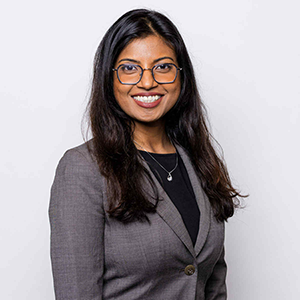 Guha’s research looks to help some of the world’s most vulnerable health populations – those diagnosed with an illness and senior citizens, who also have skeletal muscle atrophy. This means their skeletal muscle, the most abundant in the body, is losing muscle mass due to a loss of proteins.
While doctors can recommend diet and exercise changes, there is no cure. On top of this, exercise is often difficult for people diagnosed with muscle atrophy which can stem from cancer, sepsis, hypoxia, natural aging and muscle disuse.
Instead, Guha, the former SIU doctoral student, believes there’s a need for medication to treat this condition. Her dissertation specifically researched the muscle’s use of potassium channel HERG1A and its effects on the muscle’s calcium levels in hopes of opening the door to additional research to combat the disorder or find therapeutic solutions.
“This potassium channel, HERG1a, was previously known only to be found in cardiac, brain and smooth muscle cells but my mentor, associate professor Amber Pond and her colleague, showed for the first time that it exists in the skeletal muscle as well,” said Guha, who earned her doctorate in biochemistry and molecular biology. “I became super involved with the project and ended up feeling very strongly and passionate about it.”
Guha took skeletal muscle cells from mice and increased the amount of the potassium channel HERG1A in the cells to track calcium level changes. In response, her research found that several calcium signaling pathways increased, creating an imbalance of calcium ions in the cell.
“One of the most important components that ensures the proper functionality of most cells including muscle cells is calcium,” Gruha added. “It is crucial for the cells to fine tune where calcium is released, when it is released and how much it is released.”
The next step will be researching if an increase in HERG1a is a cause of muscle atrophy or if it’s an effect of the condition.
Currently, Guha is working in a lab on a novel vision pathway in mice and learning more about how it functions using an intricate technique called whole cell patch clamp.