
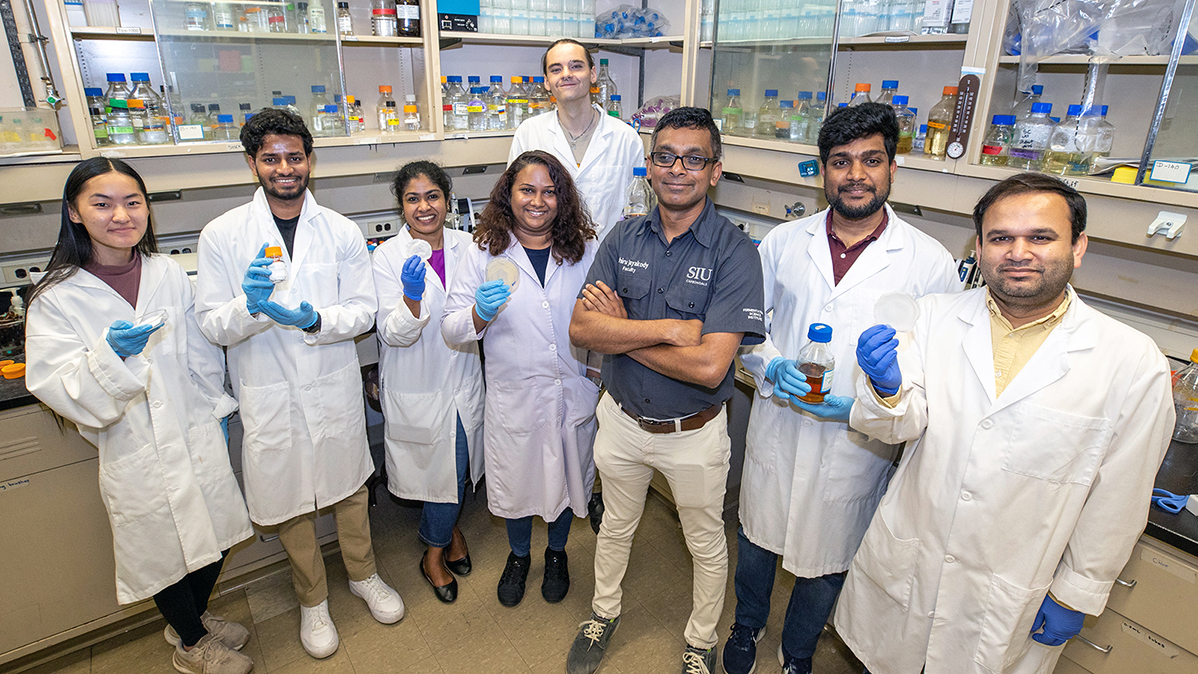
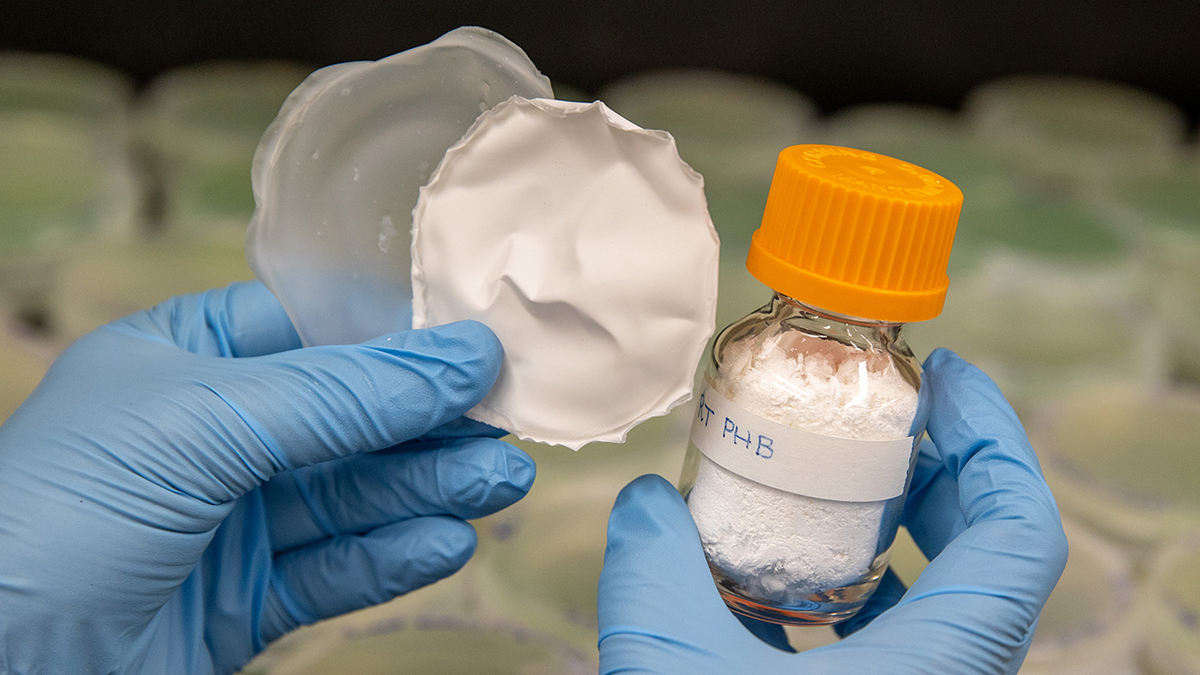
Jayakody and his student research team showcase pieces of their biodegradable plastic, pharmaceutical product, and plastic-derived chemicals as well as a plate containing microbial strain, Erwinia LJJL01. Photo by Russell Bailey.
April 27, 2026
SIU researchers use new bacteria to create sustainable bio-products
CARBONDALE, Ill. — A quick stop for an iced coffee and a breakfast sandwich on the morning commute, grabbing cutlery from the breakroom during lunch, or picking up a soda to wash down dinner. Our mostly thoughtless consumption of single-use plastic is a growing problem, inundating landfills and potentially harming our bodies.
A team of researchers at Southern Illinois University Carbondale have a solution to help minimize single-use plastics using a novel microbe engineered to eat synthetic plastic and create biodegradable plastic. Now, their lab work with the microbe extends far beyond biodegradable plastic and includes the possibility of bio-products like sustainable jet fuel and pharmaceuticals.
The problem
The associate professor behind the work is Lahiru Jayakody in the School of Biological Sciences. He’s worried about single-use plastics overflowing landfills – and the decades or longer it takes for them to degrade. While recycling is a step in the right direction and has become a common practice for some households and businesses, it’s not the most efficient process.
“If you take a plastic bottle, only 30% of that can go into a new plastic bottle if you recycle,” Jayakody said. “Every time you recycle, the material properties go down. You must get virgin plastic to make the new plastic bottle, so it’s not very sustainable.”
Another of Jayakody’s concerns is the unknown impact that micro-plastics and nano-plastics are having on the human body. For example, drinking out of a plastic water bottle or reheating food in a plastic container can cause microscopic particles of plastic to enter our blood stream, organs, and tissues.
“Seven decades ago, when plastic was discovered, everyone was so excited. It was a huge convenience.” Jayakody said. “Now we have a problem -- micro- and nano-plastics in our bodies. Plastic particles are everywhere, including water, the soil, and our agriculture systems.”
A new microbe
Jayakody and a former colleague, Jeff Linger, were hunting for a microbe that can deteriorate lignin, a hard-to-degrade material from waste biomass (agricultural residue like corn stover). They were interested in finding a microbe(s) that can use syringol, a molecule that comes from lignin degradation. Jayakody and Linger searched various sites in the United States that potentially have microbes capable of breaking lignin. After striking out for several months, Jayakody ironically isolated the microbe from waste charcoal samples from the backyard of Linger’s Colorado home. It’s named Erwinia spp. strain LJJL01 after Jayakody and Ling’s initials.
Many of the Erwinia strains are known plant pathogens. Scientists found nonpathogenic Erwinia strains in other continents, including Australia. This discovery marked the first report of a potentially non-pathogenic Erwinia bacteria strain in the United States that can survive or grow on waste biomass-derived substrates, such as lignin, and even on synthetic plastic-degraded compounds.
How it works
After arriving at SIU, Jayakody wanted to further research this specific Erwinia strain and its potential. Over the past six years, he and his student research team have fed the microbe synthetic and natural waste products. They engineered the strain by changing the genetic elements to manufacture high-value bio-products.
- Tea leaves and coffee waste and plastic → microbe → muconic acid → chemical for bio-degradable plastic
- Sugar or textile waste → microbe → acetoin → bio-degradable jet fuels
- Tea leaves and coffee waste and plastic → microbe → compound for chemotherapy and child myopia
- Excess agriculture waste carbon → microbe → polyhydroxybutyrate and polylactic → food packaging
- Soy waste → microbe → polyester amides → bio-degradable nylon
These high-value chemicals can also make bio-degradable plastic, advanced material like fiberglass-reinforced plastic, and enable biological recycling. The strain can be used to create compounds with green biological processes to replace toxic chemicals such as phthalate for Polyvinyl chloride-based plastic, known to many as PVC pipe.
“This is a robust and versatile microbe,” Jayakody said. “This strain has remarkably genetic traits that can be used in bio-industry, not only for plastic waste deconstruction but also making products that address the plastic pollution problem.”
Due to these breakthroughs and real-world applications, this work, “A catabolic powerhouse for biorefineries: characterization and engineering Erwinia spp. strain LJJL01 to produce bioproducts: Trends in Biotechnology,” is now published in the journal Trends in Biotechnology; One of the high impact journals in the biotechnology field.
The students
Jayakody credits much of the research’s success on his team of students, who have a range of academic experience. The current students in this lab include:
- Lakshika Dissanayake, graduate student.
- Saptarshi Ghosh, post-doctoral.
- Isabell Hou, Carbondale Community High School student.
- Bhagya Jayantha, graduate student.
- Sandhya Jayasekara, graduate student.
- Dushmantha Madushanka, graduate student.
- Elwood Sheflin, undergraduate student
Jayakody said this research team exemplifies SIU’s commitment to undergraduate involvement in high level research, offering opportunities often reserved for graduate schools elsewhere. This is particularly true given SIU’s R1 Research designation
“Southern Illinois University Carbondale is able to attract high-skilled, talented graduate students,” Jayakody said. “We also have an exceptionally good system to give opportunities to undergraduate students. This publication shows SIU can connect all the different tiers of students to one article. That’s the most exciting part to me.”
One student who has been with Jayakody from the beginning is Dissanayake, who started on the project as a graduate student in 2020.
 “The work that we did with this bacterium never ceases to amaze me,” said Dissanayake, who is now working on her doctorate’s degree in microbiology, biochemistry and molecular biology. “Every time we try to do something with this bacterium, it gave a very good result.”
This pushed Dissanayake to continue to research the microbe and its possibilities while spearheading experiments in the lab and writing a portion of the journal article. In 2022, preliminary findings earned her the Environmental Research and Education Foundation (EREF) scholarship. Dissanayake was the first student from SIU to receive the award, and she was followed by another member of the research team, Bhagya Jayantha.
As a lead on this project, Dissanayake also assigned the research team to specific tasks and mentored Hou, who started working in the lab during her freshman year of high school and is hooked on conducting research.
“The first day I thought I might be shadowing and learning the procedures,” Hou said. “They actually had me doing tasks on the first day.”
Hou said she helped with graphs, data analysis, and mini-experiments contributing to the larger work of the research. Now, a senior in high school, Hou believes these skills will support her goals of pursuing a secondary education and career in the science field.
“I had some experience in chemistry, but this was a big eye-opener for me,” Hou said. “Completely different field and completely different tools and techniques. It was a great opportunity for me to learn in this lab.”
Next steps
The next step for the research is for each chemical process by the microbe to clear regulatory approval by the federal government. This will allow for industrial use of the microbe and the high-value chemicals it produces. SIU is now instrumental in translating this kind of research with the inclusion of BioLaunch, which is a part of the Gower Translational Research Center (GTRC)
Jayakody spearheaded the development of the Biotech Core at GTRC and said, “We now have the capability to upscale the process at Biotech core and generate key information to transfer Bench-scale science to the industry.”
Looking ahead, Jayakody and his research team want this work to be furthered for the greater good of the local community and beyond.
“In science what is most important is reproducibility and translation accept,” Jayakody added. “I don’t want to put out something that’s unrepeatable, not helping humankind, and damaging our environment.”
This work is funded by the U.S. National Science Foundation-Faculty Early Career Development Program, U.S. Department of Energy, industrial partner Green Core LLC, Japan, and EREF, as well as the Southern Illinois University Carbondale REACH (Research-Enriched Academic Challenge) program.
“None of this would have been possible without the generous support from federal and industrial funding agencies,” Jayakody added. “I would like to thank all of them for supporting our research mission and helping to nurture the next generation of scientists. I must also mention that the work of three undergraduates on this project was supported through REACH. SIU has an excellent initiative to support undergraduate research.”