
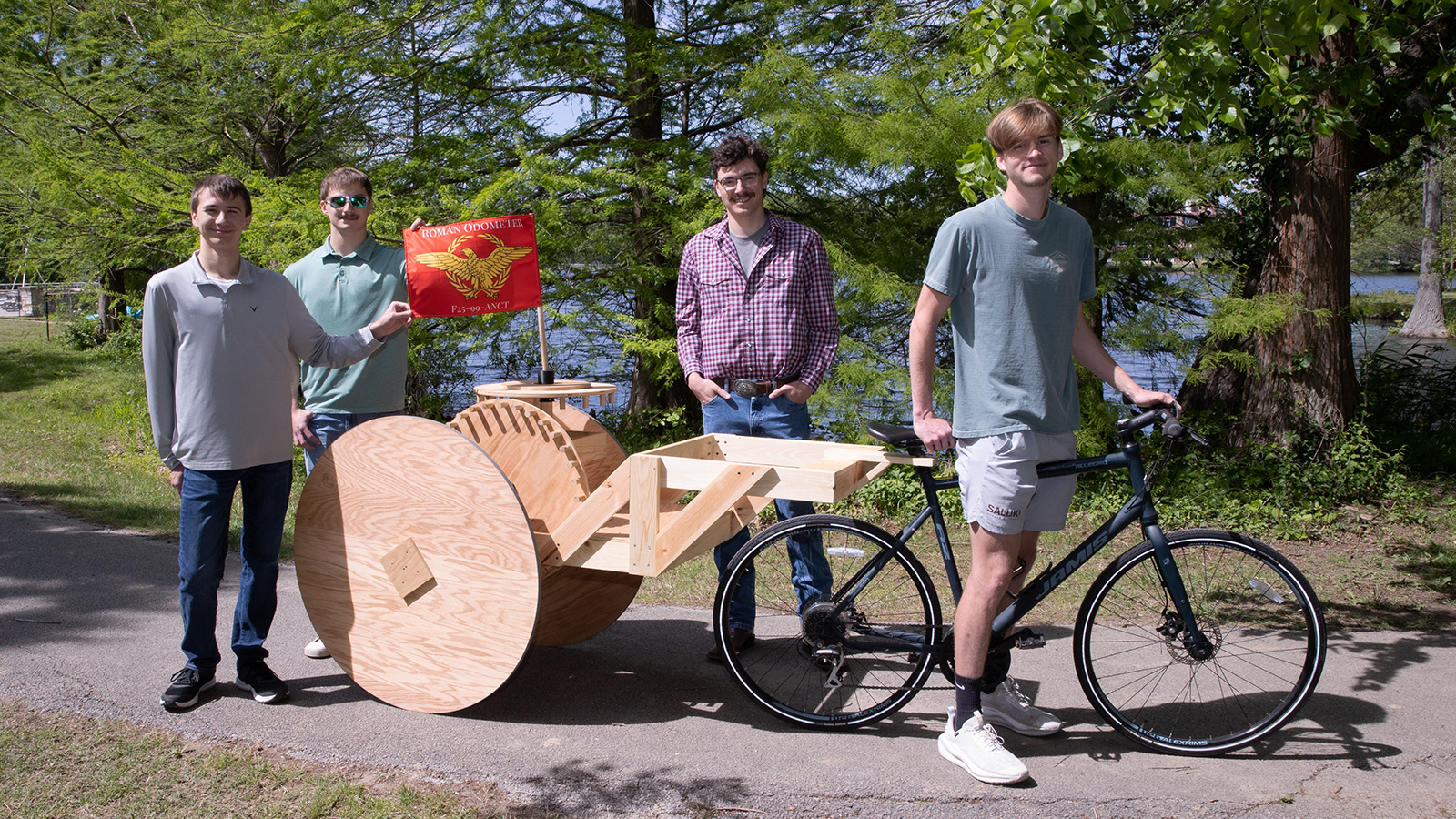
SIU Carbondale engineering seniors, from left, Aaron Wellinghoff, Josh Farmer, Garrett Zeller and Weston Jokerst replicated an ancient Roman odometer. The team created the design, constructed the machine and gave it a test run. (Photo by Russell Bailey)
April 22, 2026
SIU engineering students recreate ancient Roman odometer to measure distance
CARBONDALE, Ill. — When in ancient Rome, do as the Romans do. For senior engineering students at Southern Illinois University Carbondale, that means recreating an ancient Roman odometer.
Not only did the students recreate the machine, but it’s remarkably accurate at its job in measuring distance. The project is the latest by students in SIU’s ancient practices program led by Ken Anderson, professor in geology and Advanced Energy Institute director.
A demonstration will take place on Tuesday, April 28, from 10 a.m. to 1 p.m. in room A131 of the Engineering building.
“I have always been interested in history so getting the opportunity to make a design based off of historical drawings like this was very interesting to experience,” said Garrett Zeller, who served as the project manager. “Based on our research, we could not find any cited recreations of the ancient models we used as references for our project, so we felt inclined to attempt it ourselves.”
Media availability
Reporters, photographers, and news crews are welcome to cover the ancient odometer demonstration in SIU’s Engineering Building, room A131 from 10 a.m. to 1 p.m. on April 28. To arrange for interviews or more information, contact Ken Anderson at kanderson@siu.edu.or Garrett Zeller, a mechanical engineering undergraduate student at 937-896-1272 or garrett.zeller@siu.edu.
This year’s project is the latest in a series of ancient practices program designs that students have been involved with for several years. Anderson believes these projects give students insight into how past engineers solved problems without the ability to rely on modern technology. AEI funded this year’s project after external source funding closed.
“The Romans built an enormous empire with a sophisticated highway system, and they needed a means to measure distances reliably,” Anderson said. “They didn't have access to technology like GPS, so they solved the problem by applying the tools they had in ingenious ways, by designing and building devices like what these students have built, that still got the job done. That's an important lesson — not every problem requires an expensive technological solution.”
The odometer works by using a series of wooden gears, connected to the axle of a cart. After a specific number of rotations, the gears drop a pebble into a bucket. When reaching a destination, simply count the pebbles to get a measure of the distance. For this project, students started by researching and analyzing ancient odometer designs, then used computer-aided design (CAD) software to create digital models before selecting the design that they would attempt to recreate.
Bumps on the road
Aaron Wellinghoff, one of the CAD designers, said constructing the gear train was the team’s biggest challenge. The gear train had to be simple and lightweight while also having the ability to measure long distances.
“Ensuring proper alignment and smooth operation required careful planning, precise measurements, and multiple adjustments,” he said. “Even small errors could lead to inefficiencies or mechanical issues.”
This meant meticulous attention to detail, testing, making corrections, and repeating until the machine was fine tuned. The soon-to-be engineers also had to practice time and project management, communication, and task delegation.
Another brick in the road was finding modern machinery to construct ancient parts.
“For the final construction, we needed a computer numerical control machine with a 4-by-8-foot bed to cut our wheels and gears,” Zeller said. “We had some issues with finding one that fit our needs and that was also operational at that time which caused some setbacks.”
Test Drive
While Romans used a horse or donkey to pull their machines, the SIU students opted for more modern transportation with a bike. Although the team was confident that their odometer would function, the big question of would the measurements be accurate was quickly resolved.
“Every time we crossed a 100-meter mark out at the track, we heard our odometer drop a marble, indicating a 100-meter measurement,” said Weston Jokerst. “We were ecstatic.”
The team planned for the odometer to be within a 5% accuracy range, but the first full testing run showed a remarkable 0.19% error over the course of a mile.
Timeless Lessons
All of the students plan to take their experience and lessons learned from this project into the workforce after graduation, including Joshua Farmer who has a job lined up at Marcum Engineering in Marion, Illinois, where he’ll work in the consulting engineering field.
“I will be sure to regularly communicate with team members on future projects and meet timelines as required for a project’s success,” Farmer said.
Farmer hopes the SIU community will attend the odometer demonstration to support their efforts and get a glimpse of the ancient past on a modern campus.