
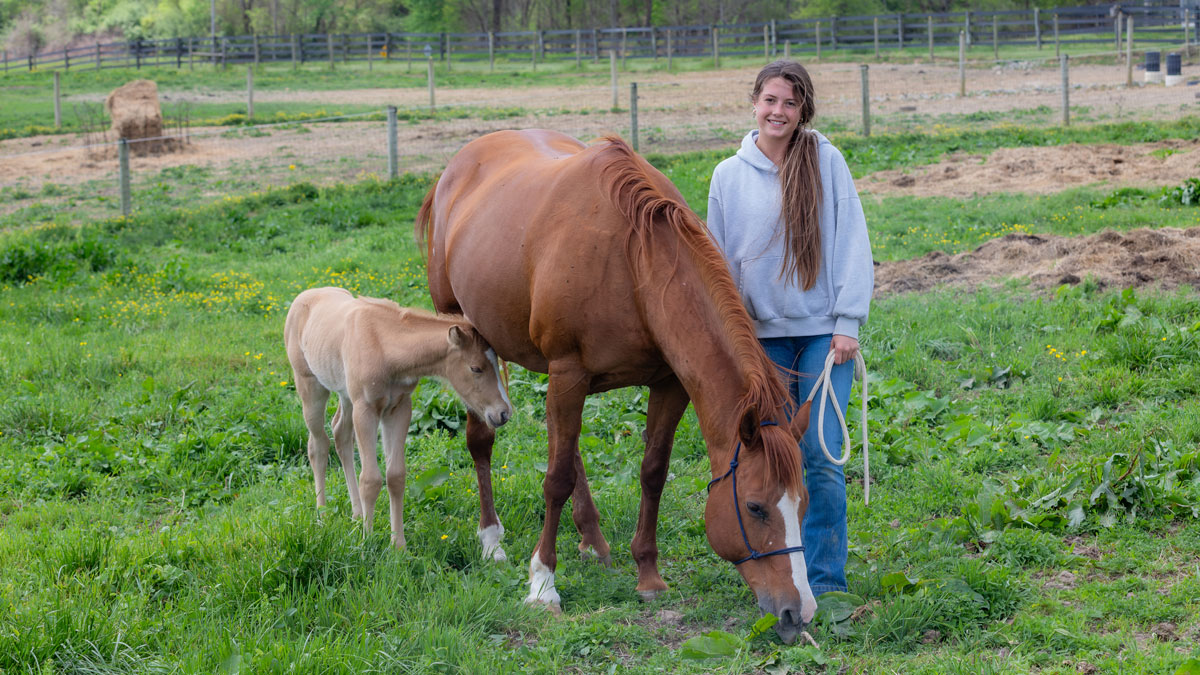
Alayna Menees, a sophomore in SIU Carbondale’s animal science program, stands in the pasture at the Equine Center with the foal named, River, born on April 9, 2026, as her mom, Amazon, grazes on grass. (Photo by Erasmus Tornye)
April 20, 2026
Foal watch offers SIU students invaluable experience delivering baby horses
CARBONDALE, Ill. — It’s a breezy spring afternoon at Southern Illinois University Carbondale’s Equine Center and the sun is shining down on two fresh faces in the pasture — Bonnie and River. These weeks-old horses have cotton-like manes, wobbly legs, and never stray too far from their mothers.
Each year, new foals are born at the Equine Center and SIU students play a significant role in their delivery. As mares in foal get closer to their due date, students rotate 12-hour shifts overnight in the barn. It’s called foal watch and it offers students firsthand experience that cannot be replicated in a classroom.
One student who participated this spring is sophomore Alayna Menees, who has worked at the Equine Center for two years. The Southern Illinois native said the mares must be monitored nightly.
“You can tell by their belly if it’s dropped that will tell you if the baby is in position or not,” Menees, who is majoring in animal science with a pre-veterinary emphasis, said. “Also, their hind end will get super loose, and you can basically flip their tail over on their back.”
When signs of a foal’s possible delivery are visible, students stay in the Equine Center lounge from 6 p.m. to 6 a.m. and monitor cameras in the stalls of the pregnant horses. This process starts around spring break and can last a month or longer. In Menees’ case, after her foal watch shift ended, it meant clocking in for her job at the Equine Center doing chores around the stables.
“The most challenging part was probably staying excited about it whenever you’re staying awake all night, every night and there’s no baby” said Menees of Anna, Illinois.
When a horse finally goes into labor, it’s all hands-on deck. Students call Samantha Wuest, assistant director of University Farms and Equine Center manager, to deliver the foal which only lasts 30 minutes after the mare’s water breaks. Once the foal arrives, there’s more work to do. Students watch Wuest check for signs that both mom and baby are healthy, including getting the foal up and walking after an hour, measuring the colostrum levels in the milk and examining the state of the placenta.
“I just think it’s amazing bringing a new life into the world, and it’s even better when you work here because you get to see that baby every day,” said Menees. “You get to see it grow up and the horse it becomes.”
Wuest said students enrolled in the Animal Science program can also take part in foal watch. Students take lower-level equine classes in their freshman and sophomore years, watching videos of a foal being born and learning the foundational skills.
Then, students in their junior and senior years can take part in overnight shifts in the barn as part of Animal Science 419, also known as “Stable Management.”
“It’s kind of a once in a lifetime thing for some people to where this is the safest environment for students to be able to learn and take part in a foal’s birth,” said Wuest, who took part in her own foal watch as a graduate student in 2016.
SIU Carbondale is the only public university in Illinois to offer a four-year equine program. Wuest believes this experience prepares students for jobs after graduation, such as breeding, stallion handling, mare care or delivering foals.
This is the first year that the Equine Center has helped foal horses owned by the public and boarded at the stables. This allowed four additional chances for students to experience a mare delivering a foal.
Mark Schwarm is a new instructor at the Equine Center, and this is his first time experiencing foal watch. Schwarm said he’s impressed with the effort Wuest puts into guiding the students, as well as the life lessons students learn during the experience.
“It teaches students perseverance, responsibility, and being aware of their surroundings,” Schwarm said.
When Menees graduates and closes the door to the barn for the last time, she’ll walk away with that invaluable experience as she pursues a career as a veterinarian, “I have learned a lot about handling horses, watching them foal, their anatomy, and behavior.”