
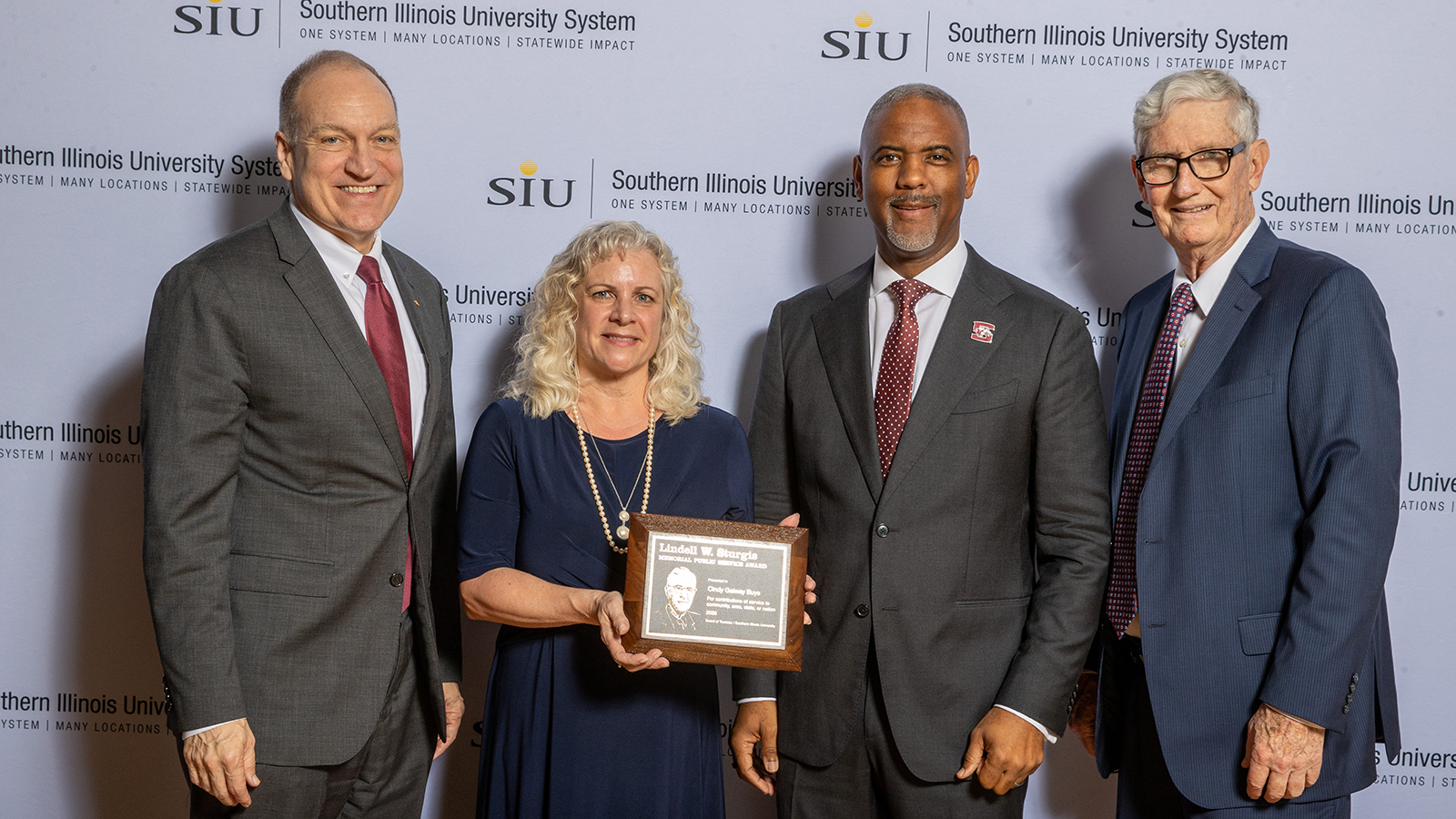
2026 Sturgis Award recipient – Cindy Buys, second from left, was honored with the 2026 Lindell W. Sturgis Memorial Public Service Award. With Buys, from left, are SIU President Daniel Mahony, SIU Carbondale Chancellor Austin A. Lane and SIU Board of Trustees Chair J. Phil Gilbert. (Photo by Russell Bailey)
April 16, 2026
SIU’s 2026 Sturgis Award recipient strives to make the world a better place
CARBONDALE, Ill. — Cindy Buys’ empathy and passion for community service and helping others comes from the deep sense of faith she developed while growing up.
That foundation blossomed into a desire to serve her community.
“I think sometimes when we are young, we think we are going to change the world,” said Buys, SIU Simmons Law School professor and the 2026 Lindell W. Sturgis Award recipient. “But what I’ve learned is what is important to me is to make my corner of the world a better place.”
Buys received the Sturgis Award during today’s (April 16) SIU Board of Trustees meeting. Presented since 1980, the award honoring the late Lindell Sturgis, a Metropolis native who served more than 30 years on the board, recognizes SIU Carbondale employees for public service unrelated to their jobs.
Buys came to SIU in 2001 and is a recognized legal expert in constitutional, immigration and international law. She has served as interim dean, acting associate dean for academic affairs, and founder and director of the law school’s pro bono immigration projects, which also provides externship opportunities for students.
Buys’ volunteer work includes being one of the founders of Carbondale Area Interfaith Refugee Support (CAIRS) which assists with refugee resettlement in Southern Illinois; working with various organizations, including the Southern Illinois Immigrant Rights Project to help safeguard the legal rights of immigrants who come to the United States; the United Nations Association Southern Illinois Chapter,; the Rotary Club of Carbondale, and serving on the First Presbyterian Church’s mission ministry and other church outreach efforts. She also mentors female law students and attorneys in helping them find their own voices and confidence in a historically predominately male profession.
Work doesn’t stop at theory
Hannah Brenner Johnson, dean of the SIU Simmons Law School, wrote that Buys’ work extends locally, nationally and internationally and is “a model for public service to her community.”
“Her contributions are truly endless. She lives by example and models what it means to engage in community service to one’s community,” Brenner Johnson wrote.
Angela Upchurch, law school professor and associate dean for academic affairs, wrote that Buys’ work “reflects not only professional excellence, but also deep moral conviction and personal generosity.”
“What distinguishes Cindy Buys most is that her work does not stop at theory,” Upchurch said. “Her impact is visible in the real lives of immigrants in our state and local community — families who have found stability, dignity, and opportunity because of her tireless advocacy.”
One example is supporting an Afghan family that fled the Taliban and relocated to Carbondale, Upchurch wrote. Buys not only provided legal assistance to the family, but “opened her heart to them,” including bringing the children to the law school’s Halloween festivities to experience a community event and “begin building friendships in a welcoming environment.”
“Moments like that, which are small on the surface but deeply meaningful, helped ensure they felt not like outsiders, but like neighbors,” Upchurch wrote. “That combination of professional skill and personal hospitality is rare and extraordinary.”
From practitioner to professor
Buys spent 10 years in public and private practice in Washington, D.C. after graduating from Syracuse University School of Law in 1991. She got hooked on asylum law while working as a summer associate with a firm that encouraged pro bono work. She took on a case involving two men from the Soviet Union we were persecuted for being gay. Because of that case, Buys rearranged her class schedule to include immigration law during her third year of law school.
“With asylum law, in particular, you are truly saving someone’s life,” Buys said, noting people fleeing persecution must show “they have a “well-founded fear of persecution if they are returned to their country.”
“Many of the clients that I have worked with have been beaten, shot at, imprisoned,” she said. “Many terrible things have happened to them because they expressed opposition to the government or they have a personal characteristic that the government didn’t like.”
Buys said when she graduated law school she always thought she would like to be a law professor but wanted first to practice law because that experience would help later in the classroom. Buys said she and her husband, Gerry, had always talked about a university community “being a great place to raise a family.”
The couple has two adult children. Buys said Gerry “is an amazingly supportive spouse and I couldn’t do what I do without him.”
Immigration changes
Buys emphasized it’s important to remember immigrants don’t flee their home because conditions are good in their country. Most people who immigrate, seek asylum, or who are undocumented and seeking work in the United States do so “because things are failing at home” and are “primarily seeking a better life for their children, their families and themselves.”
Studies show immigrants commit crimes at lower rates than the general population, and the legal system should appropriately deal with those who do commit crimes. But Buys said those individuals still deserve compassion and are entitled to human rights.
Buys added that the nation’s immigration system has been broken “for a long time” and new policies are needed.
“There’s plenty of blame to go around on both sides,” she said. “But I really do wish that we could come together as a country and create a policy that worked better both for people wanting to come to the United States and our society. I think it’s possible, but we have to have the political will to do it.”
Active in mentoring
Buys also actively encourages female law students and attorneys to seek out and become involved in available opportunities, whether working with a law review journal or a bar association. She said studies show females who are in the legal profession “don’t tend to put ourselves forward quite as much — we wait for someone to suggest it or ask us to do something before we step up to the plate.
“One of the messages I’ve tried to get to my women attorneys is it okay to put yourself out there, and I’ve tried to be the one who nudges them to do things and to challenge themselves to step up into those positions,” Buys said. She participates in a program through the American Society of International Law that works with early career attorneys in a structured mentoring program.
Law school supports community involvement
Buys is the fifth Sturgis Award recipient from the law school since 2005, which Buys said is a good reflection on the law school community.
“It’s part of the ethos of the legal profession and the community spirit of this law school, in particular, that people do give a lot to the community,” she said. “It’s important that I’m part of this larger community that encourages and supports engaging with our community and doing service work.”