
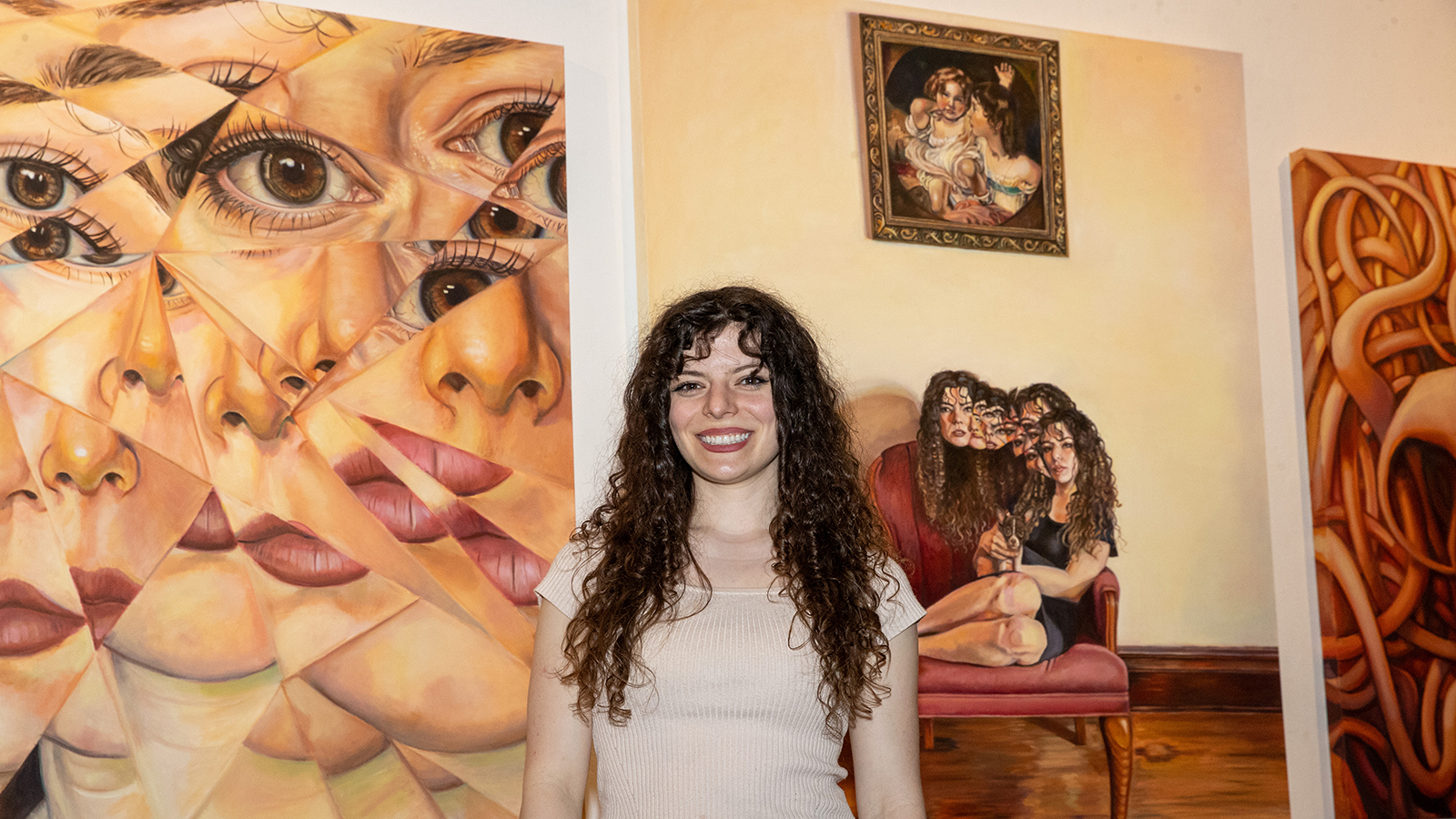
Works by Autumn Meyer (top), Zach Abella (middle) and Kassidee Gabby are sharing SIU Carbondale’s most prestigious art prize. (Photos by Russell Bailey)
April 15, 2026
Three artists share SIU Carbondale’s 2026 Rickert-Ziebold award
CARBONDALE, Ill. — Autumn Meyer’s art — which won her honors as one of three Southern Illinois University Carbondale School of Art and Design students to share the 2026 Rickert-Ziebold Trust Award — serves as an open invitation to view how everyone sees the world differently and helps people understand the experience of living with Tourette Syndrome and Obsessive-Compulsive Disorder.
“It’s a lot about not only feeling the perception of movement — how OCD and Attention-Deficit/Hyperactivity Disorder (ADHD) alter how we see it — but how everybody does see the world differently. This is giving a glimpse into a hyperactive way of feeling and seeing movement,” said Meyer, who is from Highland, Illinois.
The Rickert-Ziebold Trust Award is the university’s most prestigious art prize and earns Meyer and her co-winners a share of the $22,500 prize. Also winning the award are Zach Abella, a senior glass major from Tacoma, Washington, and Kassidee Gabby, a communication design major from Marion, Illinois. Seven students, including some who graduated in the fall 2025 semester, were finalists this year.
View the exhibition showcasing their artwork through Saturday, April 18, in the SIU Surplus Gallery, 432 S. Washington St., Carbondale. The exhibit is open to the public from 11 a.m. to 3 p.m. today through Friday and from 10 a.m. to noon Saturday. A reception is set for 6-8 p.m. Friday in the Surplus Gallery, with the awards presentation at 7 p.m. The gallery is in the Studio Arts Building, formerly known as the Glove Factory.
Sun Kyoung Kim, an associate professor in metals and Rickert-Ziebold committee chair, said the seven finalists’ research and exhibits “are impressive.”
“I see everyone's deep reflection on themselves and others as well as their effort to understand, investigate and express who they are or what they believe,” she said. “I would like to commend their professionalism and support for one another. Everyone came in with a carefully considered plan for their installation and helped each other when they could.”
Winning installations
Meyer’s “Movement: Perception, Obsession, Fragmentation” exhibition includes eight oil paintings and one pencil drawing. In her artist’s statement, Meyer notes that “movement is ever-changing; the constant in all of our lives.”
“The repetition of facial features in my paintings not only resembles the overwhelming nature of perceiving movement through an obsessive mind, but it also symbolizes the routine ties, involuntary movements I cannot refrain from,” Meyer wrote.
Meyer graduated in December 2025 with a double major in art, including a specialization in painting, and Languages, Cultures, and International Studies with a specialization in Spanish. The larger paintings each took between 200 and 300 hours to complete, with the smaller pieces averaging around 50 hours each.
“I’m very thankful to the faculty here, said Meyer, who is planning to attend graduate school to earn a Master of Fine Arts degree in painting and become a professor. “They are the ones who helped me design my style.”
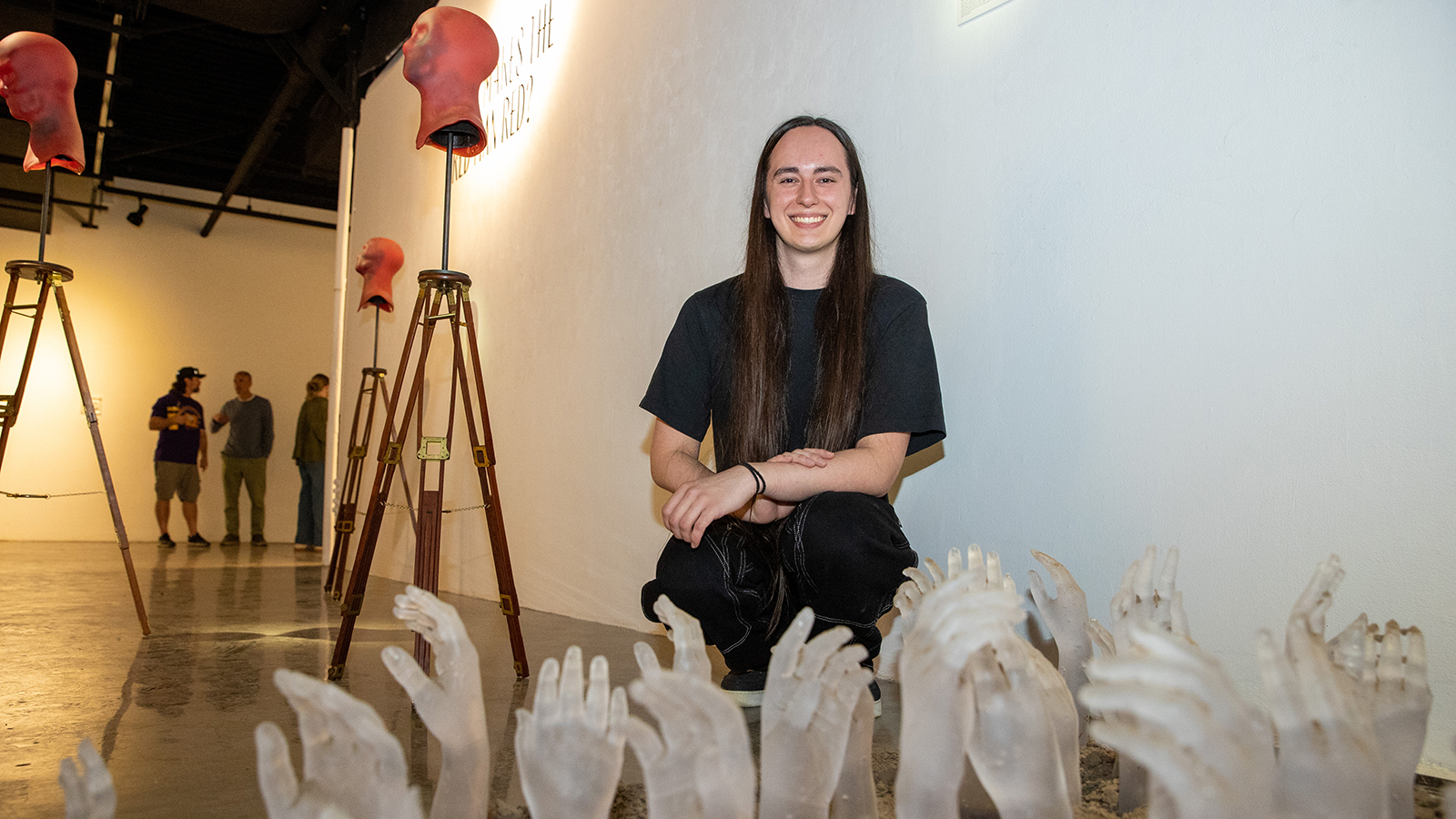 Abella’s glass artistry in “Who Makes the Red Man Red” reflects the skewing of Native American identity in the 1900s, along with the empowering memories of children who attended an indigenous boarding school near St. Louis from 1824 to 1831. A Citizen Potawatomi, Abella also views his exhibition and work as a way to educate others.
“I think our place as academia-based artists is to educate people about things we are passionate about and care about,” he said. “I really wanted it to be a community project where we can educate and fill the gaps.”
The exhibition includes six glass-blown heads mounted on vintage camera tripods, symbolizing reflections and reinterpretations of portraits taken by Edward Curtis over a 30-year period. Curtis now receives contemporary criticism for “fabricating and inauthentically depicting native identity,” Abella writes.
Abella’s work also includes 30 hands arising from soil collected where the boarding school once stood. He recruited 30 Southern Illinois children between 6 and 14 years old to provide their hands for the glass castings.
Abella said he only recently learned his grandfather attended an indigenous boarding school as a youth.
“It’s connected to me, this is my heritage,” he said. “This is a shared heritage of all Native peoples and it’s something people don’t know about.”
Abella said it is “an incredible honor” to earn the award. He is making plans to travel to the Prague, Czech Republic, for further study with master glass sculptor Martin Janecký.
Abella said the competition was tough and he's honored to share space with the other finalists.
Under Consume
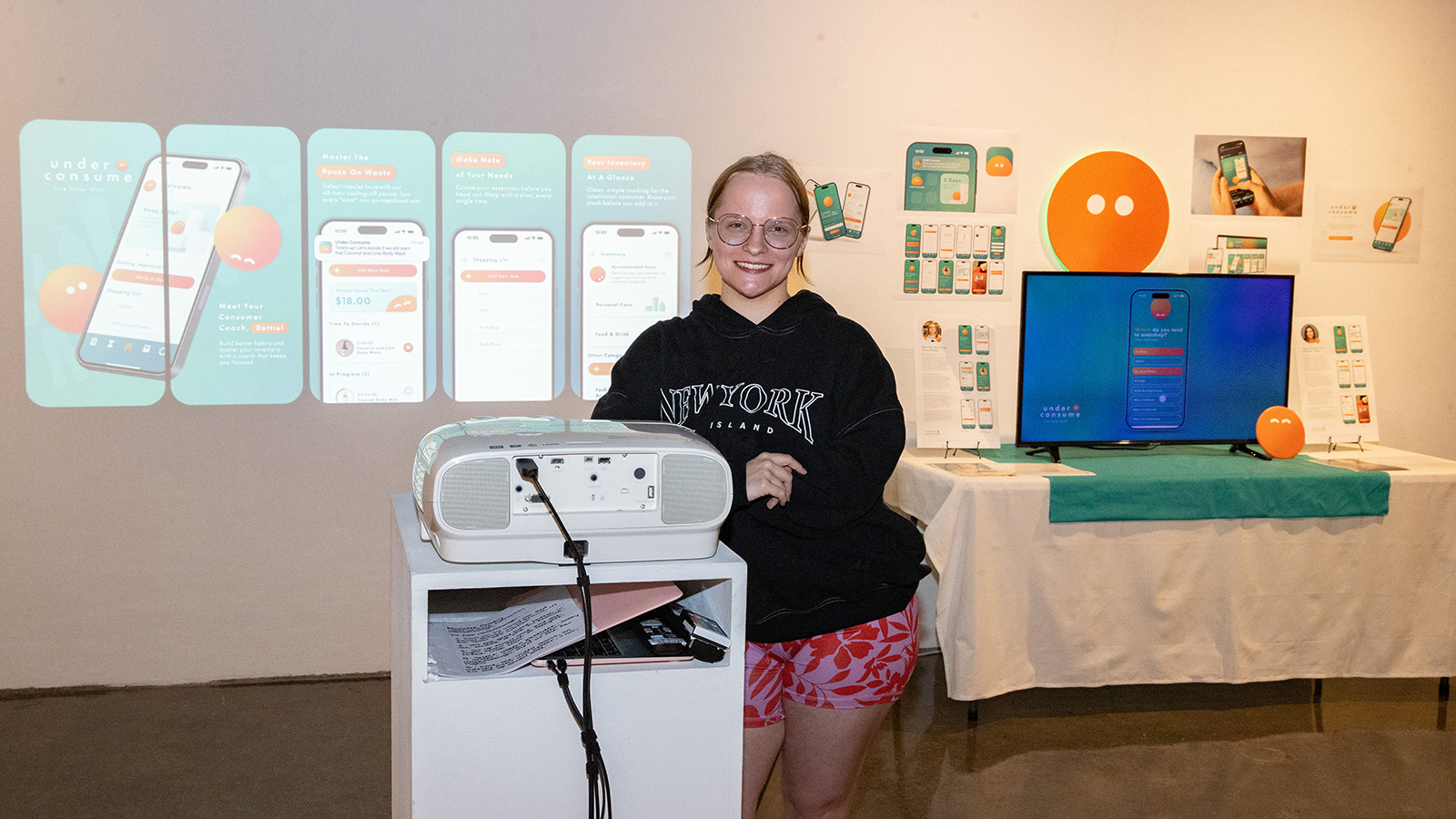 Gabby’s digital artwork focused on creating an aid that helps people with overconsumption — or “inventory saturation management” leading to smarter shopping habits. The design approach provides people to look at their phones and see what they already have.
The artwork features “Dottie”, a nonjudgemental consumer coach whose “positive reinforcement replaces remorse over past decisions with joy for sensible purchase and better inventory management.”
Gabby’s artist statement notes that Under Consume reframes sustainability “as a daily act of self-care by employing character-driven coaching and simpler visual language. Small wins, such as avoiding impulse purchases or finishing an item, show that the most valuable asset is the one you already own.” The design-led app “prioritizes long-term user satisfaction over the dopamine boost of acquiring items.”
Gabby, who also works as an internal designer for a local bank, noted that receiving the award was bittersweet — her twin sister, Kennadee, was also a finalist.
“I’m sad that my sister wasn’t picked, but I am over the moon – so incredibly grateful and blessed. I still cannot believe it,” she said.
The other four finalists were:
- Lydia Dowell, industrial design, Columbia, Illinois.
- Naomi Fader, art education, Godfrey, Illinois.
- Kennadee Gabby, art education, Marion, Illinois.
- Olive Vowell, ceramics, Paducah Kentucky.
Longtime award
The purpose of the Rickert-Ziebold Trust Award is to promote excellence in visual arts. The award was established by the Rickert family in honor of the late Joseph Rickert, an attorney and former state senator from Waterloo, to encourage young artists. Because of the Rickert family’s “vision, love of art, and confidence in the future,” the School of Art and Design is able to present cash awards annually to Rickert-Ziebold scholars.