
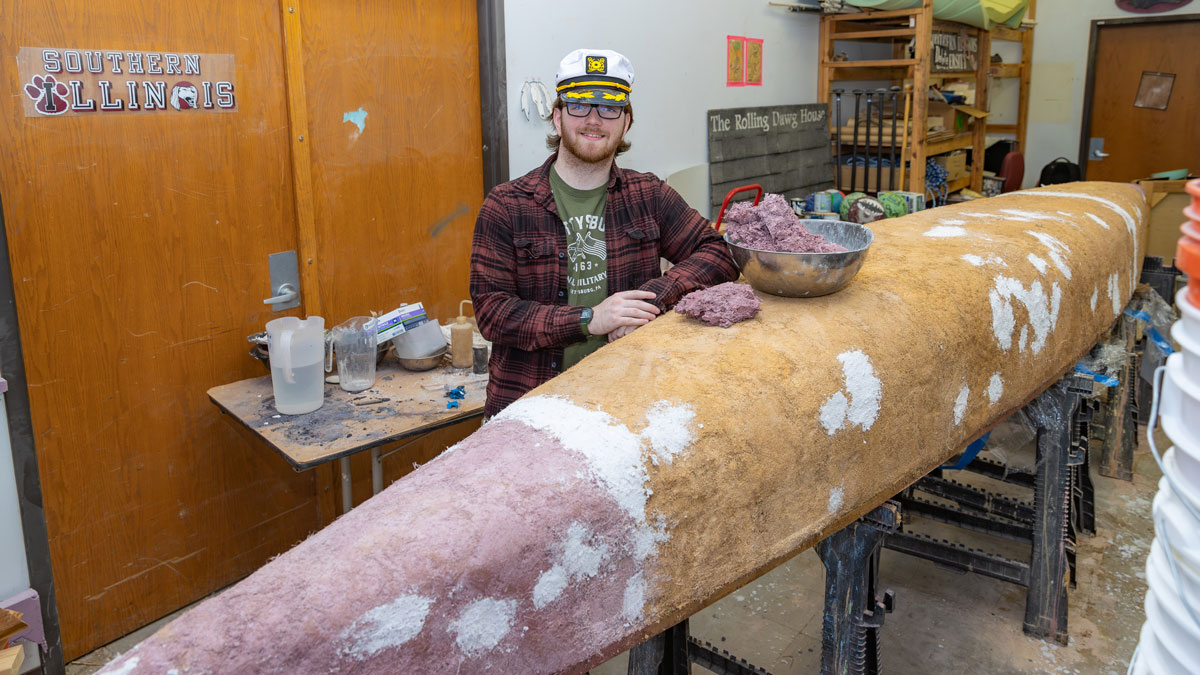
Concrete canoe captain Wayne Tinsman, an SIU Carbondale civil engineering undergraduate student, works on the Saluki Dog canoe for the upcoming 2026 American Society of Civil Engineers Mid-America Symposium. (Photo by Erasmus Tornye)
April 02, 2026
SIU Carbondale hosting concrete canoe, steel bridge competitions
CARBONDALE, ILL. — It’s not every day you see a canoe dressed like a hot dog. With that visual in mind, imagine the canoe is also made of concrete — and is racing other canoes. It might seem unlikely, but it will be reality soon at Southern Illinois University Carbondale.
The SIU chapter of The American Society of Civil Engineers (ASCE) hosts the 2026 Mid-America Symposium April 9-11. The symposium is the result of a coordinated effort by students, faculty, and staff across the university, led by faculty adviser Ajay Kalra, an associate professor in the School of Civil, Environmental, and Infrastructure Engineering (CEIE), and undergraduate student Cordelia Lemons serving as the symposium chair.
Around 450 students from 17 universities will participate in several engineer-related activities, including concrete canoe and steel bridge competitions. The concrete canoe competition will be held at Campus Lake starting at 7 a.m. on April 10; the steel bridge competition is at Banterra Center starting at 7 a.m. on April 11.
A dedicated team of SIU students, led by concrete canoe team captain Wayne Tinsman, has spent countless hours planning, designing and constructing their canoe. This year, the vessel is a nod to a flavorful and sometimes messy-to-eat tradition.
“The Saluki Dog is a hot dog with barbeque pulled pork and nacho cheese on top of it,” said Tinsman, a civil engineering undergraduate student. “We just figured why not? It represents our school.”
So, what does it take to get a concrete canoe to float? The concrete mix must be made up of light-weight materials. This way, the vessel can be buoyant, yet sturdy enough to hold four students.
Several other design factors play into the canoe’s buoyancy.
“We use Styrofoam on the very end that helps with the floating, on top of designing it like a realistic canoe,” Tinsman said. “We made the bottom really flat so it’s harder for the canoe to flip.”
If all goes to plan, the “floating Saluki Dog” will participate in five races, which take place over the course of around nine hours once all the ASCE chapters compete.
SIU’s concrete canoe by numbers:
- One: year to plan, design, and construct the canoe.
- Five: students on the concrete canoe team.
- Nine: materials used in the concrete mix.
- 300 pounds: estimated canoe weight.
- $550: total cost to construct the canoe
- 680 pounds: estimated minimum weight the canoe is designed to hold.
Media availability
Reporters, photographers and news crews are welcome to cover the 2026 ASCE Mid-America Symposium. To arrange for interviews or more information, contact Bibas Pokhrel, a research assistant with the School of Civil, Environmental, and Infrastructure Engineering at 618-203-4524 or siusymposium@gmail.com
It’s not just concrete canoes — it’s also steel bridges. Led by team captain Dayton Gaughan and Debarshi Sen, a faculty adviser and CEIE assistant professor, SIU’s steel bridge team has spent months preparing for the competition and refining their design. The competition challenges participants to assemble what student Bibas Pokhrel calls “human-sized” steel bridges in real time. The bridge must span approximately 20 feet and is evaluated under loading conditions of up to 2,500 pounds, according to the ASCE.
“Participating universities will bring prefabricated steel members and tools,” said Pokhrel, a master’s degree student in civil engineering and the communications lead for the symposium. “During the competition, they assemble the bridge by bolting the pieces together under strict time constraints.”
Pokhrel believes this is a rare opportunity for participants to put their engineering skills to the test and practice teamwork, communication and stress management.
“The experience that they're going to get is invaluable,” he said. “They're going to compete, they're going to learn, so this is going to be a great event for them.”
The canoes and bridges are scored on several factors, including design, materials used, durability and appearance. Judges overseeing both competitions are engineers themselves, giving students a chance to gain valuable feedback from experts in the field.
Winners will move forward to the national competition being held June 25-27 at Fairmont State University in West Virginia.
More information, including a list of other events happening during the symposium, is available.