
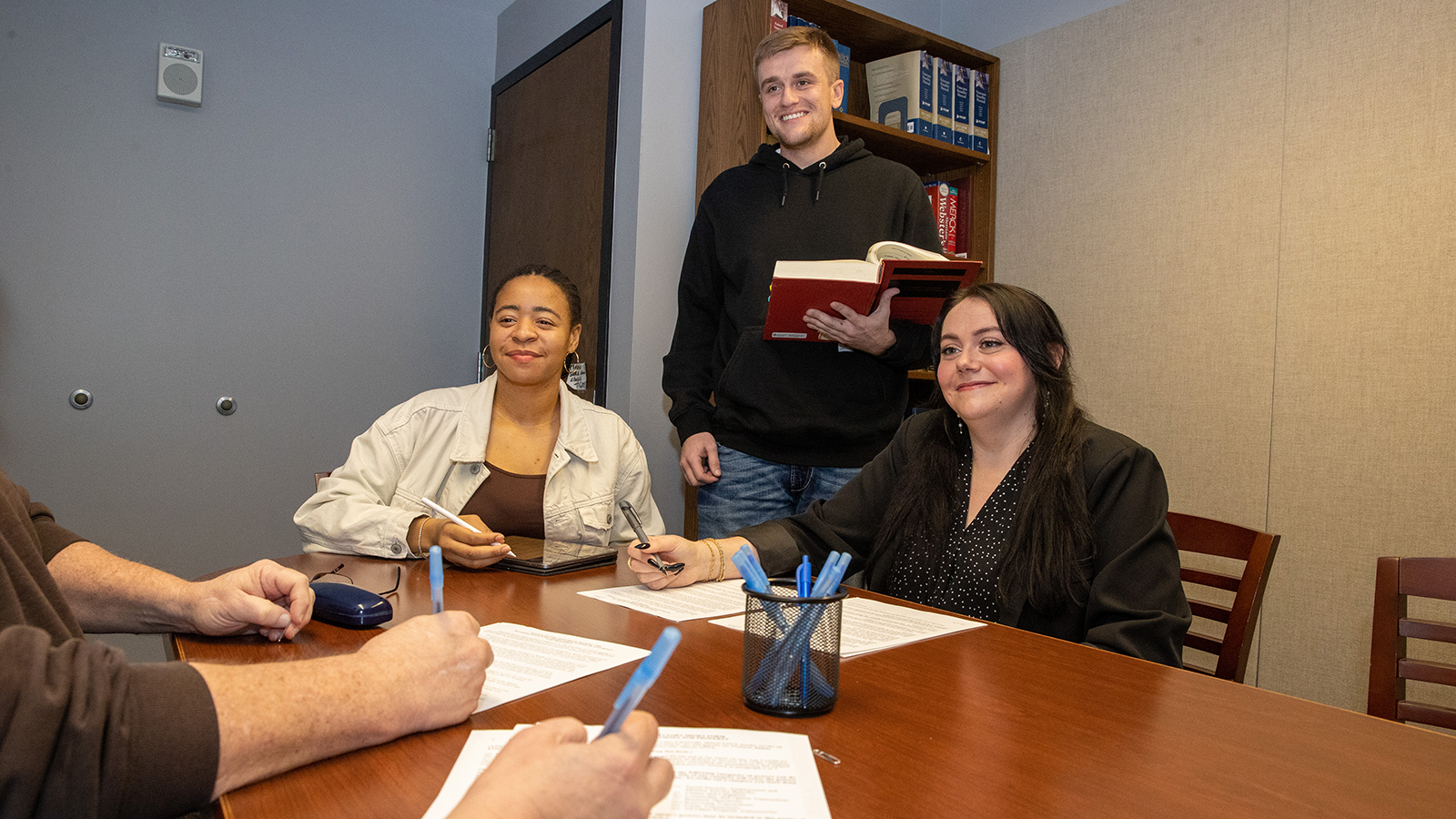
SIU Simmons Law School students, from left, Jordyn Perkins, Bradley Weishaar and Laura Clark, are enrolled in the Civil Practice Clinic and, among other tasks, assist clients with estate planning documents. (Photo by Russell Bailey)
March 04, 2026
SIU Simmons Law School is expanding legal clinics
CARBONDALE, Ill. — The Southern Illinois University Simmons Law School is expanding opportunities for students to receive experiential training through additional legal clinics that will serve more clients in the region.
With Civil Practice and Juvenile Justice clinics already in place, Dean Hannah Brenner Johnson said the law school is working to provide additional clinic opportunities for students and expand the availability of legal services in Southern Illinois. The Lawyers Trust Fund recently provided a grant to establish a Clinical Legal Fellow position that will support the work of the Civil Practice Clinic. And starting with the fall 2026 semester, a new clinical course on immigration law taught by Professor Cindy Buys will be offered to third-year students to work on immigration-related cases.
Expanding opportunities for students to assist clients as part of their legal education “is a significant priority,” said Brenner Johnson, who came to SIU in July 2025. “It helps our students develop the skills necessary to become practice ready by the time they graduate.” She added that faculty also indicated an interest in expanding clinical programs as part of the law school’s strategic plan.
In clinical settings, second- or third-year students can earn academic credit for work they perform under the supervision of a clinical law professor/attorney including counseling clients, preparing documents, and conducting initial intake. In addition, students apply for and obtain “711 licenses”, which under Illinois Supreme Court Rule 711, allows them to make court appearances on behalf of their respective clients.
Dale J. Aschemann, a clinical associate professor of law, oversees the Civil Practice Clinic. Eight students per semester may have eight to 12 clients at a given time, he said. In 2025, the clinic assisted 305 individual clients and addressed 648 matters, ranging from wills to guardianships that the clinic initiated for adults with disabilities and minors who lack the legal capacity to speak for themselves, Aschemann said.
‘Important first step’
Brenner Johnson indicated that the law school plans to have the Clinical Legal Fellow in place before summer. This could mean providing services to an additional 35 clients in 2026, Aschemann said.
The clinical legal fellowship, along with a clinical course on immigration law, is a “really important first step” in building up the law school’s experiential program, Brenner Johnson said. The law school is utilizing a multifaceted approach with grant applications and working with donors in an effort to expand the clinics. Offering services to veterans and domestic violence survivors are among the priorities.
New immigration law clinical course
Buys said the new clinical course will focus on providing legal information and resources to noncitizens who are in civil immigration detention. Third-year students will participate in the clinic for one semester at a time. The course is in partnership with The Immigration Project, based in Bloomington, Illinois.
“Their attorneys and staff will help coordinate interviews, provide interpreters, and supervise our law students,” said Buys, who oversaw law students working with the Immigration Detention Project at the Tri-County Detention Center in Ullin from 2005-2021.
Illinois, however, no longer has state or local immigration detention facilities, with detainee intake interviews conducted by phone or virtually with immigrants who are detained in neighboring states, she said.
Students will observe virtual hearings with immigration judges and gain knowledge of substantive immigration laws, constitutional law and administrative law. They will also improve their interviewing skills, learn to work with interpreters, and gain an understanding of immigration hearing procedures, Buys said. A vast majority of detained noncitizens do not have access to legal information, advice and counsel, she said, so the clinic work will be particularly impactful.
‘Noncitizens have a right to due process including a right to be represented by counsel at their own expense, as ‘persons’ protected by the Fifth Amendment,” Buys said. “Many of the noncitizens in detention have pending applications for immigration benefits such as asylum. We aim to make sure they know their rights and understand the legal processes, regardless of the ultimate outcome of the matter. Given the increasing number of noncitizens being detained over the past year, the need for assistance is growing exponentially.”
Meeting the region’s needs
Brenner Johnson noted the law school’s mission when founded more than 50 years ago to educate students and address the region’s unmet legal needs, remains crucial. Simmons Law School alumni are seated in over 200 state and federal judgeships, and there are more than 4,000 practicing alumni.
Legal clinics serve a two-fold mission, Brenner Johnson said.
“They help students gain practical experience as they are preparing to be lawyers and also serve the legal needs of the community,” she said. “This is particularly important in Southern Illinois, where there is a shortage of lawyers in many rural areas. This means that many people have difficulty obtaining legal assistance and accessing critical legal services.”
Many law students also gain relevant experience by working for legal aid organizations like Land of Lincoln, private law firms, the judiciary, state and federal prosecutors and public defenders, Brenner Johnson added, “Those internship and externship experiences are also a crucial part of law students’ professional development. The clinic provides just one more opportunity,” she said.