
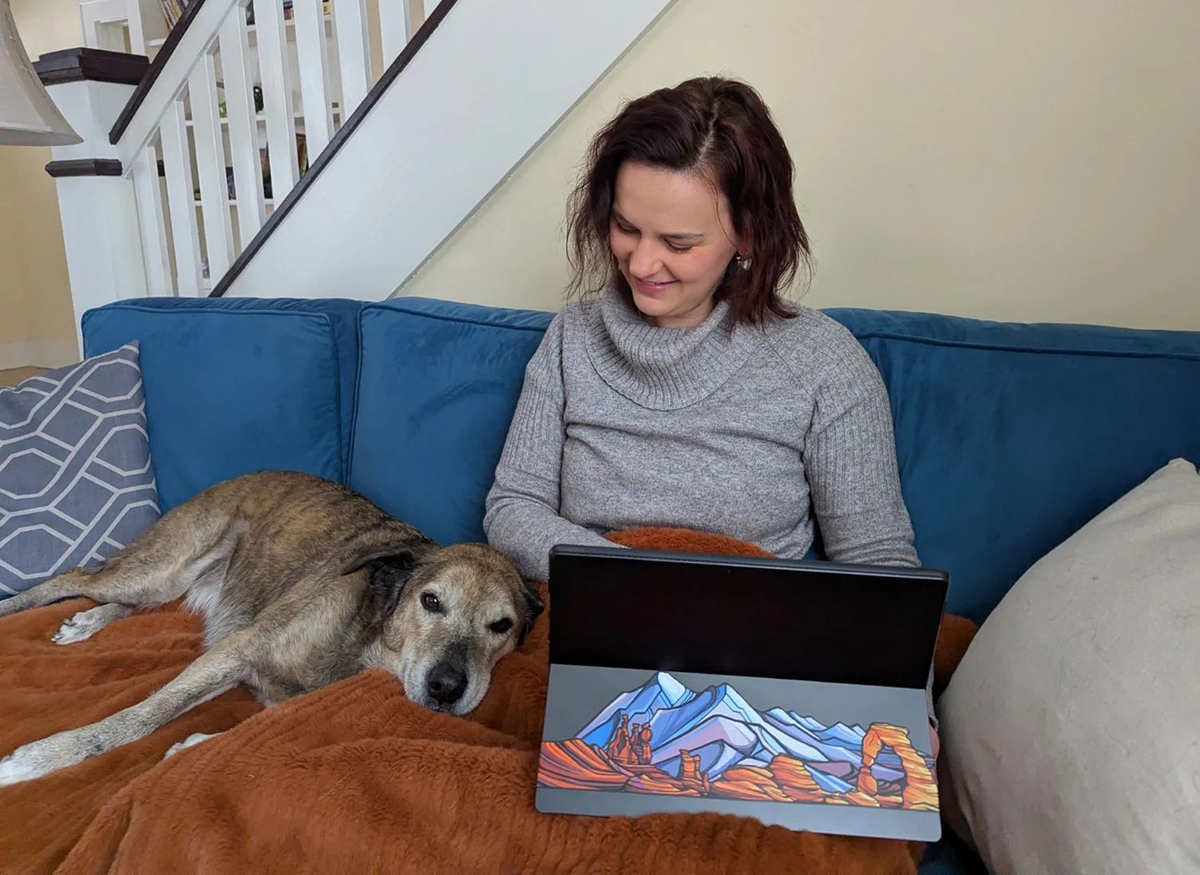
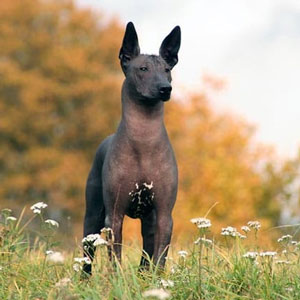
Chris Stantis, assistant professor of anthropology at SIU Carbondale, works from home with her dog, Hatch, a local rescue. Stantis was part of a research team that used isotopic analysis of ancient dog teeth to determine that specialized breeds — possibly including ancestors of the modern Xoloitzcuintli, Mexico's treasured national dog — may have traveled hundreds of miles along well-developed trade routes on the western Maya frontier. (Top photo by Spencer Stantis; bottom photo by Maikemo at Danish Wikipedia, Wikipedia Commons.)
February 26, 2026
From teeth to trade routes: SIU researcher traces ancient dogs' origins to reveal new clues about the Maya world
CARBONDALE, Ill. — To trace connections across the ancient Maya world, archaeologists often follow objects that traveled, such as jade, obsidian, or pottery. But Chris Stantis — assistant professor of anthropology at Southern Illinois University Carbondale — starts somewhere less expected: dogs.
Working with an international team led by Elizabeth Paris at the University of Calgary, Stantis set out to answer a deceptively simple question: were these animals raised locally, or brought in from elsewhere? By analyzing chemical “fingerprints” preserved in dog teeth and bones, they found that the answer was neither simple nor local. Their findings, published in the Journal of Archaeological Science, show that some dogs appear to have traveled hundreds of miles.
The evidence comes from two hilltop sites in Chiapas, Mexico: Moxviquil and Tenam Puente, part of what Stantis described as a “cultural frontier zone” where Maya and non-Maya communities overlapped and interacted. By sampling ancient dog remains from two separate hilltop communities, the team could test whether the same signals showed up across the Chiapas highlands — or varied by site.
The findings add a new, living layer to what archaeologists know about exchange between roughly A.D. 400 and 800, suggesting networks robust enough to move more than objects.
“When we think about trade networks, we often think about inanimate commodities,” Stantis said. “But dogs are different. They’re living animals that require feeding, care, and transport.” Evidence that people were bringing dogs long distances points to routes that weren't just active but organized enough to support the movement of life — not only goods.
To trace the dogs' origins, the team used stable isotope analysis — a kind of chemical detective work that turns bones and teeth into long-term records of diet and place. For Stantis, the results offer a powerful reminder of what stable isotope methods can reveal, providing more definitive evidence than traditional archaeological methods sometimes allow.
“This isn't the first time archaeologists have suggested dog trade in the Maya world,” Stantis noted. “But with more refined isotopic methods, our paper was able to make more informed hypotheses about where these dogs may have come from.”
The chemistry of the past
The term sounds technical, but the science behind stable isotope analysis rests on a straightforward idea: bodies keep traces of what they eat and drink. Those traces become part of bones and teeth, preserving a chemical record long after an animal is gone.
Stable isotopes don't decay like radioactive ones. Instead, they create lasting chemical signatures based on diet and environment. By measuring these isotopic ratios, researchers can answer questions that artifacts and written records often can't.
“As animals grow, elements from what they eat and drink get built into their bodies,” Stantis explained. “Teeth are especially helpful because tooth enamel forms early in life and doesn't remodel the way bone does.” In other words, a tooth preserves a snapshot of where an animal was living when it was young.
 To determine whether the Chiapas dogs grew up locally or came from elsewhere, the team created a regional baseline from 45 plant samples from central Chiapas, then matched the dogs' tooth signatures against it.
The contrast was clear: deer and other herbivores looked local, consistent with nearby hunting, but many dogs did not. The isotope results suggest these canines were imported from lowland Maya regions — possibly as far as the northern Yucatán, roughly 350–400 miles away — rather than raised locally in the Chiapas highlands. At Tenam Puente, several dogs pointed to the same distant origin — at Moxviquil, the signatures suggested multiple source regions.
Diet added another clue. The dogs showed isotope patterns consistent with heavy maize consumption and relatively high protein — a diet that looks less like scavenging and more like deliberate feeding, suggesting these animals were being cared for intentionally.
Taken together, the chemistry doesn't just show that animals moved — it hints at the human systems behind that movement. Dogs that came from far beyond Chiapas and ate “human-like” diets point to planning, care, and sustained connections between communities. And for Stantis, that's the bigger point: stable isotope analysis can turn a set of bones and teeth into something closer to a biography, revealing the living networks that made the Maya world work.
Opening new doors to discovery
Stantis grew up in a military family; when her father retired from the Army, they settled in rural northern Alabama outside Huntsville. Her family valued education and reading. Her grandfather's National Geographic subscription — going back decades — gave her what she calls “plenty of fodder for learning about the big world out there.” Her mother had been a journalist, and that curiosity about people left a lasting impression. “Her ability to talk to anyone is really admirable and intensely useful for any anthropologist,” Stantis said.
By the time she reached college, that early fascination with places and people had started to feel less like a hobby and more like a direction. At Auburn University, Stantis started in zoology before gravitating toward anthropology — “humans are my favorite animals,” she likes to joke. Kristrina Shuler, an award-winning Auburn professor who earned her doctorate at SIU, first introduced Stantis to the field of bioarchaeology. Stantis went on to earn a master’s degree in paleopathology at Durham University in England and a Ph.D. at the University of Otago in New Zealand, where she analyzed remains from Tonga and Fiji to study ancient diet and movement.
Stantis’ graduate and postdoctoral work has taken her across an unusually wide map — from plague-era burials in medieval London to ancient Egypt, Polynesian island communities, and Peru. Instead of anchoring her career to one region or time period, she follows the questions isotope chemistry is uniquely suited to answer: where an individual grew up, what they ate, and what their bodies can reveal about mobility and identity.
Building a lab and training students
After years of postdoctoral roles that required frequent moves, Stantis said SIU has offered something new — stability, and the chance to build a research group and mentor students over multiple years. She’s involving students in lab work, data analysis, and pilot studies, while also integrating Illinois materials into broader questions about bone preservation and connecting with local archaeological specialists.
But Stantis also thinks beyond her own lab. She helped found IsoArcH, an open-access repository that makes isotopic datasets easier to find and reuse, especially for researchers and students at institutions without expensive journal subscriptions. As those datasets grow, she argues, more questions can be asked — and re-asked — from the lab, the computer, or the classroom, making archaeology accessible beyond physically demanding excavations.
That accessibility extends beyond who can participate to how the work itself is conducted. Earlier generations of researchers didn't always treat human remains with respect or include descendant communities in decisions about research. Stantis advocates approaches that involve communities in shaping questions about the past — not simply being studied from the outside. The same isotope tools that help reconstruct ancient lives can also serve the present. In forensic projects, for example, improved accuracy can help identify unknown individuals and provide families answers and closure.
It's that combination — rigorous science in service of human questions — that Stantis emphasizes when students ask if they should pursue bioarchaeology. She’s honest about the demanding path and tight job market. But she also tells them why people stay. In her hands, a tooth can become a kind of passport stamp — proof of where a life began and how far it traveled. Careful science, she reminds them, can turn small traces into big stories — like her research revealing the connections that shaped the Maya world long before maps recorded them.
Video featuring Stantis explaining how ancient Maya civilizations went to great lengths — traveling hundreds of miles — to bring home their “little buddies” is available here.