
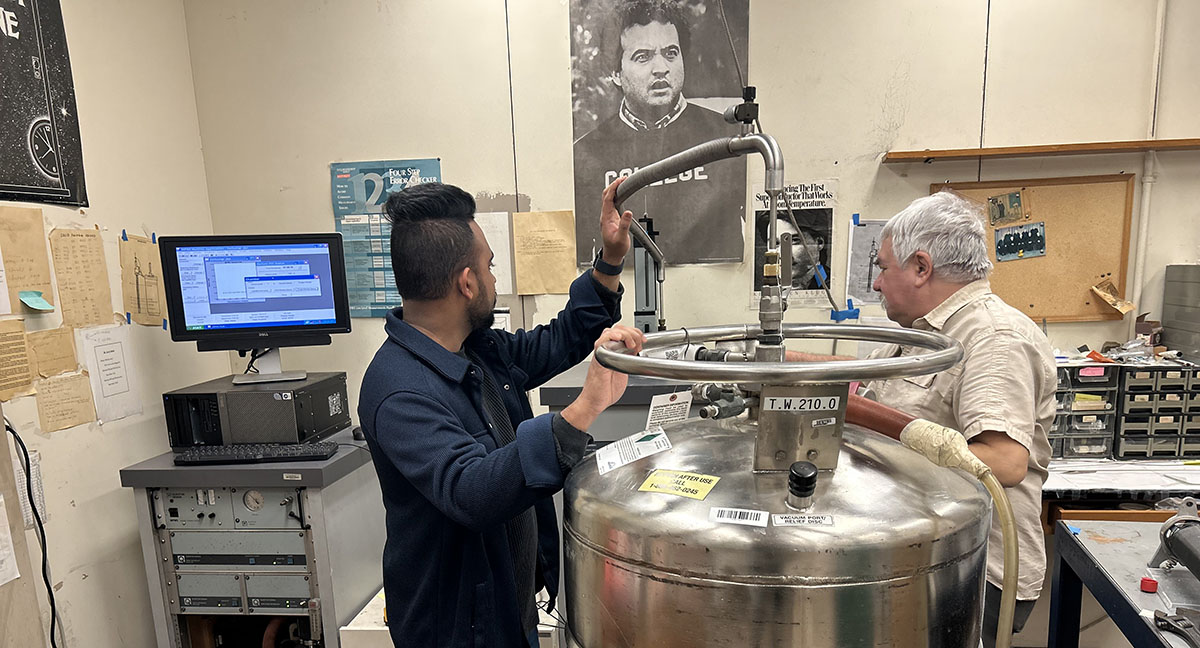
SIU Carbondale doctoral student Dushmantha Kumara De Silva Gusthigngnhadurage (left) and Igor Dubenko work in Saikat Talapatra and Naushad Ali's lab. (Photo courtesy of Saikat Talapatra)
January 29, 2026
SIU physics research team gets $523K grant to seek more efficient cooling systems
CARBONDALE, Ill. – If investigations led by a team of Southern Illinois University Carbondale physics researchers succeed, refrigerators and air conditioners might not demand so much energy.
Saikat Talapatra, a professor, Igor Dubenko, a researcher, and Naushad Ali, an emeritus faculty member in SIU’s School of Physics and Applied Physics, and a colleague from Louisiana State University will research whether the right materials can lead to more efficient and more environmentally-friendly cooling systems. SIU’s portion of the three-year project, “Phase Transitions and Physical Behaviors in Metastable Multicaloric Materials,” is funded by a $523,000 grant from the U.S. Department of Energy.
Current refrigeration employs vapor compression, in which a circulating liquid absorbs heat, removes it from a space and ejects the heat elsewhere. The problem is that the process requires a lot of energy. For example, the Energy Information Administration reports air conditioning accounted for 19% of electricity consumption in U.S. homes in 2020. The demand is expected to grow as more people need air-conditioning in a warming global climate and new data centers need climate control.
The team of SIU and LSU researchers will explore if solid materials, such as metals, treated with magnetic fields or pressure, can cool a space but consume less energy in the process.
“The discovery of a practical and effective solid-state refrigeration material will lead to more efficient cooling systems, operating from near room temperature to cryogenic ranges,” Talapatra said. “The impact of this could be profound: It would be a significant step toward energy independence, national security and a cleaner global environment, as cooling is one of the world’s most energy-demanding technologies.”